

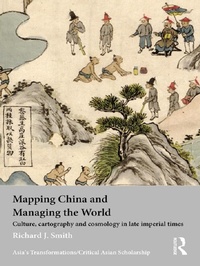
Mapping China and Managing the World
Culture, Cartography and Cosmology in Late Imperial Times
1st Edition
Published on 20. May 2013
288 pages
978-1-136-20922-2 (ISBN)
Description

From the founding of the Qin dynasty in 221 BCE to the present, the Chinese have been preoccupied with the notion of ordering their world. Efforts to create and maintain order are expressed not only in China's bureaucratic institutions and methods of social and economic organization but also in Chinese philosophy, religious and secular ritual, and comprehensive systems of classifying all natural and supernatural phenomena.
Mapping China and Managing the World focuses on Chinese constructions of order (zhi) and examines the most important ways in which elites in late imperial China sought to order their vast and variegated world. This book begins by exploring the role of ancient texts and maps as the two prominent symbolic devices that the Chinese used to construct cultural meaning, and looks at how changing conceptions of 'the world' shaped Chinese cartography, whilst both shifting and enduring cartographic practices affected how the Chinese regarded the wider world. Richard J. Smith goes on to examine the significance of ritual in overcoming disorder, and by focusing on the importance of divination shows how Chinese at all levels of society sought to manage the future, as well as the past and the present. Finally, the book concludes by emphasizing the enduring relevance of the Yijing (Classic of Changes) in Chinese intellectual and cultural life as well as its place in the history of Sino-foreign interactions.
Bringing together a selection of essays by Richard J. Smith, one of the foremost scholars of Chinese intellectual and cultural history, this book will be welcomed by Chinese and East Asian historians, as well as those interested more broadly in the culture of China and East Asia.
Mapping China and Managing the World focuses on Chinese constructions of order (zhi) and examines the most important ways in which elites in late imperial China sought to order their vast and variegated world. This book begins by exploring the role of ancient texts and maps as the two prominent symbolic devices that the Chinese used to construct cultural meaning, and looks at how changing conceptions of 'the world' shaped Chinese cartography, whilst both shifting and enduring cartographic practices affected how the Chinese regarded the wider world. Richard J. Smith goes on to examine the significance of ritual in overcoming disorder, and by focusing on the importance of divination shows how Chinese at all levels of society sought to manage the future, as well as the past and the present. Finally, the book concludes by emphasizing the enduring relevance of the Yijing (Classic of Changes) in Chinese intellectual and cultural life as well as its place in the history of Sino-foreign interactions.
Bringing together a selection of essays by Richard J. Smith, one of the foremost scholars of Chinese intellectual and cultural history, this book will be welcomed by Chinese and East Asian historians, as well as those interested more broadly in the culture of China and East Asia.
Reviews / Votes
"Mapping China and Managing the World should prove a useful work for those who study China's cultural and social history as well as the global history of cultural exchange. [...] Smith's additions to his previous work and responses to other scholarship make Mapping China and Managing the World valuable both for those not already familiar with his previous scholarship and for those who are particularly interested in it. Additionally, instructors would do well to consult this work when preparing lectures on Chinese cosmology and when considering readings to assign to students, given the accessibility of the book and the number of useful illustrations in the chapters on the Yijing and Chinese cartography." - Daniel Knorr, University of Chicago, Journal of International and Global StudiesMore details
Series
Language
English
Place of publication
London
United Kingdom
Publishing group
Taylor & Francis Ltd
Target group
College/higher education
File size
6,28 MB
ISBN-13
978-1-136-20922-2 (9781136209222)
Copyright in bibliographic data and cover images is held by Nielsen Book Services Limited or by the publishers or by their respective licensors: all rights reserved.
Schweitzer Classification
Other editions
Additional editions
Richard J. Smith
Mapping China and Managing the World
Culture, Cartography and Cosmology in Late Imperial Times
Book
10/2012
1st Edition
Routledge
€242.20
Shipment within 15-20 days
Richard J. Smith
Mapping China and Managing the World
Culture, Cartography and Cosmology in Late Imperial Times
Book
10/2012
1st Edition
Routledge
€88.19
Shipment within 15-20 days
Person
Richard J. Smith is the George and Nancy Rupp Professor of Humanities and Professor of History at Rice University, USA
Content
1. Introduction 2. The Languages of the Yijing and the Representation of Reality 3. Mapping China's World: Cultural Cartography in Late Imperial China 4. Ritual in Qing Culture 5. The Teachings of Ritual and the Rectification of Customs: Echos of Tradition in the Political Culture of Modern China 6. Divination in Qing Culture 7. Jesuit Interpretations of the Yijing in Global Perspective
