

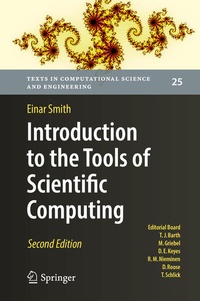
Introduction to the Tools of Scientific Computing
Description

The book provides an introduction to common programming tools and methods in numerical mathematics and scientific computing. Unlike standard approaches, it does not focus on any specific language, but aims to explain the underlying ideas.
Typically, new concepts are first introduced in the particularly user-friendly Python language and then transferred and extended in various programming environments from C/C++, Julia and MATLAB to Maple and Mathematica. This includes various approaches to distributed computing. By examining and comparing different languages, the book is also helpful for mathematicians and practitioners in deciding which programming language to use for which purposes.
At a more advanced level, special tools for the automated solution of partial differential equations using the finite element method are discussed. On a more experimental level, the basic methods of scientific machine learning in artificial neural networks are explained and illustrated.
Reviews / Votes
"This book covers a lot of ground, and overall it does so very well. . On nearly every page, the reader can find numerous code snippets . that are explained in great detail. . I can warmly recommend it to my colleagues and STEM students as a welcome resource to help them with this decision tree." (Andreas Mang, SIAM Review, Vol. 64 (2), June, 2022)More details
Other editions
Additional editions
Previous edition
Person
Content
Introduction.- Part I, Background.- Part II, Core Languages.- Part III, Commercial Computing Environments.- Part IV, Distributed Computing.- Part V, Specialized Programming Environments.- References.- Index.
