

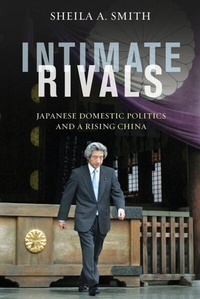
Intimate Rivals
Japanese Domestic Politics and a Rising China
1st Edition
Published on 28. July 2015
384 pages
978-0-231-53802-2 (ISBN)
Description

No country feels China's rise more deeply than Japan. Through intricate case studies of visits by Japanese politicians to the Yasukuni Shrine, conflicts over the boundaries of economic zones in the East China Sea, concerns about food safety, and strategies of island defense, Sheila A. Smith explores the policy issues testing the Japanese government as it tries to navigate its relationship with an advancing China.
Smith finds that Japan's interactions with China extend far beyond the negotiations between diplomats and include a broad array of social actors intent on influencing the Sino-Japanese relationship. Some of the tensions complicating Japan's encounters with China, such as those surrounding the Yasukuni Shrine or territorial disputes, have deep roots in the postwar era, and political advocates seeking a stronger Japanese state organize themselves around these causes. Other tensions manifest themselves during the institutional and regulatory reform of maritime boundary and food safety issues.
Smith scrutinizes the role of the Japanese government in coping with contention as China's influence grows and Japanese citizens demand more protection. Underlying the government's efforts is Japan's insecurity about its own capacity for change and its waning status as the leading economy in Asia. For many, China's rise means Japan's decline, and Smith suggests how Japan can maintain its regional and global clout as confidence in its postwar diplomatic and security approach diminishes.
Smith finds that Japan's interactions with China extend far beyond the negotiations between diplomats and include a broad array of social actors intent on influencing the Sino-Japanese relationship. Some of the tensions complicating Japan's encounters with China, such as those surrounding the Yasukuni Shrine or territorial disputes, have deep roots in the postwar era, and political advocates seeking a stronger Japanese state organize themselves around these causes. Other tensions manifest themselves during the institutional and regulatory reform of maritime boundary and food safety issues.
Smith scrutinizes the role of the Japanese government in coping with contention as China's influence grows and Japanese citizens demand more protection. Underlying the government's efforts is Japan's insecurity about its own capacity for change and its waning status as the leading economy in Asia. For many, China's rise means Japan's decline, and Smith suggests how Japan can maintain its regional and global clout as confidence in its postwar diplomatic and security approach diminishes.
All prices
More details
Other editions
Additional editions

Book
04/2015
Columbia University Press
€52.04
Shipment within 10-20 days
Person
Sheila A. Smith is senior fellow for Japan studies at the Council on Foreign Relations (CFR). She lives in Washington, D.C.
Content
Preface
Acknowledgments
Abbreviations
1. Contending with China
2. Diplomacy and Domestic Interests
3. Japan's Imperial Veterans
4. A Shared Maritime Boundary
5. Food Safety
6. Island Defense
Conclusion
Notes
Bibliography
Index
Acknowledgments
Abbreviations
1. Contending with China
2. Diplomacy and Domestic Interests
3. Japan's Imperial Veterans
4. A Shared Maritime Boundary
5. Food Safety
6. Island Defense
Conclusion
Notes
Bibliography
Index
Read the chapter, "Contending with China":

