

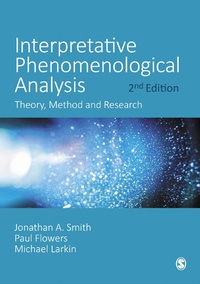
Interpretative Phenomenological Analysis
Theory, Method and Research
2nd Edition
Published on 1. December 2021
240 pages
978-1-5297-8077-2 (ISBN)
Description

Interpretative phenomenological analysis (IPA) is a qualitative research approach committed to the examination of how people make sense of their major life experiences. This text provides a detailed guide to conducting IPA research, presenting the theoretical underpinnings of the approach, a comprehensive overview of the stages of an IPA research project, and examples of high-quality IPA studies.
Extended worked examples from the authors' own studies in health, psychological distress, and identity illustrate the breadth and depth of IPA research, making this book the definitive guide to IPA for students and researchers alike.
New to this edition:
- A thoroughly updated chapter dedicated to analysis
- An exemplary mini-study
- Improved and updated terminology
- A chapter discussing innovations in design, data collection, and collaboration
'It is not often I can use "accessible" and "phenomenology" in the same sentence, but reading the new book, Interpretative Phenomenological Analysis...certainly provides me the occasion to do so. I can say this because these authors provide an engaging and clear introduction to a relatively new analytical approach' - The Weekly Qualitative Report
Extended worked examples from the authors' own studies in health, psychological distress, and identity illustrate the breadth and depth of IPA research, making this book the definitive guide to IPA for students and researchers alike.
New to this edition:
- A thoroughly updated chapter dedicated to analysis
- An exemplary mini-study
- Improved and updated terminology
- A chapter discussing innovations in design, data collection, and collaboration
'It is not often I can use "accessible" and "phenomenology" in the same sentence, but reading the new book, Interpretative Phenomenological Analysis...certainly provides me the occasion to do so. I can say this because these authors provide an engaging and clear introduction to a relatively new analytical approach' - The Weekly Qualitative Report
Reviews / Votes
I have been using this book since it was published - recommending it to undergraduate and postgraduate students both as the definitive account of the IPA approach and as an accessible introduction to experiential qualitative research more broadly. The chapters on designing an IPA study, collecting and analysing data, and writing up an IPA study in particular are excellent...This book remains an invaluable addition to the toolkit of resources for teachers and students of qualitative research, and I thoroughly recommend it to both. -- Victoria Clarke * Psychology: Learning and Teaching, Volume 9, Number 1 *More details
Edition
Second Edition
Language
English
Place of publication
London
United Kingdom
Publishing group
Sage Publications Ltd (Digital)
Target group
College/higher education
Product notice
Reflowable
ISBN-13
978-1-5297-8077-2 (9781529780772)
Copyright in bibliographic data and cover images is held by Nielsen Book Services Limited or by the publishers or by their respective licensors: all rights reserved.
Schweitzer Classification
Other editions
Additional editions
Jonathan A. Smith | Paul Flowers | Michael Larkin
Interpretative Phenomenological Analysis
Theory, Method and Research
Book
12/2021
2nd Edition
SAGE Publications Ltd
€52.55
Shipment within 15-20 days
Jonathan A. Smith | Paul Flowers | Michael Larkin
Interpretative Phenomenological Analysis
Theory, Method and Research
Book
12/2021
2nd Edition
SAGE Publications Ltd
€168.10
Shipment within 15-20 days
Persons
Jonathan A. Smith is Professor of Psychology at Birkbeck University of London, UK where he leads the interpretative phenomenological analysis (IPA) research group. He has written many articles applying IPA to a range of areas in health, clinical and social psychology. He is co- author (with Paul Flowers and Michael Larkin) of Interpretative Phenomenological Analysis: Theory, Method and Research (Sage, 2009). He also has a wider interest in qualitative psychology generally and has co-edited a number of books in the area.
Content
1. Introduction
2. The theoretical foundations of IPA
3. Planning an IPA research study
4. Collecting data
5. Analysis
6. Writing
7. Advanced designs and innovative approches
8. Connecting IPA with perspectives in the human sciences
9. Assessing validity and quality
10. Research Exemplar A: Health and illness
11. Research Exemplar B: Psychological distress
12. Research Exemplar C: Identity and life transitions
13. Conclusion and reflections on future developments
2. The theoretical foundations of IPA
3. Planning an IPA research study
4. Collecting data
5. Analysis
6. Writing
7. Advanced designs and innovative approches
8. Connecting IPA with perspectives in the human sciences
9. Assessing validity and quality
10. Research Exemplar A: Health and illness
11. Research Exemplar B: Psychological distress
12. Research Exemplar C: Identity and life transitions
13. Conclusion and reflections on future developments
