

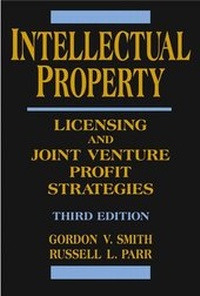
Intellectual Property
Description

More details
Other editions
New editions
Additional editions

Persons
Content
1. Emergence of Intellectual Property Exploitation Strategies.
1.1 Factors Driving Strategic Alliance: Time, Cost, and Risk.
1.2 A Short History of Corporate Strategies.
1.3 Legal Attitudes Enhance Value.
1.4 Onward.
2. Introduction to Exploitation Strategies.
2.1 Some History.
2.2 Enter Technological Change.
2.3 Business Enterprise Model.
2.4 Economics of Exploitation.
2.5 Development of Intellectual Property.
2.6 Source of Production Factors.
2.7 Internal Strategies.
2.8 The Entrepreneuring Corporation.
2.9 Acquisition.
2.10 External Strategies.
2.11 Ownership Alliances.
2.12 Other Liquidity Concerns.
2.13 Establishing a Cross-ownership Alliance.
2.14 Strategic Alliances-Rapid Technological Change.
2.15 Summary.
3. Introduction to the History and Economics of Legal Limits on Licensing Intellectual Property Rights.
3.1 A Brief History of the Legal Limits on Licensing.
3.2 The Economic Principles Underlying Legal Limits on Licensing Patent and Related Rights.
3.3 The Basic Options of Intellectual Property Owners.
3.4 The Law and the Basic Options of Intellectual Property Owners.
4. Creating Industry Standards.
4.1 Eastman Kodak.
4.2 Apple Computer.
4.3 Aluminum Corporation of America.
4.4 Avoiding a Free-For-All.
4.5 Free Access Can Still be Profitable.
5. Economic Analysis of Exploitation-Underlying Theory.
5.1 Underlying Theory.
5.2 Essential Ingredients.
5.3 Discounted Cash Flow.
5.4 Application to Intellectual Property.
5.5 When Specific Data is Unavailable.
5.6 Summary.
6. Economic Contributions of Intellectual Property.
6.1 Intellectual Property Contributes Powerfully to Earnings.
6.2 Intellectual Property Sustains Superior Earnings.
6.3 Enhanced Profits and Intellectual Property.
6.4 Investment Rates of Return Analysis.
6.5 Discounted Cash Flow Analysis.
6.6 Comparable License Transactions.
6.7 Simplistic Rules of Thumb.
7. Use of the 25% Rule in Valuing Intellectual Property.
7.1 Introduction.
7.2 History of the Rule.
7.3 Explanation of the Rule.
7.4 Illustration of the Rule.
7.5 Application of the Rule.
7.6 Justification for the Rule.
7.7 Criticisms of the Rule.
7.8 Empirical Test of the Rule.
7.9 Conclusions.
8. Determining a Royalty Rate-An Example.
8.1 Description of the Patented Dermapulse Invention.
8.2 Financial Review.
8.3 Intellectual Property Economic Contribution.
8.4 Analysis of Specific market Transactions.
8.5 Conclusion.
9. An Infringement Damages Analysis for Determining a Royalty Rate.
9.1 Georgia-Pacific v. United States Plywood.
9.2 Summary.
10. Risks of Exploitation.
10.1 Elements of Risk.
10.2 Risk and Royalties.
10.3 Intellectual Property Economic Life.
10.4 Summary.
11. Licensing Economics and Royalty Rates.
11.1 Pricing the Alternatives.
11.2 Licensing.
11.3 Primary Economic Drivers.
11.4 Secondary Economic Drivers.
11.5 Evaluating the Net Present Value.
11.6 Summary.
12. Dealing with Early-Stage Intellectual Property.
12.1 Early-stage Technology.
12.2 Development Costs.
12.3 Risk.
12.4 Time.
12.5 The DCF Mechanism.
12.6 Using DCF as a Measuring Tool.
13. Trademark Licensing.
13.1 Trademark Royalties.
13.2 Royalty Quantification.
14. Licensing Internet Assets.
14.1 Internet Background.
14.2 Internet Economics.
14.3 Internet Licensing.
15. Licensing Negotiations and Agreements.
15.1 Licensing Negotiations.
15.2 Licensing Agreements.
15.3 Critical Questions.
15.4 Licensing-in Technology.
15.5 Licensing-Out Technology.
15.6 Conclusion.
16. Another View of Licensing Strategies.
16.1 Defensive Strategies.
16.2 Cost Centers.
16.3 Profit Centers.
16.4 Integrated Management.
16.5 Visionary Intellectual Property Management.
16.6 Making the Big Bucks.
16.7 Intellectual Property Touches all Aspects of Life.
16.8 Intangible Assets at the Center of Deals.
16.9 E-Commerce and Intellectual Property.
16.10 Specific Trends in Intellectual Property Deal Making.
16.11 Trademark Strategies.
16.12 Intangible Riches.
17. Joint Venture.
17.1 Ownership Split.
17.2 Expansion at Overboard Industries, Inc.
17.3 Consumer Electronics.
17.4 Access to the Technology.
17.5 Access to the market.
17.6 Measuring Potential Value from Pin-Point.
17.7 Weighted Average Cost of Capital.
17.8 Internal Technology Development.
17.9 Internal Trademark Development.
17.10 Going it Alone.
17.11 Summary.
17.12 Special Problems with Strategic Alliances.
18. Corporate Acquisition as an Exploitation Strategy.
18.1 The Acquisition Process.
18.2 Impact on Intangible Assets and Intellectual Property in a Merger.
18.3 Focus on Intangibles.
18.4 Summary.
19. University Technology Transfer.
19.1 University Technology Transfer Goals.
19.2 University Offices of Technology Transfer.
19.3 Conflicts of Interest.
19.4 Nonexclusive Licenses.
19.5 Finding Technology.
19.6 Rewards of Inventorship.
19.7 Harvard University-Royalty Sharing Policy for Intellectual Property.
19.8 John Hopkins University-Sharing of Revenue From Intellectual Property.
19.9 Dealing with Universities.
20. Global Exploitation Potential.
20.1 Impact of the International Environment.
20.2 Accounting Issues.
20.3 Taxes.
20.4 Transfer Pricing.
20.5 Methods for Determining Intangible Asset Transfer Prices.
20.6 Political Risk.
20.7 New Markets.
20.8 Repatriation.
20.9 Cultural Issues.
20.10 Investment Risk.
20.11 Legal Protection.
20.12 Summary.
21. Organizing for the Future.
21.1 Mapping Intellectual Property.
21.2 Identification.
21.3 Assembled Workforce.
21.4 Captive Spare Parts Annuity.
21.5 Computer Software.
21.6 Copyrights.
21.7 Customer Lists.
21.8 Distribution Networks.
21.9 Trademarks.
21.10 Strategic Plan and Gap Analysis.
22. Understanding the Business and Risks of Licensing.
22.1 Introduction.
22.2 Overview of Licensing.
22.3 Licensing Business Risks.
22.4 License Management.
22.5 "Auditing" the Royalty Obligations.
22.6 Common Audit Procedures and Findings.
22.7 Remedies from Breaches of Licensing Contracts.
22.8 Conclusion.
A. Investment Rate of Return Requirements.
B. Financial and Business Information Sources.
C. Licensing Transaction Examples and Royalty Rates.
Index.
