

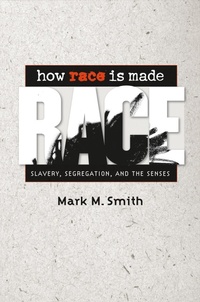
How Race Is Made
Description

For at least two centuries, argues Mark Smith, white southerners used all of their senses — not just their eyes — to construct racial difference and define race. His provocative analysis, extending from the colonial period to the mid-twentieth century, shows how whites of all classes used the artificial binary of “black” and “white” to justify slavery and erect the political, legal, and social structure of segregation. Based on painstaking research, How Race Is Made is a highly original, always frank, and often disturbing book. After enslaved Africans were initially brought to America, the offspring of black and white sexual relationships (consensual and forced) complicated the purely visual sense of racial typing. As mixed-race people became more and more common and as antebellum race-based slavery and then postbellum racial segregation became central to southern society, white southerners asserted that they could rely on their other senses — touch, smell, sound, and taste — to identify who was “white” and who was not. Sensory racial stereotypes were invented and irrational, but at every turn, Smith shows, these constructions of race, immune to logic, signified difference and perpetuated inequality. Smith argues that the history of southern race relations and the construction of racial difference on which that history is built cannot be understood fully on the basis of sight alone. In order to come to terms with the South’s past and present, Smith says, we must explore the sensory dynamics underpinning the deeply emotional construction of race. How Race Is Made takes a bold step toward that understanding.
More details
Other editions
Additional editions
Person
Mark M. Smith is Carolina Distinguished Professor of History at the University of South Carolina. He is author or editor of six previous books, including Listening to Nineteenth-Century America (from the University of North Carolina Press) and Stono: Documenting and Interpreting a Slave Revolt.
Content
- Cover Page
- how race is made
- Copyright Page
- Dedication
- CONTENTS
- ILLUSTRATIONS
- Introduction Making Sense of Race
- 1 Learning to Make Sense
- 2 Fooling Senses, Calming Crisis
- 3 Senses Reconstructed, Nonsense Redeemed
- 4 Finding Homer Plessy, Fixing Race
- 5 The Black Mind of the South
- 6 The Brown Concertina
- NOTES
- ACKNOWLEDGMENTS
- INDEX
