

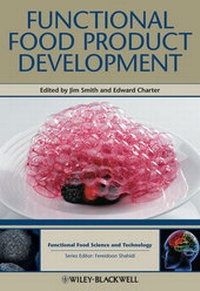
Functional Food Product Development
Description

Reviews / Votes
"It will also be of interest to researchers and foodscience students." (South African Food Science AndTechnology, 1 May 2012)More details
Other editions
Additional editions
Persons
Content
Contributors.
PART I NEW TECHNOLOGIES FOR FUNCTIONAL FOOD MANUFACTURE.
1 Microencapsulation in functional food product development (Luz Sanguansri and Mary Ann Augustin).
1.1 Introduction.
1.2 Microencapsulation.
1.3 Microencapsulated food ingredients.
1.4 Development of microencapsulated ingredients.
1.5 Delivery of microencapsulated ingredient into functional foods.
1.6 Conclusion.
Acknowledgements.
References.
2 Nanoencapsulation of food ingredients in cyclodextrins: Effect of water interactions and ligand structure (M.F. Mazzobre, B.E. Elizalde, C. dos Santos, P.A. Ponce Cevallos and M.P. Buera).
2.1 Introduction.
2.2 Brief history.
2.3 Structure and properties of cyclodextrins.
2.4 Formation and characterisation of the inclusion complexes.
2.5 Water adsorption isotherms.
2.6 Water and the stability and release of encapsulated nutraceuticals.
2.7 Applications and future prospects.
Acknowledgements.
References.
3 Supercritical carbon dioxide and subcritical water: Complementary agents in the processing of functional foods (Keerthi Srinivas and Jerry W. King).
3.1 Introduction.
3.2 Sub- and supercritical fluid solvents.
3.3 Sub- and supercritical fluid extraction.
3.4 Tandem processing using sub- and supercritical fluids.
3.5 Integrated critical fluid processing technology.
3.6 Production-scale critical fluid-based nutraceutical plants and commercial products.
References.
4 Emulsion delivery systems for functional foods (P. Fustier, A.R. Taherian and H.S. Ramaswamy).
4.1 Introduction.
4.2 Food emulsions.
4.3 Delivery systems for bioactive materials.
4.4 Encapsulation of polyunsaturated fatty acids - an example application.
4.5 Conclusions.
References.
PART II FUNCTIONAL INGREDIENTS.
5 Functional and nutraceutical lipids (Fereidoon Shahidi).
5.1 Omega-3 fatty acids and products.
5.2 Monounsaturated fatty acids.
5.3 Medium-chain fatty acids and medium-chain triacylglycerols.
5.4 Conjugated linoleic acids and &#gamma;-linolenic acid.
5.5 Diacylglycerol oils.
5.6 Structured lipids.
5.7 Conclusions.
References.
6 The use of functional plant ingredients for the development of efficacious functional foods (Christopher P.F. Marinangeli and Peter J.H. Jones).
6.1 Introduction.
6.2 Soy extracts.
6.3 Plant sterols and stanols.
6.4 Fiber and its various components: &#beta;-Glucan and inulin.
6.5 Conclusions.
References.
7 Dairy ingredients in new functional food product development (S.L. Amaya-Llano and Lech Ozimek).
7.1 Historical aspects.
7.2 Functional dairy product development.
7.3 Health and dairy functional ingredients.
7.4 Galacto-oligosaccharides, lactulose, lactitol and lactosucrose.
7.5 Growth factors.
7.6 Specific lipids.
7.7 The n-3 and n-6 polyunsaturated fatty acids.
7.8 Uses in food systems.
7.9 Regulations.
7.10 Future considerations.
References.
8 Probiotics and prebiotics (Anna Sip and Wlodzimierz Grajek).
8.1 Introduction.
8.2 Probiotic strains.
8.3 Functional properties of probiotics.
8.4 Medical applications.
8.5 Gastrointestinal infections of different etiology.
8.6 Colitis.
8.7 Functional bowel disorders.
8.8 Disorders in lipid metabolism.
8.9 Disorders of calcium and phosphate metabolism.
8.10 Food allergy.
8.11 Metabolic disorders.
8.12 Cancer.
8.13 Other disease entities.
8.14 Selection of probiotic strains.
8.15 Technological aspects and production of probiotic foods.
8.16 Probiotic products.
8.17 Prebiotics.
8.18 The application of prebiotics.
8.19 Synbiotics.
8.20 Conclusions.
References.
9 The influence of food processing and home cooking on the antioxidant stability in foods (Wlodzimierz Grajek and Anna Olejnik).
9.1 Introduction.
9.2 Mechanical processing.
9.3 Drying.
9.4 Conclusions.
References.
10 Development and commercialization of microalgae-based functional lipids (Jaouad Fichtali and S.P.J. Namal Senanayake).
10.1 Introduction.
10.2 Industrial production of microalgal lipids.
10.3 Composition of algal biomass.
10.4 Characteristics of algal lipids.
10.5 Safety studies of algal lipids.
10.6 Applications.
References.
PART III PRODUCT DESIGN AND REGULATION.
11 New trends for food product design (Juan-Carlos Arboleya, Daniel Lasa, Idoia Olabarrieta and Iñigo Martínez de Marañón).
11.1 Introduction.
11.2 Functional food product design: Case studies.
11.3 Conclusions.
References.
12 Reverse pharmacology for developing functional foods/herbal supplements: Approaches, framework and case studies (Anantha Narayana D.B.).
12.1 What is reverse pharmacology?
12.2 Ayurveda's strength for functional foods.
12.3 Framework for functional food development.
12.4 Case studies.
12.5 Factors to make reverse pharmacology work.
Acknowledgments.
References.
13 An overview of functional food regulation in North America, European Union, Japan and Australia (Paula N. Brown and Michael Chan).
13.1 Introduction.
13.2 The Canadian regulatory framework.
13.3 The United States regulatory framework.
13.4 The European Union's regulatory framework.
13.5 The Japanese regulatory framework.
13.6 The Australian regulatory framework.
13.7 Conclusions on food regulation.
References.
PART IV FUNCTIONAL FOODS AND HEALTH.
14 Functional foods that boost the immune system (Calvin London).
14.1 The rise of immune-boosting functional foods.
14.2 Review of the immune system.
14.3 Immune-enhancing nutrients.
14.4 Inherent functional foods.
14.5 Fortified and modified food components.
14.6 Ancillary functional food components.
14.7 Functional immune-boosting animal feeds.
14.8 The future of immune-boosting functional foods.
References.
15 The Mediterranean diets: Nutrition and gastronomy (Federico Leighton Puga and Inés Urquiaga).
15.1 Mediterranean diet definition.
15.2 Food components in the Mediterranean diet.
15.3 Some health mechanisms of the Mediterranean diet.
15.4 Mediterranean diet and gastronomy.
15.5 Mediterranean diet 'food at work' intervention.
References.
16 Functional foods for the brain (Ans Eilander, Saskia Osendarp and Jyoti Kumar Tiwari).
16.1 Introduction.
16.2 Evidence from intervention trials.
16.3 Challenges in fortification of foods for children.
16.4 Conclusions.
References.
17 Tangible health benefits of phytosterol functional foods (Jerzy Zawistowski).
17.1 Introduction.
17.2 Phytosterol properties.
17.3 Efficacy of phytosterols.
17.4 Mechanism of action of phytosterols.
17.5 Safety of phytosterols.
17.6 Manufacturing of phytosterols.
17.7 Challenges in formulation, regulatory approval and commercialisation of phytosterol-containing foods.
17.8 Conclusion.
Acknowledgement.
References.
18 Obesity and related disorders (Yanwen Wang).
18.1 Definition of obesity and commonly used measures.
18.2 Prevalence of overweight and obesity.
18.3 Health costs related to obesity.
18.4 Etiology of obesity.
18.5 Obesity and cardiovascular disease.
18.6 Obesity and type 2 diabetes.
18.7 Prevention of obesity.
18.8 Treatment of obesity.
18.9 Natural products for obesity prevention and intervention.
18.10 Conclusion.
References.
19 Omega-3, 6 and 9 fatty acids, inflammation and neurodegenerative diseases (Cai Song).
19.1 Introduction.
19.2 The functions of omega-3, 6, 9 fatty acids in the brain and in the immune system.
19.3 Changes in concentrations and ratios of these fatty acids in neurodegenerative diseases.
19.4 The therapeutic effects in clinical investigations.
19.5 Mechanism by which EFAs treat different diseases.
19.6 Weakness of current treatments and researches, and the future research direction.
References.
20 Functional food in child nutrition (Martin Gotteland, Sylvia Cruchet and Oscar Brunser).
20.1 Maternal milk: The gold standard of functional food for infants.
20.2 Infant formulas.
20.3 Main bioactive compounds in breast milk and their use in infant formulas.
20.4 Conclusions.
References.
21 Functional foods and bone health: Where are we at? (Wendy E. Ward, Beatrice Lau, Jovana Kaludjerovic and Sandra M. Sacco).
21.1 Osteoporosis is a significant public health issue.
21.2 Bone is a dynamic tissue throughout the life cycle.
21.3 Assessment of bone health.
21.4 Foods and dietary components that may modulate bone metabolism throughout the life cycle.
21.5 Soy and its isoflavones.
21.6 Fish oil and n-3 long-chain polyunsaturated fatty acids.
21.7 Flaxseed and its components, secoisolariciresinol diglycoside and &#alpha;-linolenic acid.
21.8 Summary - Where are we at?
21.9 Where do we go from here?
References.
Index.
The colour plate section.
