

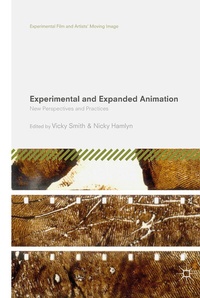
Experimental and Expanded Animation
Description

This book discusses developments and continuities in experimental animation that, since Robert Russet and Cecile Starr's Experimental Animation: Origins of a New Art (1976), has proliferated in the context of expanded cinema, performance and live 'making' and is today exhibited in galleries, public sites and online. With reference to historical, critical, phenomenological and inter-disciplinary approaches, international researchers offer new and diverse methodologies for thinking through these myriad animation practices. This volume addresses fundamental questions of form, such as drawing and the line, but also broadens out to encompass topics such as the inter-medial, post-humanism, the real, fakeness and fabrication, causation, new forms of synthetic space, ecology, critical re-workings of cartoons, and process as narrative. This book will appeal to cross and inter-disciplinary researchers, animation practitioners, scholars, teachers and students from Fine Art, Film and Media Studies, Philosophy and Aesthetics.
More details
Other editions
Additional editions
Persons
Vicky Smith
is a lecturer at the University for the Creative Arts, UK. Her experimental animation practice of 30 years has screened internationally in cinemas, galleries and on C4TV. She has published in
Animation: an Interdisciplinary Journal and Sequence
.
Nicky Hamlyn
is Professor of Experimental Film at the University for the Creative Arts and a lecturer at the Royal College of Art, UK. He is the author of
Film Art Phenomena
(2003) and co-editor of and contributor to
Kurt Kren: Structural Films
(2016). His film and video work is available on three DVD compilations from LUX, RGB and Film Gallery, Paris.
Content
1.Introduction, Vicky Smith and Nicky Hamlyn.- 2. Lines and Interruptions in Experimental Animation, Simon Payne.- 3. Performing the Margins of the New, Dirk de Bruyn.- 4. 21 st Century Flicker: Jodie Mack, Benedict Drew and Sebastian Buerkner, Barnaby Dicker.- 5. Experimental Time-lapse Animation and the Manifestation of Change and Agency in Objects, Vicky Smith.- 6. Analogon: Of A World Already Animated, Sean Cubitt.- 7. Space and Material: The Virtual Object in Early CGI Art, Alex Jukes.- 8. Just about Film: Bruce McClure, Guy Sherwin and the Resurgence of Celluloid Sound Projections, Nicky Hamlyn.-9.- Re-Splitting, De-Syncronising, Re-Animating: (E)motion, Neo-spectacle and Innocence in the film-works of John Stezaker, Paul Wells.- 10. Cut to Cute: Fact, Form, and Feeling in Digital Animation, Johanna Gosse.- 11. Into the post feminist doll house: Animation, Installation and Mushi, Suzanne Buchan.- 12. Intermediality in the tableaux vivants in Magic Mirror (75min, 2013) and Confessions To The Mirror (2016), Sarah Pucill.- 13. Siting Animation: the Affect of Place, Birgitta Hosea.
