

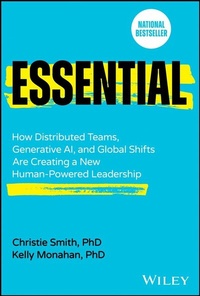
Essential
Description

Discover and embrace the future of human-powered leadership
In an era where the foundational elements of business are being disrupted, Essential: How Distributed Teams, Generative AI, and Global Shifts are Creating a New Human-Powered Leadership emerges as a crucial guide for leaders navigating the profound changes reshaping industries and markets worldwide. This book, penned by a team of seasoned business and leadership strategists, offers a radical and necessary perspective on management transformation, emphasizing the importance of human-centered leadership in meeting the full potential of the technology age.
The authors explain how to:
- Unlock radical management transformation, demonstrating how to lead with humanity at the forefront, addressing changing attitudes about labor, management, and organizational goals in a way that fosters growth and innovation
- Adapt to the new business landscape, leveraging insights about managing distributed teams and incorporating emerging technologies like generative AI without losing the essence of your organization's talent and skills
- Achieve immediate, impactful change with realistic strategies and actionable techniques backed by thousands of hours of original research and practical experience
- Improve the way we live by revolutionizing the way we work
Essential is not just a book; it's a roadmap for 21st-century leaders facing existential challenges in a rapidly evolving global market. Perfect for managers, executives, directors, founders, entrepreneurs, and any business leader aiming to steer their organization towards success in a transformed landscape, this book provides the tools and insights needed to lead with conviction and humanity.
Whether you're looking to redefine your leadership approach, adapt to the transformed market, or leave a lasting legacy, this book offers a compelling case for why now is the time for a leadership reinvention. Dive into this essential resource and begin your journey towards leading with greater impact and humanity in the business world of today and tomorrow.
More details
Other editions
Additional editions
Persons
CHRISTIE SMITH, PHD, is the founder of The Humanity Studio, a human intelligence company dedicated to transforming workplaces and communities. She is the former global lead of Talent & Organization at Accenture, the former Vice President for Inclusion and Diversity at Apple, and the former Managing Partner of the West Region of the U.S. at Deloitte. She is a sought-after speaker and advisor for boards, CEOs, and C-suite leaders on growth, governance, talent, operating models, and organizational design.
KELLY MONAHAN, PHD, is a Managing Director at Upwork. She leads the organization's future of work research program and leads the Upwork Research Institute. Her research has been published in the MIT Sloan Management Review, Harvard Business Review, and the Journal of Strategic Management. She is the author of How Behavioral Economics Influences Management Decision-Making: A New Paradigm.
Content
Introduction 1
Part I The Business Imperative for Human-Powered Leadership 9
Chapter 1 The Economics of Human-Powered Leadership 11
Chapter 2 Skills Scarcity in the Digital Age 25
Chapter 3 Investing in Human Intelligence 47
Part II What Humans Require 57
Chapter 4 Purpose 59
Chapter 5 Agency 75
Chapter 6 Well-being 93
Chapter 7 Connection 107
Part III What Leaders Must Do 117
Chapter 8 Soft Skills Are Power Skills 119
Chapter 9 The Essentials of Leadership 137
Endnotes 163
Acknowledgments 179
About the Authors 181
Index 183
CHAPTER 1
The Economics of Human-Powered Leadership
"People follow leaders by choice. Without trust, at best you get compliance."
- Jesse Lyn Stoner1
As researchers we have a great appreciation for the lessons of our past and how they shape our present and future. We rely on historical perspectives to understand how organizations and the economy have evolved in response to advances in technology, automation, and machines over time, which have in turn informed employee capability and skills requirements. In this chapter, we examine how technological advances have shifted the power dynamics between employers and employees, widened the skills gap, and presented new socioeconomic challenges that require us to reexamine our leadership. So please bear with the history lessons because they are critical to the foundational argument of the book - that humans must be at the center of our organizations for our societies and the global economy to flourish into the future.
A Brief History of Organizational Evolution: How We Got Here
Where is here exactly? The pandemic, a growing consumer demand for more sustainable products and business models, and the rapid embrace of stakeholder capitalism more generally have all accelerated three long-term macroeconomic trends: flattened organizations, the democratization of data, and skills scarcity. (Stakeholder capitalism assumes the purpose of business is for more than maximizing shareholder profits and seeks to add value to stakeholders such as society, employees, and vendors.) These forces translate into specific organizational shifts that leaders are now navigating, largely without a playbook. Taken together, they create the business imperative to reexamine our organizations and leaders with new criteria that put humans at the center of the way we work, prioritize, and make decisions.
Decades of top-down management theory have been upended in recent years in favor of the flattened organization - it's simply too costly to design today's workplace around hierarchical structures. As a result, decision-making is very often conducted from the bottom up, with workers driving innovation and collaboration and using it to take collective action. This trend is spurred on by the fact that workers today often know more than their leaders about how work actually gets done. Most leaders lack a basic knowledge of the technology used to drive their business forward, and as data and knowledge are increasingly democratized, those working closest to it hold the most power and influence. In today's digital environment, it is the insights gleaned, not the data itself, that is most valuable.
With these factors at play, and no longer being limited to seek employment locally, highly skilled workers are empowered in ways never seen before to capitalize on career opportunities. But these circumstances, while favorable for some, create a growing concern for those workers unable to keep up with market demands. An imbalance in the supply and demand of talent has created a skills gap that is costing both businesses and society trillions of dollars. It is arguably the most urgent problem facing our organizations today.
The impact of these trends on the global economy illuminates a need for organizational change that shifts focus from asset management to talent management. Put another way, the power dynamic has changed polarities, giving leverage to stakeholders at the expense of enterprises.
In 2023 alone, we've seen how this shift has changed the game for leaders. Take, for example, the leverage UPS drivers had in negotiating higher rates and better working conditions. Due to the low unemployment rates and lack of available workers, leadership at UPS did not have much leverage in negotiating and gave the workforce most of what they demanded, including higher wage rates and better workplace conditions.2 Or consider the example of Open AI, whose CEO was ousted, only to be reinstated days later when nearly the entire employee population threatened to quit. Finally, in the hotly debated return-to-office movement, we see that workers still have the upper hand as many refuse to adhere to their leaders' call for a return to office.
A human-first approach to business is not simply the popular or politically expedient thing to do. Neither is it merely a change in rhetoric for management to sound more empathetic and appeal to the zeitgeist. Genuine change is required - and hard to achieve - for the continued growth of our organizations and the health of the global economy.
Zeroing in on Profit and Productivity
Our brief history lesson starts with the First Industrial Revolution in the late eighteenth to early nineteenth centuries, during which organizations primarily focused on efficiency, productivity, and mass production. As you may well know, the introduction of factories and machinery led to the emergence of large-scale manufacturing, with organizations structured around hierarchical and centralized systems of control for the first time. This way of working required specific roles from people to manage the mass production of products in a brand-new way. During this period, we saw the rise of manufacturing companies, such as DuPont, Ford, and Boston Manufacturing.3
The leading economist and management thinker of the eighteenth century, Adam Smith, believed a division of labor was necessary to reduce the costs of goods that resulted from newfound global demand. As a result, there was a steep decline in training people for a "trade" or "craft" - instead, these newly formed organizations sought workers to fulfill a narrow and specific task within a large production line. The birth of management transpired as companies realized they needed a new role within their organization to coordinate the array of people now working on specialized and interdependent tasks along the production line.
The advantages of this new way of working were clear from a traditional economics perspective. Goods and services could now be made at scale, servicing new global customers as well as ensuring a level of standardization otherwise unachievable. The disadvantages to the human worker were also profound. Without a direct connection to the customer or product, it quickly became unclear what should motivate people tasked with the same repetitive workday. Workers during this time often lamented their boss's capricious management style, the result of inadequate training to understand and meet core human needs - ones we all share, regardless of which century we live in.4
A leading railroad analyst at this time, Henry Varnum Poor, cautioned of the dangers that this change in work was having on people. He warned, "Regarding man as a mere machine, out of which all the qualities necessary to be a good servant can be enforced by the mere payment of wages, may not work, as duties cannot always be prescribed, and the most valuable are often voluntary ones."5
How We Became "Cogs in a Wheel"
This First Industrial Revolution gave way to Frederick Taylor's and others' examination of scientific management in the late nineteenth and early twentieth century. The principles of this approach are characterized by a focus on engineering, optimizing, and standardizing work processes and tasks to achieve greater efficiency and productivity, from which we saw the rise of specialized job roles and detailed job descriptions.
During this period, the phrase "cog in a wheel" became a well-known way to describe how most workers felt under Taylor's relentless focus to break down jobs further into small discrete tasks that would be aggressively measured for productivity. (While the concept of the cog in a wheel originated in the fifteenth century, its use as applied to workers became mainstream in the 1930s.) What ensued is described by the twentieth- century management thinker Whiting Williams as "the worst time in history" for labor relations.6 In 1919, more than four million American workers, or 20% of the nation's workforce, went on strike.7 Turnover at leading companies, such as the Ford Motor Company, reached 380% with 10% daily absentee rates of their workforce.8 The lack of human-centric management was costing the already fragile US economy. As a result, the government formed an Industrial Relations committee to better understand the state of labor and how this new scientific management was influencing talent.
Their conclusion? That the system operated with a complete disregard for employee welfare for the sake of profit, and in the process denied employees a say in the standards of their own working conditions. Under these circumstances, the report concluded, there would be no reason for workers to endorse or support a system that "[reduces] them to mere soulless machinery, mechanical in action, denuded of thought, and which would rob them of their humanhood."9
What Motivates Us?
Ultimately, the report deemed scientific management ill-equipped to move the economy forward, and with more attention paid to job roles and competencies, an examination of what having a workforce of employees really means began. The Human Relations Movement in the early to mid-twentieth century thus shifted the focus of organizations toward understanding the social and psychological aspects of work and its influence on...
