
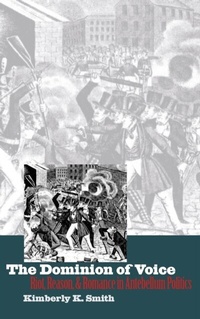
The Dominion of Voice
Description
Alles über E-Books | Antworten auf Fragen rund um E-Books, Kopierschutz und Dateiformate finden Sie in unserem Info- & Hilfebereich.
Winner: Merle Curti Intellectual History Award
In this work of historically informed political theory, Kimberly Smith sets out to understand how nineteenth-century Americans answered the question of how the people should participate in politics. Did rational public debate, the ideal that most democratic theorists now venerate, transcend all other forms of political expression? How and why did passion disappear from the ideology (if not the practice) of American democracy? To answer these questions, she focuses on the political culture of the urban North during the turbulent Jacksonian Age, roughly 1830-50, when the shape and character of the democratic public were still fluid.
Smith's method is to interpret, in light of such popular discourse as newspapers and novels, several key texts in nineteenth-century American political thought: Frederick Douglass's Fourth of July speech and Narrative, Angelina Grimke's debate with Catharine Beecher, Frances Wright's lectures, and Harriet Beecher Stowe's Uncle Tom's Cabin. Such texts, Smith finds, highlight many of the then-current ideas about the extremes of political expression. Her readings support the conclusions that the value of rational argument itself was contested, that the emergent Enlightenment rationalism may have helped to sterilize political debate, and that storytelling or testimony posed an important challenge to the norm of political rationality.
Smith explores facets of the political culture in ways that make sense of traditions from Whiggish resistance to Protestant narrative testimony. She helps us to understand such puzzles as the point of mob action and other ritualistic disruptions of the political process, our simultaneous attraction to and suspicion of political debates, and the appeal of stories by and about victims of injustice. Also found in her book are keen analyses of the antebellum press and the importance of oratory and public speaking.
Smith shows that alternatives to reasoned deliberation?like protest, resistance, and storytelling?have a place in politics. Such alternatives underscore the positive role that interest, passion, compassion, and even violence might play in the political life of America. Her book, therefore, is a cautionary analysis of how rationality came to dominate our thinking about politics and why its hegemony should concern us. Ultimately Smith reminds the reader that democracy and reasoned public debate are not synonymous and that the linkage is not necessarily a good thing.
All prices
More details
Other editions
Additional editions
Person
Kimberly K. Smith is assistant professor of political science at Carleton College.
Content
Preface
Introduction
Part I. Mob Action
1. Eighteenth-Century Riots
2. Rioting in the Antebellum Era
Part II. Public Debate
3. Neoclassical Rhetoric and Political Oratory
4. Enlightenment Rationalism and Political Debate
Part III. Narrative Testimony
5. Storytelling
6. Sympathy
Conclusion
Notes
Bibliography
Index

System requirements
File format: ePUB
Copy protection: Adobe-DRM (Digital Rights Management)
System requirements:
- Computer (Windows; MacOS X; Linux): Install the free reader Adobe Digital Editions prior to download (see eBook Help).
- Tablet/smartphone (Android; iOS): Install the free app Adobe Digital Editions or the app PocketBook before downloading (see eBook Help).
- E-reader: Bookeen, Kobo, Pocketbook, Sony, Tolino and many more (not Kindle).
The file format ePub works well for novels and non-fiction books – i.e., „flowing” text without complex layout. On an e-reader or smartphone, line and page breaks automatically adjust to fit the small displays.
This eBook uses Adobe-DRM, a „hard” copy protection. If the necessary requirements are not met, unfortunately you will not be able to open the eBook. You will therefore need to prepare your reading hardware before downloading.
Please note: We strongly recommend that you authorise using your personal Adobe ID after installation of any reading software.
For more information, see our ebook Help page.
File format: PDF
Copy-Protection: Adobe-DRM (Digital Rights Management)
System requirements:
- Computer (Windows; MacOS X; Linux): Install the free reader Adobe Digital Editions prior to download (see eBook Help).
- Tablet/smartphone (Android; iOS): Install the free app Adobe Digital Editions or the app PocketBook before downloading (see eBook Help).
- E-reader: Bookeen, Kobo, Pocketbook, Sony, Tolino and many more (only limited: Kindle).
The file format PDF always displays a book page identically on any hardware. This makes PDF suitable for complex layouts such as those used in textbooks and reference books (images, tables, columns, footnotes). Unfortunately, on the small screens of e-readers or smartphones, PDFs are rather annoying, requiring too much scrolling.
This eBook uses Adobe-DRM, a „hard” copy protection. If the necessary requirements are not met, unfortunately you will not be able to open the eBook. You will therefore need to prepare your reading hardware before downloading.
Please note: We strongly recommend that you authorise using your personal Adobe ID after installation of any reading software.
For more information, see our eBook Help page.
File format: ePUB
Copy protection: Watermark-DRM (Digital Rights Management)
System requirements:
- Computer (Windows; MacOS X; Linux): Use a reading software that can process the file format ePUB: e.g., Adobe Digital Editions or FBReader – both free (see eBook Help).
- Tablet/Smartphone (Android; iOS): Before downloading, install the free app Adobe Digital Editions (see eBook Help).
- E-reader: Bookeen, Kobo, Pocketbook, Sony, Tolino and many more (not Kindle).
The file format ePUB works well for novels and non-fiction books – i.e., „flowing” text without complex layout. On an e-reader or smartphone, line and page breaks automatically adjust to fit the small displays.
This eBook uses Watermark-DRM, a „soft” copy protection. This means that there are no technical restrictions to prevent illegal distribution. However, there is a personalised watermark embedded in the eBook that can be used to identify the purchaser of the eBook in the event of misuse and to provide evidence for legal purposes.
For more information, see our eBook Help page.
