

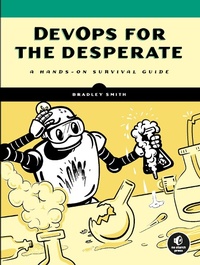
DevOps for the Desperate
A Hands-On Survival Guide
Published on 12. July 2022
176 pages
978-1-7185-0249-9 (ISBN)
Description

DevOps for the Desperate is a hands-on, no-nonsense guide for those who land in a DevOpsenvironment and need to get up and running quickly.
This book introduces fundamental concepts software developersneed to know to flourish in a modern DevOps environment including infrastructure as code, configurationmanagement, security, containerization and orchestration, monitoring and alerting, and troubleshooting.Readers will follow along with hands-on examples to learn how to tackle common DevOps tasks.
The book begins with an exploration of DevOps concepts using Vagrant and Ansible to build systemswith repeatable and predictable states, including configuring a host with user-based security. Next up is acrash course on containerization, orchestration, and delivery using Docker, Kubernetes, and a CI/CDpipeline. The book concludes with a primer in monitoring and alerting with tips for troubleshootingcommon host and application issues.
You'll learn how to:
• Use Ansible to manage users and groups, and enforce complex passwords
• Create a security policy for administrative permissions, and automate a host-based firewall
• Get started with Docker to containerize applications, use Kubernetes for orchestration, and deploycode using a CI/CD pipeline
• Build a monitoring stack, investigate common metric patterns, and trigger alerts
• Troubleshoot and analyze common issues and errors found on hosts
This book introduces fundamental concepts software developersneed to know to flourish in a modern DevOps environment including infrastructure as code, configurationmanagement, security, containerization and orchestration, monitoring and alerting, and troubleshooting.Readers will follow along with hands-on examples to learn how to tackle common DevOps tasks.
The book begins with an exploration of DevOps concepts using Vagrant and Ansible to build systemswith repeatable and predictable states, including configuring a host with user-based security. Next up is acrash course on containerization, orchestration, and delivery using Docker, Kubernetes, and a CI/CDpipeline. The book concludes with a primer in monitoring and alerting with tips for troubleshootingcommon host and application issues.
You'll learn how to:
• Use Ansible to manage users and groups, and enforce complex passwords
• Create a security policy for administrative permissions, and automate a host-based firewall
• Get started with Docker to containerize applications, use Kubernetes for orchestration, and deploycode using a CI/CD pipeline
• Build a monitoring stack, investigate common metric patterns, and trigger alerts
• Troubleshoot and analyze common issues and errors found on hosts
More details
Other editions
Additional editions
Book
07/2022
No Starch Press
€33.00
Available immediately
Person
Bradley Smith is a Director of Infrastructure and resides in Denver, Colorado. He has been an engineer for more than 20 years at many startups and businesses of varying sizes. He's built and trained numerous DevOps, SRE, and software engineering teams. A Boston native, Bradley graduated from the University of Massachusetts Lowell.
