

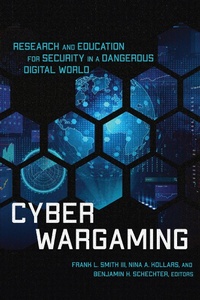
Cyber Wargaming
Description

A first-of-its-kind theoretical overview and practical guide to wargame design
Government, industry, and academia need better tools to explore threats, opportunities, and human interactions in cyberspace. The interactive exercises called cyber wargames are a powerful way to solve complex problems in a digital environment that involves both cooperation and conflict. Cyber Wargaming is the first book to provide both the theories and practical examples needed to successfully build, play, and learn from these interactive exercises.
The contributors to this book explain what cyber wargames are, how they work, and why they offer insights that other methods cannot match. The lessons learned are not merely artifacts of these games-they also shed light on how people interpret and interact with cyberspace in real life. This book covers topics such as cyber action during conventional war, information effects in conflict scenarios, individual versus group decision-making, the intersection of cyber conflicts and nuclear crises, business resilience, emerging technologies, and more.
Cyber Wargaming will be a vital resource for readers interested in security studies and wargame design in higher education, the military, and the private sector.
More details
Other editions
Additional editions
Persons
Frank L. Smith III is a professor in and director of the Cyber & Innovation Policy Institute at the US Naval War College.
Nina Kollars is a special assistant to the undersecretary of defense for research and engineering and a nonresident research fellow with the Cyber & Innovation Policy Institute at the US Naval War College.
Benjamin Schechter is a senior wargaming lead at Systems Planning and Analysis Inc.
Content
Acknowledgments
1 Shall We Play a Game? Fundamentals of Cyber Wargaming
Frank L. Smith III, Nina A. Kollars, and Benjamin H. Schechter
Part I: Research Games
2 Cyber Wargames as Synthetic Data
Andrew Reddie, Ruby Booth, Bethany Goldblum, Kiran Lakkaraju, and Jason C. Reinhardt
3 Wargames Research on Cyber and Nuclear Crisis Dynamics
Benjamin H. Schechter, Jacquelyn Schneider, and Rachael Shaffer
4 Wargaming International and Domestic Crises: Island Intercept and Netwar
David E. Banks and Benjamin M. Jensen
5 Imperfect Information in Conventional Wargaming
Chris Dougherty and Ed McGrady
6 Adding Time to the Cyber Kill Chain: The "Merlin" Tool for Wargaming
Paul Schmitt, Catherine Lea, Jeremy Sepinsky, Justin Peachy, and Steve Karppi
7 Games within Games: Cognition, Social Groups, and Critical Infrastructure
Rachael Shaffer
Part II: Educational Games
8 Playful Learning about Cybersecurity
Andreas Haggman
9 The Cyber 9/12 Strategy Challenge: Feedback Loops for Student Success
Safa Shahwan Edwards and Frank L. Smith III
10 The Evolution of the North American Electric Reliability Corporation's Grid Security Exercise
Matthew Duncan
11 Breaching the C-Suite: Cyber Wargaming in the Private Sector
Maxim Kovalsky, Benjamin H. Schechter, and Luis R. Carvajal-Kim
12 Develop the Dream: Prototyping a Virtual Cyber Wargame
Chris C. Demchak and David H. Johnson
13 Breathing Life into Military Doctrine through Cyber Gameplay
Benjamin C. Leitzel
14 Matrix Game Methodologies for Strategic Cyber and Information Warfare
Hyong Lee and James DeMuth
Part III: Conclusion
15 Balancing Zealots and Skeptics About Emerging Technology: A Wargaming Blueprint for Innovation
Nina A. Kollars and Benjamin H. Schechter
Index
Contributors
