

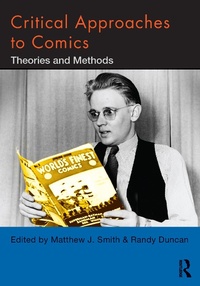
Critical Approaches to Comics
Theories and Methods
1st Edition
Published on 22. March 2012
328 pages
978-1-136-88473-3 (ISBN)
Description

Critical Approaches to Comics offers students a deeper understanding of the artistic and cultural significance of comic books and graphic novels by introducing key theories and critical methods for analyzing comics. Each chapter explains and then demonstrates a critical method or approach, which students can then apply to interrogate and critique the meanings and forms of comic books, graphic novels, and other sequential art. The authors introduce a wide range of critical perspectives on comics, including fandom, genre, intertextuality, adaptation, gender, narrative, formalism, visual culture, and much more.
As the first comprehensive introduction to critical methods for studying comics, Critical Approaches to Comics is the ideal textbook for a variety of courses in comics studies.
Contributors: Henry Jenkins, David Berona, Joseph Witek, Randy Duncan, Marc Singer, Pascal Lefevre, Andrei Molotiu, Jeff McLaughlin, Amy Kiste Nyberg, Christopher Murray, Mark Rogers, Ian Gordon, Stanford Carpenter, Matthew J. Smith, Brad J. Ricca, Peter Coogan, Leonard Rifas, Jennifer K. Stuller, Ana Merino, Mel Gibson, Jeffrey A. Brown, Brian Swafford
As the first comprehensive introduction to critical methods for studying comics, Critical Approaches to Comics is the ideal textbook for a variety of courses in comics studies.
Contributors: Henry Jenkins, David Berona, Joseph Witek, Randy Duncan, Marc Singer, Pascal Lefevre, Andrei Molotiu, Jeff McLaughlin, Amy Kiste Nyberg, Christopher Murray, Mark Rogers, Ian Gordon, Stanford Carpenter, Matthew J. Smith, Brad J. Ricca, Peter Coogan, Leonard Rifas, Jennifer K. Stuller, Ana Merino, Mel Gibson, Jeffrey A. Brown, Brian Swafford
Reviews / Votes
"In this volume, ably edited by Randy Duncan and Matthew J. Smith, some of the brightest and best international comics critics have joined forces to apply a variety of theoretical approaches to selected major texts to elucidate their appeal for the modern reader. The result is a user-friendly guide for professors, students, and general readers alike. Criticism has seldom been more fun." -M. Thomas Inge, Blackwell Professor of Humanities, Randolph-Macon College"The strength of this overview is in its truly admirable breadth-the broad range of objects it analyzes along with the various methodologies it brings to bear on comics. This volume is a valuable introduction to the lexicon of what many are now calling 'comics studies' that usefully seeks to enlarge the emerging field as opposed to fixing it down." -Hillary Chute, Neubauer Family Assistant Professor, English, University of Chicago 'In this volume, ably edited by Randy Duncan and Matthew J. Smith, some of the brightest and best international comics critics have joined forces to apply a variety of theoretical approaches to selected major texts to elucidate their appeal for the modern reader. The result is a user-friendly guide for professors, students, and general readers alike. Criticism has seldom been more fun.' -M. Thomas Inge, Blackwell Professor of Humanities, Randolph-Macon College
'The strength of this overview is in its truly admirable breadth-the broad range of objects it analyzes along with the various methodologies it brings to bear on comics. This volume is a valuable introduction to the lexicon of what many are now calling 'comics studies' that usefully seeks to enlarge the emerging field as opposed to fixing it down.' -Hillary Chute, Neubauer Family Assistant Professor, English, University of Chicago
'Despite the increasingly broad academic interest in and published studies of comic books, until now there has not been a single-volume handbook to methods in the field... If there is to be a discipline of 'comics studies,' this is the sort of book necessary for the conversation.' - D. Orcutt, CHOICE magazine
'Editors Matthew J. Smith and Randy Duncan deserve applause for their meticulous editing of Critical Approaches to Comics.' - Kirsten Mollegaard, University of Hawai'i at Hilo
More details
Language
English
Place of publication
London
United Kingdom
Publishing group
Taylor & Francis Ltd
Target group
College/higher education
Product notice
Reflowable
Illustrations
65 s/w Photographien bzw. Rasterbilder
65 Halftones, black and white
File size
57,32 MB
ISBN-13
978-1-136-88473-3 (9781136884733)
Copyright in bibliographic data and cover images is held by Nielsen Book Services Limited or by the publishers or by their respective licensors: all rights reserved.
Schweitzer Classification
Other editions
Additional editions
Book
10/2011
1st Edition
Routledge
€77.40
Shipment within 15-20 days
Book
10/2011
1st Edition
Routledge
€240.50
Shipment within 15-20 days
Persons
Matthew J. Smith is Professor of Communication at Wittenberg University. He regularly teaches "Graphic Storytelling" and leads an annual field study at Comic-Con International. Recent books include The Power of Comics: History, Form and Culture (with Randy Duncan) and Online Communication: Linking Technology, Culture, and Identity (with Andrew F. Wood).
Randy Duncan is Professor of Communication at Henderson State University. He is co-author of The Power of Comics: History, Form and Culture (with Matthew J. Smith). Duncan is a co-founder (with Peter Coogan) of the Comics Arts Conference, and serves on the Editorial Board of the International Journal of Comic Art and the Board of Directors of the Institute for Comics Studies. He was recently presented the Inkpot Award for Achievement in Comic Arts during the Pioneers of Comics Scholarship panel at Comic-Con International in San Diego.
Randy Duncan is Professor of Communication at Henderson State University. He is co-author of The Power of Comics: History, Form and Culture (with Matthew J. Smith). Duncan is a co-founder (with Peter Coogan) of the Comics Arts Conference, and serves on the Editorial Board of the International Journal of Comic Art and the Board of Directors of the Institute for Comics Studies. He was recently presented the Inkpot Award for Achievement in Comic Arts during the Pioneers of Comics Scholarship panel at Comic-Con International in San Diego.
Content
Introduction: Should We Discipline the Reading of Comics? Henry JenkinsI. Form 1. Wordless Comics: The Imaginative Appeal of Peter Kuper's The SystemDavid Berona 2. Comics Modes: Caricature and Illustration in the Crumb Family's Dirty LaundryJoseph Witek 3. Image Functions: Shape and Color as Hermeneutic Images in Asterios Polyp Randy Duncan 4. Time and Narrative: Unity and Discontinuity in The InvisiblesMarc Singer 5. Mise en scene and Framing: Visual Storytelling in Lone Wolf and CubPascal Lefevre 6. Abstract Form: Sequential Dynamism and Iconostasis in Abstract Comics and Steve Ditko's Amazing Spider-ManAndrei MolotiuII. Content 7. Philosophy: "The Triumph of the Human Spirit" in X-MenJeff McLaughlin 8. Journalism: Drawing on Words to Picture the Past in Safe Area GorazdeAmy Kiste Nyberg 9. Propaganda: The Pleasures of Persuasion in Captain AmericaChristopher MurrayIII. Production 10. Political Economy: Manipulating Demand and "The Death of Superman" Mark Rogers 11. Culture of Consumption: Commodification through Superman: Return to KryptonIan Gordon 12. Ethnography of Production: Editor Axel Alonso and the Sale of Ideas Stanford Carpenter 13. Auteur Criticism: The Re-Visionary Works of Alan Moore Matthew J. Smith 14. History: Discovering the Story of Jerry Siegel and Joe Shuster Brad J. RiccaIV. Context 15. Genre: Reconstructing the Superhero in All Star Superman Peter Coogan 16. Ideology: The Construction of Race and History in Tintin in the CongoLeonard Rifas 17. Feminism: Second Wave Feminism in the Pages of Lois LaneJennifer K. Stuller 18. Intertextuality: Surrealist Intertextualities in Max's Bardin Ana MerinoV. Reception 19. Cultural Studies: British Girls' Comics, Readers and Memories Mel Gibson 20. Ethnography: Wearing One's Fandom Jeffrey A. Brown 21. Critical Ethnography: The Comics Shop as Cultural Clubhouse Brian Swafford
