
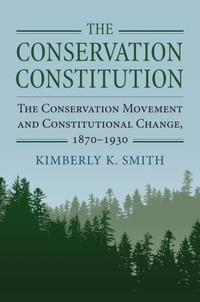
The Conservation Constitution
Description
Alles über E-Books | Antworten auf Fragen rund um E-Books, Kopierschutz und Dateiformate finden Sie in unserem Info- & Hilfebereich.
Winner: Lynton Keith Caldwell Award
Winner: Charles A. Weyerhaeuser Award
Over the course of the twentieth century, the United States emerged as a global leader in conservation policy?negotiating the first international conservation treaties, pioneering the idea of the national park, and leading the world in creating a modern environmental regulatory regime. And yet, this is a country famously committed to the ideals of limited government, decentralization, and strong protection of property rights. How these contradictory values have been reconciled, not always successfully, is what Kimberly K. Smith sets out to explain in The Conservation Constitution?a book that brings to light the roots of contemporary constitutional conflict over environmental policy.
In the mid-nineteenth century, most Progressive Era conservation policies would have been considered unconstitutional. Smith traces how, between 1870 and 1930, the conservation movement reshaped constitutional doctrine to its purpose?how, specifically, courts and lawyers worked to expand government authority to manage wildlife, forest and water resources, and pollution. Her work, which highlights a number of important Supreme Court decisions often overlooked in accounts of this period, brings the history of environmental management more fully into the story of the US Constitution. At the same time, illuminating the doctrinal innovation in the Progressives' efforts, her book reveals the significance of constitutional history to an understanding of the government's role in environmental management.
All prices
More details
Other editions
Additional editions
Person
Content
Preface
1. Introduction
2. State Wildlife Conservation
3. The Road to Missouri v. Holland
4. Forest Conservation in the States
5. Western Forest Reserves
6. Eastern Forest Reserves
7. Managing Federal Lands
8. State and Local Pollution Control
9. Federalizing Pollution Control
10. The Conservation Movement's Constitutional Legacy
Notes
Bibliography
Index

System requirements
File format: ePUB
Copy protection: Adobe-DRM (Digital Rights Management)
System requirements:
- Computer (Windows; MacOS X; Linux): Install the free reader Adobe Digital Editions prior to download (see eBook Help).
- Tablet/smartphone (Android; iOS): Install the free app Adobe Digital Editions or the app PocketBook before downloading (see eBook Help).
- E-reader: Bookeen, Kobo, Pocketbook, Sony, Tolino and many more (not Kindle).
The file format ePub works well for novels and non-fiction books – i.e., „flowing” text without complex layout. On an e-reader or smartphone, line and page breaks automatically adjust to fit the small displays.
This eBook uses Adobe-DRM, a „hard” copy protection. If the necessary requirements are not met, unfortunately you will not be able to open the eBook. You will therefore need to prepare your reading hardware before downloading.
Please note: We strongly recommend that you authorise using your personal Adobe ID after installation of any reading software.
For more information, see our ebook Help page.
File format: PDF
Copy-Protection: Adobe-DRM (Digital Rights Management)
System requirements:
- Computer (Windows; MacOS X; Linux): Install the free reader Adobe Digital Editions prior to download (see eBook Help).
- Tablet/smartphone (Android; iOS): Install the free app Adobe Digital Editions or the app PocketBook before downloading (see eBook Help).
- E-reader: Bookeen, Kobo, Pocketbook, Sony, Tolino and many more (only limited: Kindle).
The file format PDF always displays a book page identically on any hardware. This makes PDF suitable for complex layouts such as those used in textbooks and reference books (images, tables, columns, footnotes). Unfortunately, on the small screens of e-readers or smartphones, PDFs are rather annoying, requiring too much scrolling.
This eBook uses Adobe-DRM, a „hard” copy protection. If the necessary requirements are not met, unfortunately you will not be able to open the eBook. You will therefore need to prepare your reading hardware before downloading.
Please note: We strongly recommend that you authorise using your personal Adobe ID after installation of any reading software.
For more information, see our eBook Help page.
File format: ePUB
Copy protection: Watermark-DRM (Digital Rights Management)
System requirements:
- Computer (Windows; MacOS X; Linux): Use a reading software that can process the file format ePUB: e.g., Adobe Digital Editions or FBReader – both free (see eBook Help).
- Tablet/Smartphone (Android; iOS): Before downloading, install the free app Adobe Digital Editions (see eBook Help).
- E-reader: Bookeen, Kobo, Pocketbook, Sony, Tolino and many more (not Kindle).
The file format ePUB works well for novels and non-fiction books – i.e., „flowing” text without complex layout. On an e-reader or smartphone, line and page breaks automatically adjust to fit the small displays.
This eBook uses Watermark-DRM, a „soft” copy protection. This means that there are no technical restrictions to prevent illegal distribution. However, there is a personalised watermark embedded in the eBook that can be used to identify the purchaser of the eBook in the event of misuse and to provide evidence for legal purposes.
For more information, see our eBook Help page.
