

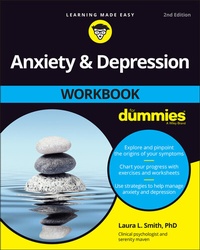
Anxiety & Depression Workbook For Dummies
Description

If you're one of the millions of people affected by--or whose loved ones are affected by--anxiety and depression, you're probably looking for strategies to help subdue or even transcend these debilitating and painful disorders. In that case, Anxiety and Depression Workbook For Dummies is a great place to start.
This book is filled with chapters that cut across diagnostic categories, incorporating treatment techniques based on Cognitive Behavioral Therapy, Acceptance and Commitment Therapy, Emotion Focused Therapy, and Interpersonal Therapy. Use the techniques explored in this book to start making real changes, which can quickly lead to you feeling better. It also includes:
* Practical and hands-on descriptions of mindfulness-based practices you can implement immediately
* Brand-new updates to reflect modern changes in technology, social media, and the prevalence of loneliness
* Consideration of the pros and cons of medications and other biological interventions for depression and anxiety, including exploration of the placebo effect
* Additional worksheets online available for download
Perfect for anyone trying to work through the challenging issues presented by anxiety and depression, for those trying to help a loved one do the same thing, or for those in therapy, this book is an excellent supporting resource that can help contribute to positive changes in the lives of people affected by emotional distress.
More details
Other editions
Additional editions
Person
Content
Part 1: Dissecting Distress and Preparing a Plan 5
Chapter 1: Sorting Out Symptoms of Anxiety and Depression 7
Chapter 2: Discovering the Beginnings 21
Chapter 3: Overcoming Obstacles to Change 35
Chapter 4: Minding Your Moods 47
Part 2: Thinking About Thinking: Thought Therapy 59
Chapter 5: Untangling Twisted Thinking 61
Chapter 6: Indicting and Rehabilitating Thoughts 79
Chapter 7: Looking at Problematic Assumptions 101
Chapter 8: Managing Mindfulness and Achieving Acceptance 119
Part 3: Actions Against Angst: Behavior Therapy 133
Chapter 9: Facing Feelings: Avoiding Avoidance 135
Chapter 10: Lifting Mood Through Exercise 145
Chapter 11: Entertaining Enjoyment 157
Chapter 12: Moving and Tackling Life's Problems 167
Part 4: Focus on Physical Feelings 179
Chapter 13: Sleeping Soundly for Emotional Health 181
Chapter 14: Making the Medication Decision 193
Part 5: Relationship Therapy 201
Chapter 15: Restoring Relationships 203
Chapter 16: Smoothing Out Conflict 215
Part 6: Looking Beyond Anxiety and Depression 225
Chapter 17: Reining in Relapse 227
Chapter 18: Promoting Positives 241
Part 7: The Part of Tens 255
Chapter 19: Ten Reasons to Seek Additional Support 257
Chapter 20: Ten Ways to Help a Loved One with Anxiety or Depression 261
Index 265
Chapter 1
Sorting Out Symptoms of Anxiety and Depression
IN THIS CHAPTER
Figuring out how depression and anxiety affect you
Finding your personal starting point
Knowing when to get more help
For people all over the world, these past years of unrest, divisiveness, and fear and uncertainty related to the devastating pandemic have increased stress significantly. Stress often precedes the emergence of emotional disorders, especially anxiety and depression. In the United States, recent surveys suggest that about 40 percent of the adult population suffer from notable symptoms of anxiety or depression. The rates of anxiety and depression among adolescents have also risen dramatically due to disruptions in their lives during these tumultuous times.
Everyone feels sad or worried from time to time. Such emotions are both natural and unavoidable. People worry about their children, bills, aging parents, jobs, health, and powerful social issues. And most people have shed a tear or two watching a sad movie or a news story about a poignant tragedy. It's perfectly natural to experience significant sadness when faced with loss, frustration, or pain. That's normal. Anxiety and depression are part of everyday life.
But when sadness fills most of your days or worries saturate your mind, that's not so normal. You may be experiencing a real problem with depression or anxiety. Anxiety and depression can affect how you think, behave, feel, and relate to others. The discussion and quizzes in this chapter help you figure out how depression and anxiety affect your life. When you understand what's going on with your emotions, you can start doing something to manage them more effectively.
This workbook is designed to help with troubling emotions. It isn't meant to be a comprehensive review of emotional disorders. Many people choose to use this book along with professional counseling or therapy. Some use this book on their own. If you want more information and an in-depth discussion about anxiety or depression, take a look at the latest editions of Anxiety For Dummies or Depression For Dummies.
Don't freak out if the quizzes in this chapter reveal that you have a few symptoms of anxiety or depression. Almost everyone has struggles; that's human. However, you should be concerned when these symptoms significantly interfere with your life. See the later section in this chapter, "When and Where to Get More Help," for more information.
If your symptoms are numerous and severe or your life seems out of control, you should consult your primary care provider or a mental health professional. These quizzes aren't meant to replace trained mental health professionals - they're the only people who can really diagnose your problem.
Dwelling on Negative Thoughts
If you were able to listen in on the thoughts that reverberate through a depressed person's head, you might hear, "I'm a failure," "My future looks bleak," "Things just keep on getting worse," or "I regret so many things in my life."
On the other hand, the thoughts of an anxious person might sound like, "I'm going to make a fool out of myself when I give that speech," "I never know what to say at parties," "The freeway scares me to death," "I know that the odds of a plane crash are small, but flying scares me," or "I'm going to have a nervous breakdown if my editor doesn't like what I write."
Thoughts influence the way you feel. The very darkest thoughts usually lead to depression, whereas anxiety usually stems from thoughts about being judged or hurt. And, of course, people often have both types of thoughts.
Do your thoughts dwell on the dark, dismal, or the scary aspects of life? Take the quiz in Worksheet 1-1 to determine if your thoughts reflect a problem with anxiety or depression. Put a check mark next to an item if you feel the statement applies to you.
Although these thoughts can occur to someone who's depressed or anxious (or both), the odd-numbered items are most indicative of depression, and the even-numbered items reflect anxious thinking. There's no pass or fail mark on this quiz. However, the more items you endorse, the more you have cause for concern; specifically, if you check more than eight or ten items, you should think seriously about addressing your condition. At the same time, if you very strongly believe in or you frequently have any of these thoughts, you may have too much anxiety or depression. For example, if you worry all the time (item number 2) with no relief, you could benefit from working on that issue.
Worksheet 1-1 The Negative Thinking Quiz
- 1. Things are getting worse and worse for me.
- 2. I worry all the time.
- 3. I think I'm worthless.
- 4. I never know what to say.
- 5. No one would miss me if I were dead.
- 6. I'm afraid that I'll get sick.
- 7. I think I'm a failure.
- 8. My thoughts race, and I obsess about things.
- 9. I don't look forward to much of anything.
- 10. I get really nervous around people I don't know.
- 11. The world would be better off without me.
- 12. Thoughts about past traumas keep rolling through my mind.
- 13. I find it impossible to make decisions.
- 14. I can't stand it when I'm the center of attention.
- 15. My life is full of regrets.
- 16. I can't stand making mistakes.
- 17. I don't see things getting any better in the future.
- 18. I worry about my health all the time.
- 19. I'm deeply ashamed of myself.
- 20. I over-prepare for everything.
Take a moment to write down your results on Worksheet 1-2, and then reflect on whether or not you believe you have difficulties with anxiety, depression, or both.
Worksheet 1-2 My Reflections
If you have any thoughts of suicide or utter hopelessness, consult your primary care provider or a mental health professional immediately.
If you have symptoms of both anxiety and depression, don't be surprised. Anxiety and depression often occur together.
Blue and Anxious Behavior
If you were to follow a depressed or anxious person around, you might see some behavioral signs of their emotional turmoil. That's because depression and anxiety on the inside affect what people do on the outside. For example, a depressed person may look tired, move slowly, or withdraw from friends and family; an anxious person may avoid socializing or have a trembling voice.
Take the quiz in Worksheet 1-3 to see if your behavior indicates a problem with anxiety or depression. Check off each statement that applies to you.
Worksheet 1-3 The Distraught Behavior Quiz
- 1. I've been crying for no clear reason.
- 2. I pace around when I'm worried.
- 3. Sometimes I can't make myself get out of bed.
- 4. I avoid going into crowded areas.
- 5. I can't seem to make myself exercise.
- 6. I avoid risks because I'm afraid of failure.
- 7. I don't do things for fun lately.
- 8. I always stay away from activities that could be dangerous.
- 9. I've been missing work lately because I just don't have the motivation.
- 10. I'm really fidgety.
- 11. I feel like I am walking in quicksand; I can't get moving.
- 12. I avoid people or places because I feel anxious.
- 13. I don't care what I look like anymore.
- 14. I spend too much time making sure I look okay.
- 15. I don't laugh anymore.
- 16. My hands shake when I'm nervous.
- 17. I've been letting things go that I need to attend to.
- 18. I feel compelled to repeat actions to keep myself safe.
Again,...
