

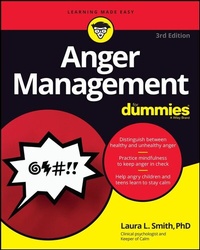
Anger Management For Dummies
Description

Everyone experiences anger from time to time, but when left unchecked or unbridled, this normal human emotion can become disruptive and damage relationships. If you're ready to stop letting anger control your life, turn to Anger Management For Dummies. This trusted source gives you tools to identify the source of your anger--whether it's fear, depression, anxiety, or stress--and offers ways to deal with the "flight or fight" instinct that anger produces, allowing you to release yourself and your life from its grip.
Anger Management For Dummies outlines specific anger management methods, skills, and exercises that you can use to take control of your feelings and actions. It provides:
* Information on the different kinds of rage, including road, air, and office
* A look at Intermittent Explosive Disorder (IED) and how to manage aggression
* Advice on how to deal with angry children and teens
* Details on how anger is related to the "fight, flight, or freeze" response of the nervous system and prepares you to fight (for good or bad)
Overcoming anger issues requires support, mindfulness, and a bit of practice--all of which this book provides. When you're ready to face your triggers and change your perspective on the emotions of anger or rage, let Anger Management For Dummies give you the helping hand you need.
More details
Other editions
Additional editions
Person
Content
Part 1: Getting Started with Anger Management 5
Chapter 1: Understanding Anger 7
Chapter 2: Finding Your Anger Profile 15
Chapter 3: Deciding Whether to Change 35
Part 2: Rethinking Anger 53
Chapter 4: Jump-Starting Anger Management 55
Chapter 5: Connecting Events to Thoughts and Feelings 67
Chapter 6: Reexamining Angry Thoughts 77
Chapter 7: Taking the Focus Off Yourself 99
Part 3: Equipping Yourself with Anger Management Tools 109
Chapter 8: Communicating Assertively with Compassion 111
Chapter 9: Mindfully Managing Anger 129
Chapter 10: Practicing Non-Angry Responses 139
Part 4: Managing Anger Hotspots 153
Chapter 11: When You Are Morally Outraged 155
Chapter 12: Dealing with Anger at Work 167
Chapter 13: Understanding and Helping Angry Children and Teens 183
Chapter 14: Subduing Anger in Intimate Relationships 203
Chapter 15: Rage Behind the Machine 215
Part 5: Handling Anger from the Past 225
Chapter 16: Letting Go of Past Anger 227
Chapter 17: Finding Forgiveness 241
Chapter 18: Preventing Relapse 249
Part 6: Living Beyond Anger 257
Chapter 19: Soothing Stress 259
Chapter 20: Balancing Your Body 275
Chapter 21: Building Social Support 293
Chapter 22: Finding Meaning and Purpose 303
Part 7: The Part of Tens 313
Chapter 23: Ten Ways to Deal with Angry People 315
Chapter 24: Ten Ways to Decrease Anger with Compassion 323
Chapter 25: Ten Anti-Anger Thoughts 327
Index 335
Chapter 1
Understanding Anger
IN THIS CHAPTER
Identifying anger and where it comes from
Examining the myths about anger
Understanding how emotions work
Finding help when you need it
What in the world is happening on airplanes? Instances of air rage have increased dramatically. Being a flight attendant has become a dangerous occupation, not because of plane crashes, but because passengers are attacking flight attendants. Despite a zero-tolerance policy, passengers are losing their minds on airplanes. Although alcohol is a factor in about half of cases of air rage, the other half of rage comes from supposedly sober passengers. What is going on?
For starters, the world is coming out of the largest pandemic in a century. Politics have never been more divisive. Economic disparity has never been greater. Changes in climate have produced more natural disasters. People feel frightened, stressed, and very, very angry.
Anger forms part of the survival mechanism of human beings. When faced with a threat, humans, not unlike other animals, either run away, freeze, or attack. Anger fuels attacks. Angry people experience a surge of energy that helps them repel adversaries.
But anger can also have the opposite effect and lead to an untimely demise. Too much anger can cause heart attacks, precipitate disabling work injuries, ruin relationships, and lead to a variety of unintended negative consequences. Anger truly is a double-edged sword.
FINDING THE KEY TO ANGER MANAGEMENT
You'd probably like a simple answer to the question "Why am I so angry, and what's the single, most effective thing I can do about it?" You're hoping that one chapter in this book will provide that answer. But, alas, that's not the way it works.
Anger is a complex human emotion. By reading this book, you can come to understand where your anger comes from - that is, which and how many of those factors that are unique to you are at work here. It may be that you need better coping skills, to cut down on drinking, increase your social outlets, enhance your sense of purpose and meaning in life, or look for a new job. A few of these items, all of them, one of them, or perhaps more, may cause problems that result in your anger. The important thing at this point is to find the right recipe for your anger management and to use the information and resources in this book to bring your emotional life to a better place.
Defining Anger
If you're like most people, you know what anger is, or at least you think you do. For example, maybe your gut tells you that a friend of yours feels angry. So you ask him if indeed he feels angry, and he responds, "No, not at all." Of course, your gut could be wrong, and your friend really isn't angry. But usually your intuition will serve you well in such instances. You can tell by your friend's tone of voice, posture, and body language.
Anger is an emotion that involves certain types of thoughts that focus on other people's intent to hurt you, unfairness, threats to your self-esteem, and frustrations. Anger expresses itself in the body (for example, muscle tension, loud voice, and restlessness) and behaviors (such as threatening actions, pacing, and clenching). Anger is a strong emotion that attempts to express displeasure and disapproval.
Choosing Anger
Humans are the only animals that have a choice about how they view the world. Cats, dogs, squirrels, hamsters, goldfish - they're all creatures of instinct, which means they respond in predictable ways that are prewired into their nervous systems. Instincts are universal, so if you scratch a Goldendoodle's tummy, he'll instantly begin shaking his hind leg. All Goldendoodles do it, and they don't have a choice in the matter.
The miraculous thing about being human is that you're not ruled by instinct. Not only do you have choices about how you respond to the world around you (for example, when someone mistreats you), but even before that, you also have a choice about how you perceive or think about that person's actions.
Do you think she did that on purpose? Was it an accident, or did he do it deliberately? Is the mistreatment specifically directed at you alone? Do you view this as a catastrophe or a life-altering event? Is this something that you think shouldn't have happened? These questions are all ones your mind considers, albeit unconsciously, before you have a chance to react - or, better yet, respond to provocation. Consider the following:
- You might say that Mike is a born pessimist, but actually that's not true. Human beings aren't born with attitudes; those attitudes come from life experience. What is true is that Mike is the product of an alcoholic home, where things could be going well one minute and fall into complete chaos the next. He found out as a child not to expect the good times to last and that he and the rest of his family were always just one beer away from a family crisis.
- So for all his adult life, Mike has expected that most things will eventually turn out badly, given enough time. No matter how loving his wife is or how cooperative his children are, in the back of his mind he harbors this expectation that any minute things will change for the worse, and he's ready to react in anger when that moment comes. Why will he get angry? It's Mike's way of defending himself against chaos, a way of feeling in control, which is a response that's different from when he was a child, hiding under the bed while his alcoholic father ranted and raved well into the night.
- Mike is unaware of how his early childhood influenced his view of the world. Like most children of alcoholics, he figures that because he survived those unpleasant years (physically at least), he's okay. He also has no clue why he loses his temper so easily.
Many people with anger problems have troubled childhoods. Their anger during childhood usually made sense at the time as a way of coping with the difficulties they faced. However, they bring their anger into the present when it usually doesn't work very well. You can acquire new, more effective ways of coping, but it takes patience and work.
Dispelling Common Anger Myths
Before you can manage your own anger, you need to be aware of what anger is and isn't. Unfortunately, myths about anger abound. Here are some of the myths to dispel from the get-go:
- If you don't express anger, you just might explode. The truth is, the more often you express anger, the more likely you will feel angry in the future. On the other hand, appropriately, carefully expressed anger can help you. So keep reading!
- Males are angrier than females. If by angrier you mean how often people experience anger, it's simply not true that men are angrier than women. Surveys show that women get mad about as frequently as men. Men and women may express anger a little differently, but research has been inconsistent on that issue.
- Anger is bad. Anger serves a variety of positive purposes when it comes to coping with stress. When controlled, it can energize you, improve your communication with other people, and defend you against fear and insecurity.
- Anger is good. When it leads to domestic violence, property damage, sexual abuse, drug addiction, ulcers, and self-mutilation, anger is definitely not good.
- Anger is only a problem when you openly express it. Many angry people either suppress their anger ("I don't want to talk about it!") or repress their anger ("I'm not angry at all - really!"). People who express their anger are the squeaky wheels who get everyone's attention; people who repress or suppress their anger need anger management just as much (see Chapter 3 for more information about the costs of anger).
- The older you get, the more irritable you are. It's the other way around: As people age, they report fewer negative emotions and greater emotional control. People, like wine and cheese, do tend to improve with age.
- Anger is all in the mind. When you get mad, that emotion instantly manifests itself in muscles throughout your entire body, the hairs on the back of your neck, your blood pressure, your blood sugar levels, your heart rate, your respiration rate, your gut, and even your finger temperature (it warms up!) long before you're fully aware of what's happening.
- Anger is all about getting even. The most common motive behind anger has been shown to be a desire to assert authority or independence, or to improve one's image - not necessarily to cause harm. Revenge is a secondary motive. A third motive involves letting off steam over accumulated frustrations - again with no apparent intent to harm anyone else.
- If you don't express anger, you'll be seen as weak. Not so. In fact, a calm, measured, assertive response (see Chapter 8 for more information about assertiveness) not only works better but also is quite powerful.
- People with anger problems have low self-esteem. In fact, sometimes they do. However, a much more common companion of anger is excessively inflated self-esteem (see Chapter 7 for more information about the...
