

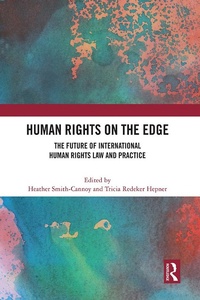
Human Rights on the Edge
The Future of International Human Rights Law and Practice
1st Edition
Published on 6. June 2023
142 pages
978-1-000-88883-6 (ISBN)
Description

This book grapples with the challenges inherent in an uncertain period for global human rights and explores the future of international human rights law and practice.
Many Western scholars are increasingly pessimistic about the future of international human rights law. However, the contributions to this volume demonstrate that far from collapsing in the face of duress, the concept of human rights has endured despite contractions and the spectre of co-option and manipulation by the powerful. In addition, law is a malleable tool that is deployed in novel ways to promote human rights. The book illustrates that the power of human rights lies not in their essentialized transcendence of time, culture, and context but in their enduring promise that a more just world can emerge from sustained and creative struggle through, against, and at the margins of states, law, and institutions. The key questions to emerge are not whether human rights law and practice will survive, but rather what are the forces that sustain, revitalize, and transform them? And what are human rights in the process of becoming?
This book will be of immense interest to those studying and researching across Politics, Human Rights, Gender and Law. It was originally published as a special issue of the Journal of Human Rights.
Many Western scholars are increasingly pessimistic about the future of international human rights law. However, the contributions to this volume demonstrate that far from collapsing in the face of duress, the concept of human rights has endured despite contractions and the spectre of co-option and manipulation by the powerful. In addition, law is a malleable tool that is deployed in novel ways to promote human rights. The book illustrates that the power of human rights lies not in their essentialized transcendence of time, culture, and context but in their enduring promise that a more just world can emerge from sustained and creative struggle through, against, and at the margins of states, law, and institutions. The key questions to emerge are not whether human rights law and practice will survive, but rather what are the forces that sustain, revitalize, and transform them? And what are human rights in the process of becoming?
This book will be of immense interest to those studying and researching across Politics, Human Rights, Gender and Law. It was originally published as a special issue of the Journal of Human Rights.
More details
Edition
1. Auflage
Language
English
Place of publication
London
United Kingdom
Publishing group
Taylor & Francis Ltd
Target group
College/higher education
ISBN-13
978-1-000-88883-6 (9781000888836)
Copyright in bibliographic data and cover images is held by Nielsen Book Services Limited or by the publishers or by their respective licensors: all rights reserved.
Schweitzer Classification
Other editions
Additional editions
Heather Smith-Cannoy | Tricia Redeker Hepner
Human Rights on the Edge
The Future of International Human Rights Law and Practice
Book
11/2024
1st Edition
Routledge
€61.30
Shipment within 10-20 days
Heather Smith-Cannoy | Tricia Redeker Hepner
Human Rights on the Edge
The Future of International Human Rights Law and Practice
Book
06/2023
1st Edition
Routledge
€204.10
Shipment within 10-20 days
Persons
Heather Smith-Cannoy is a Political Scientist at Arizona State University, where she directs the Global Human Rights Hub and the undergraduate degree program on Social Justice and Human Rights. She has published three books, and 15 articles and book chapters on human rights, international law, sex trafficking and gender.
Tricia Redeker Hepner is a Political and Legal Anthropologist at Arizona State University. Her research focuses on migration and displacement, transnationalism, human rights, transitional justice, militarism, and conflict/peace. She has published four books and more than twenty peer-reviewed journal articles or chapters. She directs ASU's Master's Program in Social Justice and Human Rights.
Tricia Redeker Hepner is a Political and Legal Anthropologist at Arizona State University. Her research focuses on migration and displacement, transnationalism, human rights, transitional justice, militarism, and conflict/peace. She has published four books and more than twenty peer-reviewed journal articles or chapters. She directs ASU's Master's Program in Social Justice and Human Rights.
Content
Foreword-The future of human rights: A research agenda Introduction-Human rights on the edge: The future of international human rights law and practice 1. NGO repression as a predictor of worsening human rights abuses 2. New frontiers in international human rights: Actionable nonactionables and the (non)performance of perpetual becoming 3. Epistemes of human rights in Kashmir: Paradoxes of universality and particularity 4. "Legal exhaustion" and the crisis of human rights: Tracing legal mobilization against sexual violence and torture of Kurdish women in state custody in Turkey since the 1990s 5. The boundaries of religion in international human rights law 6. Disentangling gendered peace: Observing gendered peace in policy 7. The evolution of the global movement to end child marriage
