

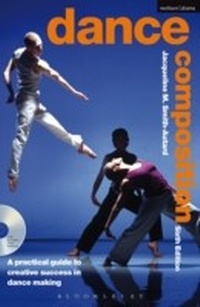
Dance Composition
A Practical Guide to Creative Success in Dance Making
6th Edition
Published on 7. June 2010
256 pages
978-1-4081-4530-2 (ISBN)
Description

"A book which has remained seminal in its field as one of the key texts in dance education. Jacqueline Smith-Autard delves into the creative arena of dance with a logic unmatched by any other creative author in this field" Speech and Drama
"Jacqueline Smith-Autard has made significant contributions to the development of dance in education in the UK and abroad" National Dance Teachers Association
Dance composition - the discipline that translates ideas into dances - is an important part of dance education. This book, a bestseller for over twenty years, is a practical guide to creative success in dance making and is a popular textbook for all those who are interested in dance composition, from secondary school to university.
This new edition includes online video resources taken from Choreographic Outcomes, a groundbreaking advanced technology resource pack aimed at comprehensively improving students' choreography. The book has been revised, redesigned and expanded. Reference to the online video is made throughout the book and new assignments based on the video material are included.
"Jacqueline Smith-Autard has made significant contributions to the development of dance in education in the UK and abroad" National Dance Teachers Association
Dance composition - the discipline that translates ideas into dances - is an important part of dance education. This book, a bestseller for over twenty years, is a practical guide to creative success in dance making and is a popular textbook for all those who are interested in dance composition, from secondary school to university.
This new edition includes online video resources taken from Choreographic Outcomes, a groundbreaking advanced technology resource pack aimed at comprehensively improving students' choreography. The book has been revised, redesigned and expanded. Reference to the online video is made throughout the book and new assignments based on the video material are included.
More details
Series
Edition
6th edition
Language
English
Place of publication
London
United Kingdom
Publishing group
Bloomsbury Publishing PLC
Target group
Professional and scholarly
Illustrations
320 line drawings, photos
ISBN-13
978-1-4081-4530-2 (9781408145302)
Copyright in bibliographic data and cover images is held by Nielsen Book Services Limited or by the publishers or by their respective licensors: all rights reserved.
Schweitzer Classification
Other editions
Additional editions
Book
06/2010
6th Edition
Methuen Drama
€42.50
Shipment within 10-20 days
Person
Jacqueline Smith-Autard is acknowledged as a world-leading exponent in dance education. She has taught dance in schools and universities and was Chief Examiner for the dance GCSE for 10 years. She was a founder member of the NDTA, is a trainer of teachers in dance education and a pioneer in the use of technology to extend and enhance dance pedagogy.
Content
- Cover
- Contents
- Preface
- A note on the DVD
- Acknowledgements
- Introduction
- Dancing and composing dances
- Dance as art
- The nature of composition
- The material elements
- Methods of construction
- The nature of dance composition
- Teaching dance composition
- Section 1
- The material content - movement and meaning
- The basic language of movement
- Analysing the language
- Choice of content
- Literal movement into dance content
- Exploring a range of movement
- Movement and meaning
- Stylising the material content
- Section 2
- Methods of construction 1 - the beginnings
- Stimuli for dance
- Types of dances
- Mode of presentation
- Improvisation
- Methods of construction 2 - motif into composition
- Arrangement of material
- Form
- What is a motif?
- Development and variation of a motif
- Repetition as a constructional element
- Types of motif
- The dance design in time
- The dance design in space
- Motif in composition
- Methods of construction 3 - motif into composition for a group
- The group as an expressive element
- Motif, development and variation
- The time aspect
- The space aspect
- Methods of construction 4 - the dance form
- Design in time
- Organisation of the form
- Methods of construction 5 - elements of construction
- Motifs
- Repetition
- Variation and contrasts
- Climax or highlights
- Proportion and balance
- Transition
- Logical development
- Unity
- Methods of construction 6 - style
- Understanding the term style
- Factors affecting the style of a dance
- How to stylise a dance
- Methods of construction 7 - improvisation in the process of composition
- Meaning of terms - improvisation and exploration
- Free and limited improvisation
- Improvisation in framework compositions
- Guiding improvisation visually
- Improvisation as process in composition
- The role of evaluation in improvisation
- Methods of construction 8 - alternative and experimental approaches in dance composition
- Meaning of terms
- Alternative movement contents and eclectic trends
- Themes and reading of themes
- Alternative and experimental approaches to dance composition
- Section 3
- The creative process in dance composition
- The creative process
- Phases in creativity
- The creative process in dance composition - an example
- Phase 1 - the impulse to create
- Phase 2 - working with the medium
- Phase 3 - realising the final form
- Phase 4 - presentation and performance, and Phase 5 - response and evalution
- Summary and conclusion
- Section 4
- Resource-based teaching/learning - dance composition
- Resource-based teaching/learning
- New technologies
- Differences in use of DVD and CD-ROM/DVD-ROM technologies
- A CD-ROM resource: Chorographic Outcomes - improving dance composition
- The accompanying DVD
- Resource-based teaching/learning - practical assignments using the DVD
- Resource-based teaching/learning using new technologies
- Section 5
- Resource-based teaching/learning - dance performance
- Performance to deepen understanding of composition
- Aims of this section
- Methods of improving dance performance
- A DVD-ROM resource: Vocalise - improving dance performance
- Resource-based teaching/learning - practical assignments using the DVD
- Section 6
- Standing back from the process - evaluations
- The composer's freedom
- Imagination and intuition
- Imagination in relation to the stimulus
- Imagination during composition
- Intuition
- Knowing and feeling
- Evaluations
- Conclusion
- References
- Technology resources
- Online video content
- Index
- A
- B
- C
- D
- E
- F
- G
- H
- I
- J
- K
- L
- M
- N
- O
- P
- Q
- R
- S
- T
- U
- V
- W
