

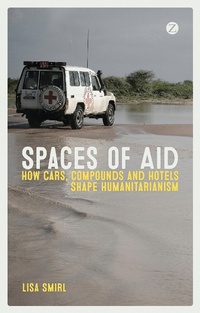
Spaces of Aid
How Cars, Compounds and Hotels Shape Humanitarianism
1st Edition
Published on 12. March 2015
265 pages
978-1-78360-351-0 (ISBN)
Description

Aid workers commonly bemoan that the experience of working in the field sits uneasily with the goals they've signed up to: visiting project sites in air-conditioned Land Cruisers while the intended beneficiaries walk barefoot through the heat, or checking emails from within gated compounds while surrounding communities have no running water.
Spaces of Aid provides the first book-length analysis of what has colloquially been referred to as Aid Land. It explores in depth two high-profile case studies, the Aceh tsunami and Hurricane Katrina, in order to uncover a fascinating history of the objects and spaces that have become an endemic yet unexamined part of the delivery of humanitarian assistance.
Spaces of Aid provides the first book-length analysis of what has colloquially been referred to as Aid Land. It explores in depth two high-profile case studies, the Aceh tsunami and Hurricane Katrina, in order to uncover a fascinating history of the objects and spaces that have become an endemic yet unexamined part of the delivery of humanitarian assistance.
Reviews / Votes
Inspirational. Lisa Smirl was one of the first to expose the spatial dimensions of aid and thus open to view a whole new area of critique and research. * Mark Duffield, professor emeritus at the University of Bristol and honorary professor, University of Birmingham; author of Global Governance and the New Wars * A fascinating and well-written book that unearths an important, but often unseen, part of the humanitarian world. Highly recommended. * Michael Barnett, George Washington University, and author of The Empire of Humanity: A History of Humanitarianism * An intriguing book on a neglected subject: the increasing trend towards aid workers barricading themselves away from "target populations" in fortified compounds, four wheel drives and grand hotels. * Development Book Review * Lisa Smirl died tragically young in 2013, aged 37. The lecturer in international relations at the University of Sussex made a big impact on the way we think about humanitarian aid. Now friends, colleagues and fans have brought Smirl's work together in the book Spaces of Aid in the hope that the debate and reform that she began will continue. The book is a critical examination of the aid landscape, looking at how the built environment of humanitarian staff - from gated communities and hotels to air-conditioned cars and mobile phones - alters power relations between international aid workers and local communities. A book well worth reading. * Lucy Siegle. The Guardian * Lisa Smirl's remarkable book teaches us that objects and structures of privilege such as the SUV and gated apartment complex contribute to the insecurity perpetuated by the international aid industry. Spaces of Aid provides us with critical insights into everyday aid life in order that we might reflect seriously on our continuing ethical responsibilities and humanitarian interventions. An inspiring read. * Marsha Henry, LSE * A ground-breaking work, which introduces a spatial dimension to humanitarian analysis while spanning fields, disciplines, and geographical areas, in order to explore what is going wrong and what might be done about it. * Professor Oliver Richmond, University of Manchester * No humanitarian scholar or aid worker can afford to ignore the political and moral realities with which this path-breaking work confronts us. * Professor Stephen Hopgood, SOAS University of London, and author of The Endtimes of Human Rights and Keepers of the Flame * Spaces of Aid is masterfully researched, theoretically innovative, and analytically sophisticated. It is essential reading for anyone interested in understanding or improving humanitarian interventions. * Severine Autesserre, Barnard College, Columbia University * Lisa Smirl was one of the most original and brilliant academics working on the global humanitarian order. * Tim Dunne, professor of international relations, University of Queensland *More details
Edition
1. Auflage
Language
English
Place of publication
London
United Kingdom
Publishing group
Bloomsbury Publishing PLC
ISBN-13
978-1-78360-351-0 (9781783603510)
Copyright in bibliographic data and cover images is held by Nielsen Book Services Limited or by the publishers or by their respective licensors: all rights reserved.
Schweitzer Classification
Other editions
Additional editions
Book
03/2015
Zed Books Ltd
€126.28
Shipment within 3-4 weeks
Book
03/2015
Zed Books Ltd
€36.90
Shipment within 3-4 weeks
Person
Lisa Smirl was a lecturer in international relations at the University of Sussex. She worked previously for the United Nations Development Programme in Africa, Southeast Europe and Central Asia. A Rhodes Scholar at Balliol College, Oxford, she did graduate work at the London School of Economics and completed a PhD at the University of Cambridge in 2010. Lisa was from Manitoba, Canada. She died in 2013 at the age of 37.
Content
Foreword
Preface
Introduction
1. Stories from the field, stories of 'the field': how aid workers experience the space of the field mission
2. Exploring the humanitarian enclave
3. How the built environment shapes humanitarian intervention
4. Building home away from home: post-tsunami Aceh and the single-family house
5. Playing house: rebuilding the Gulf Coast after Katrina
Conclusion
Preface
Introduction
1. Stories from the field, stories of 'the field': how aid workers experience the space of the field mission
2. Exploring the humanitarian enclave
3. How the built environment shapes humanitarian intervention
4. Building home away from home: post-tsunami Aceh and the single-family house
5. Playing house: rebuilding the Gulf Coast after Katrina
Conclusion
