

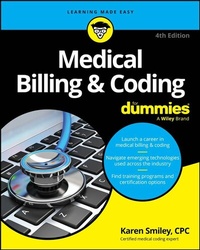
Medical Billing & Coding For Dummies
Description

The essential guide for medical billing professionals, updated for ICD-11 standards
Medical Billing & Coding For Dummies will set you up for success in getting started as a medical biller and coder. To ensure data accuracy and efficient data processing, medical offices need professionally trained coders to handle records. This book provides prospective allied health professionals with everything they need to know to get started in medical billing and coding as a career. In addition to an introduction to the basics of medical coding, you'll get information on how to find a training course, meet certification requirements, and deal with government agencies and insurance companies. Learn about the standard practices in the medical billing industry and get up to speed on the ethical and legal issues you're likely to face on the job. This accessible guide is a great entry point-and a great refresher-for anyone interested in the medical billing and coding profession.
- Get a primer on your career options in the field of medical billing
- Learn coding practices for telehealth, viral outbreaks, and other emerging issues
- Update your knowledge of the changes between ICD-10 and ICD-11 coding systems
- Find training programs and explore your options for certification
This Dummies guide is an accessible entry point for prospective professionals looking get a jump on their new career, and current professionals intent on staying up-to-date in this flexible and growing field.
More details
Other editions
Additional editions
Person
Karen Smiley, CPC, is a certified coding expert in physician and out-patient reimbursement with an extensive background as a coder, auditor, and accounts receivable manager.
Content
Introduction 1
Part 1 Getting to Know Medical Billing and Coding 5
Chapter 1 Dipping Your Toes into Medical Billing and Coding 7
Chapter 2 Exploring the Billing and Coding Professions 17
Chapter 3 Weighing Your Employment Options 31
Part 2 Boning Up on the Need-to-Knows of Your Profession 43
Chapter 4 Compliance Understanding the Rules 45
Chapter 5 Not-So-Strange Bedfellows Medical Terminology and Medical Necessity 61
Chapter 6 Getting to Know the Payers 87
Part 3 Becoming a Professional Getting Certified 105
Chapter 7 Your Basic Certification Options, Courtesy of the AAPC and AHIMA 107
Chapter 8 The Path to Certification Finding a Study Program 121
Chapter 9 Signing Up and Preparing for the Certification Exam 141
Chapter 10 Adding Street Cred Specialty Certifications and Continuing Ed 161
Part 4 Dealing and Succeeding with Nitty-Gritty On-the-Job Details 173
Chapter 11 Processing a Run-of-the-Mill Claim An Overview 175
Chapter 12 Homing In on How to Prepare an Error-Free Claim 193
Chapter 13 From Clearinghouse to Accounts Receivable to Money in the Pocket 211
Chapter 14 Handling Disputes and Appeals 223
Chapter 15 Keeping Up with the Rest of the World 245
Part 5 Working with Stakeholders 253
Chapter 16 Dealing with Commercial Insurance Claims 255
Chapter 17 Caring about Medicare and Medicaid 267
Chapter 18 Coding Ethics Being an Advocate for Your Employer 281
Part 6 The Part of Tens 297
Chapter 19 Ten Billing and Coding Mistakes and How to Avoid Them 299
Chapter 20 Ten Acronyms to Burn into Your Brain 305
Chapter 21 Ten (Plus One) Tips from Billing and Coding Pros 311
Glossary 317
Index 325
Chapter 1
Dipping Your Toes into Medical Billing and Coding
IN THIS CHAPTER
Getting to know the industry
Deciding whether the job is right for you
Choosing a certification
Planning your education
Welcome to the world of medical billing and coding! No other job in the medical field affects more lives than this one because everyone involved in the healthcare experience, from the patient and front office staff to providers and payers, relies on you. You are, so to speak, the touchstone in the medical industry.
A lot rests on your shoulders as the biller and coder. With this responsibility comes great power, and that power must be treated with respect and integrity. In this chapter, I take you on a very brief tour of what medical billing and coding entails. I hope you find, as I have, that working as a medical biller/coder is a challenging and rewarding job that helps you to fulfill your dreams as you become an integral cog of the medical industry.
Coding versus Billing: They Really Are Two Jobs
Although many people refer to billing and coding as if it were one job function (a convention I use in this book unless I'm referring to career-specific functions), billing and coding really are two distinct careers. In the following sections, I briefly describe the tasks and functions associated with each job and give you some things to think about to determine which path you want to pursue:
- The medical coder deciphers the documentation of a patient's interaction with a healthcare provider (physician, surgeon, nursing staff, and so on) and determines the appropriate procedure (CPT) and diagnosis code(s) (ICD) to reflect the services provided.
- The medical biller then takes the assigned codes and any required insurance information, enters them into the billing software, and then submits the claim to the payer (often an insurance company) to be paid. The biller also follows up on the claim as necessary.
- Both medical billers and coders are responsible for a variety of tasks, and they're in constant interaction with a variety of people (you can read about the various stakeholders in Part 5). Consider these examples:
- Because they're responsible for billing insurance companies and patients correctly, medical billers have daily interaction with both patients and insurance companies to ensure that claims are paid correctly and in a reasonable time.
- To ensure coding accuracy, coders often find themselves querying physicians regarding any questions they may have about the procedures that were performed during the patient encounter and educating other office staff on gathering required information.
- Billers (but sometimes coders, too) have the responsibility for explaining charges to patients, particularly when patients need help understanding their payment obligations, such as coinsurance and copayments, that their insurance policies specify.
- When submitting claims to the insurance company, billers are responsible for verifying the correct billing format, ensuring the correct modifiers have been appended, and submitting all required documentation with each claim.
In short, medical billers and coders together collect information and documentation, code claims accurately so that physicians get paid in a timely manner, and follow up with payers to make sure that the money finds its way to the provider's bank account. Both jobs are crucial to the office cash flow of any healthcare provider, and they may be done by two separate people or by one individual, depending upon the size of the office.
For the complete lowdown on exactly what billers and coders do, check out Chapter 2 for general information and Part 4, which provides detailed information on claims processing.
Following a Day in the Life of a Claim
When you're not interfacing with the three Ps - patients, providers, and payers - you'll be doing the meat and potatoes work of your day: coding medical records to start the process of converting provider-performed services into revenue.
Claims processing refers to the overall work of submitting and following up on claims. Here in a nutshell is the general process of claims submission, which begins almost as soon as the patient enters the provider's office:
-
The patient hands over their insurance card and fills out a demographic form at the time of arrival.
The demographic form includes information such as the patient's name, date of birth, address, Social Security or driver's license number, the name of the policyholder, and any additional information about the policyholder if the policyholder is someone other than the patient. At this time, the patient also presents a government-issued photo ID so that you can verify that they are actually the insured member.
Using someone else's insurance coverage is fraud. So is submitting a claim that intentionally misrepresents an encounter in order to obtain payment. All providers are responsible for verifying patient identity, and they can be held liable for fraud committed in their offices.
- After the initial paperwork is complete, the patient encounter with the service provider or physician occurs, followed by the provider documenting the services.
- The coder abstracts the billable codes, based on the physician documentation.
-
The coding goes to the biller who enters the information into the appropriate claim form in the billing software.
After the biller enters the coding information into the software, the software sends the claim either directly to the payer or to a clearinghouse, a company that sends the claim to the appropriate payer on the provider's behalf for reimbursement.
If everything goes according to plan, and all the moving parts of the billing and coding process work as they should, your claim gets paid and no follow-up is necessary. For a detailed discussion of the claims process from beginning to end, check out Chapters 11, 12, and 13.
Of course, things may not go as planned, and the claim may get hung up somewhere - often for missing or incomplete information - or it may be denied. If either of these happens, the biller/coder must follow up to discover the problem and then resolve it. Chapter 14 has all the details you need about this part of your job.
Keeping Abreast of What Every Coder Needs to Know
If you're going to work in the medical billing and coding industry, you must familiarize yourself with three big must-know items: compliance (following laws established by federal or state governments and regulations established by the Department of Health and Human Services or HHS, or other designated agencies), medical terminology (the language healthcare providers use to describe the diagnosis and treatment they provide), and medical necessity (the diagnosis that makes the provided service necessary). In the following sections, I introduce you to these concepts. For more information, head to Part 2.
Complying with federal and state regulations
In the United States, as in many countries, healthcare is a regulated industry and you have to follow certain guidelines. In the United States, these rules are enforced by the Office of Inspector General (OIG). The regulations are designed to prevent fraud, waste, and abuse by healthcare providers, and as a medical biller or coder, you must familiarize yourself with the basics of compliance.
Being in compliance basically means an office or individual has established a program to run the practice under the regulations as set forth by federal or state governments and the department of HHS or other designated agencies.
You can thank something called HIPAA for setting the bar for compliance. The standard of securing the confidentiality of healthcare information was established by the enactment of the Health Insurance Portability and Accountability Act (HIPAA). This legislation guarantees certain rights to individuals with regard to their healthcare. Check out Chapter 4 for more info on compliance, HIPAA, and the OIG.
Learning the lingo: Medical terminology
Everyone knows that doctors speak a different language. Turns out that that language is often based on Latin or Greek. By putting together a variety of Latin and Greek prefixes and suffixes, physicians and other healthcare providers can describe any number of illnesses, injuries, conditions, and procedures.
As a coder, you need to become familiar with these prefixes and suffixes so that you can figure out precisely what procedure codes to use. By mastering the meaning of each segment of a medical term, you'll be able to quickly make sense of the terminology that you use every day.
You can read about the most common medical prefixes and suffixes in Chapter 5.
Demonstrating medical necessity
Before a payer (such as an insurance company) will reimburse the provider, the provider must show that rendering the services was necessary. Setting a broken leg is necessary, for example, only when the leg is broken. Similarly, prenatal treatment and newborn delivery is necessary only when the patient is pregnant.
To demonstrate medical necessity, the coder must make sure that the diagnosis code supports the treatment given. Therefore, you must be familiar with...
