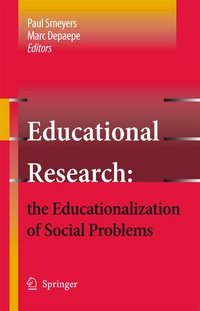
Educational Research: the Educationalization of Social Problems
Description

Pushing 'social' responsibilities on schools is a process that has been underway for a long time. This phenomenon has been studied more in Europe than in North America and the U.K. and has been labelled Pädagogisierung. The editors have chosen to use 'Educationalization' to identify the overall orientation or trend toward thinking about education as the focal point for addressing or solving larger human problems. The term describes these phenomena as a sub-process of the 'modernization' of society, but it also has negative connotations, such as increased dependence, patronization, and pampering. In this book distinguished philosophers and historians of education focus on 'educationalization' to expand its meaning through an engagement with educational theory. Topics discussed are the family and the child, the 'learning society', citizenship education, widening participation in higher education, progressive education, and schooling movements such as No Child Left Behind.
'Smeyers' and Depaepe's book offers great insights into one of the most ambivalent phenomena of today's educational world and especially educational policy. The contributions assembled represent perspectives of some of the most respected scholars in the field. Their manifold critiques of the educationalization of social problems are rather convincing. Our time is definitely ripe for such analysis!'
Roland Reichenbach, Center for Educational Studies, University of Basel, Switzerland
'This is a challenging, critical and analytical treatment of the tendency of contemporary
administrations to overburden educational institutions with the expectation that they
will provide the solutions to an increasingly diverse range of social and economic
problems. It brings together the theoretical resources of a distinguished international
group of philosophers and historians of education and deserves the carefulattention of
educational policy makers, practitioners and researchers alike.'
David Bridges, Von Hügel Institute, St Edmund's College, Cambridge, England
This publication is realized by the Research Community (FWO-Vlaanderen / Research Foundation Flanders, Belgium) Philosophy and History of the Discipline of Education: Evaluation and Evolution of the Criteria for Educational Research. Also realized by the Research Community are Educational Research: Why 'What Works' Doesn't Work (2006) and Educational Research: Networks and Technologies (2007).
More details
Other editions
Additional editions