

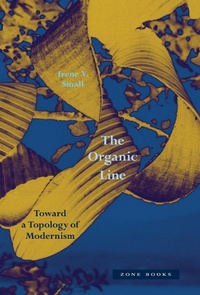
The Organic Line
Description

A major rethinking of twentieth-century abstract art mobilized by the work of Brazilian artist Lygia Clark What would it mean to treat an interval of space as a line, thus drawing an empty void into a constellation of art and meaning-laden things? In this book, Irene Small elucidates the signal discovery of the Brazilian artist Lygia Clark in 1954: a fissure of space between material elements that Clark called "the organic line." For much of the history of art, Clark's discovery, much like the organic line, has escaped legibility. Once recognized, however, the line has seismic repercussions for rethinking foundational concepts such as mark, limit, surface, and edge. A spatial cavity that binds discrepant entities together, the organic line transforms planes into flexible topologies, borders into membranes, and interstices into points of connection. As a paradigm, the organic line has profound historiographic implications as well, inviting us to set aside traditional notions of influence and origin in favor of what Small terms weak links and plagiotropic relations. These fragile, oblique, and transversal ties have their own efficacy, and Small's innovative readings of canonical modernist works such as Kazimir Malevich's Black Square, John Cage's 4'33", and Le Corbusier's machine-à-habiter, as well as contemporary works by such artists as Adam Pendleton, Ricardo Basbaum, and Mika Rottenberg, reveal the organic line's remarkable potential as an analytic instrument. Mobilizing a rich repertoire of archival sources and moving across multiple chronologies, geographies, and disciplines, this book invites us to envision modernism not as a stable construct defined by centers and peripheries, inclusions and exclusions, but as a topological field of interactive, destabilizing tensions. More than a history of a little-known artistic device, The Organic Line: Toward a Topology of Modernism is a user's guide and manifesto for reimagining modern and contemporary art for the present.
More details
Other editions
Additional editions
Person
Content
- Cover
- Contents
- Introduction: On Weak Links and Plagiotropic Relations
- I. Circling the Square: Discovery against Invention
- II. Not/Making/Marks: On the Side of Composition
- III. Inhabiting Networks, Subjecting Space
- Coda: Of Mutant Coordinates and Living Things
- Acknowledgments
- Notes
- Index
- A
- B
- C
- D
- E
- F
- G
- H
- I
- J
- K
- L
- M
- N
- O
- P
- Q
- R
- S
- T
- U
- V
- W
- Z
