

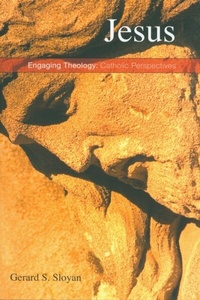
Jesus
Description

This book means to explore who Jesus was, is, and is to come, and by what series of events this man of Jewish history came to be viewed by millions as a man of God-like powers in their present lives and their hoped for future." Rich in familiarity with Jesus' Jewish world, Gerard Sloyan helps us discover a Jesus thoroughly situated in his own time and place. Grounded in the New Testament gospels, Sloyan's study leads us to an already interpreted Jesus, distinctly portrayed by each evangelist. Going outside the New Testament, Sloyan takes us into the theological questions and developments that culminated in the affirmations of the councils of Nicaea and Chalcedon. This impressive, clearly written work challenges readers to see both the historical Jesus who preached the in-breaking of God's reign and the post-resurrection Jesus whom Christians named Lord and Savior.
Gerard S. Sloyan, STD, PhD, is professor emeritus of religion at Temple University and currently visiting professor at Georgetown University, Washington, DC. He has written extensively on Jesus, including The Crucifixion of Jesus (Fortress Press, 1995) and Why Jesus Died (Fortress Press, 2004).
More details
Other editions
Additional editions
Person
Content
- Intro
- Title Page
- Copyright
- Contents
- Editor's Preface
- Author's Preface
- Chapter One: Who Jesus Was in the Religion of Israel
- The Actual or Real Jesus
- Being Raised Up from the Dead to a New Life-Fact or Fancy?
- Witnesses to the Movement Rather Than to the Man
- The Little Known of Jesus' Infancy and Early Years
- Jesus Grown to Adulthood
- Jesus as Teacher: Debates over Law Observance
- The Distinctive Purpose of Each Evangelist
- The Story of Israel Without Which Jesus Cannot Be Understood
- Kings and Kingdoms
- The Influence of the Babylonian Exile and Hellenism
- Jesus the Quintessential Jew
- The Chronicle Continued: The Markan Story
- Chapter Two: The First We Hear of Jesus in History's Record
- The Biblical Title Messiah (Christos), Anointed One
- Kyrios as Sovereign Lord or Master
- Jesus' Coming (Parousia) at the End in Glory
- Saul/Paul's Faith in Jesus Found in Other Letters
- The Silence of Paul's Extant Letters on Jesus' Public Life
- Jesus in Paul's Corinthian Correspondence
- The Jesus of the Epistolary Corpus
- Signs of Jesus' Jewishness Wrongly Imposed on Gentiles
- Jesus in the Last Written Extant Letter of Saul/Paul
- A Pauline Letter That Paul Did Not Write
- Jesus in Hebrews and Revelation
- Chapter Three: Knowing Jesus from What He Taught
- Jesus' Many Teachings in Matthew
- The Beatitudes and the Woes
- The Our Father
- The Devil in the Desert
- Recorded Prayers from Jesus' Lips
- The Lengthy Prayer Spoken at the Last Supper
- Jesus' Descent from a Long Line of Storytellers
- More of Jesus' Teaching in Matthew
- Some Further Matthew Parables Explored
- Luke's Teachings of Jesus Special to Him
- Prodigality Can Mean Generous Giving but Not Here
- Jesus as Exorcist and Wonderworker
- A Brief Foretelling of Jesus' Life, Death, and Resurrection as Bringing Redemption
- Chapter Four: What John Does with the Figure of Jesus
- John's Technique of Having Jesus Mystify, Then Explain
- The Last Supper Discourse
- Chapter Five: Jesus' Death and Resurrection
- The Markan Passion Narrative as Basic to Matthew and Luke
- The Roman Legionaries and the Pilate Characterization
- Some Touches Proper to Luke and John
- The Crucifixion Proper
- All Other References to Jesus' Death Unlike These Playbooks
- The Resurrection of Jesus that Changed Everything
- Three Non-Markan Ways of Bringing the Story to an End
- Chapter Six: Jesus in Late New Testament Epistles and Second-Century Writings
- Jesus in the Didache
- The Letters of the Great Ignatius, Martyr
- Jesus in the Second-Century Apologists
- Jesus in the Lengthy Treatise of a Missionary Bishop
- Late Apocryphal Gospels, Some Orthodox, Some Gnostic in Intent
- Chapter Seven: Jesus at the Center of Doctrinal-Political Argument
- The Vocabulary of Debate and Its Major Topic
- The Heretical Teaching of Arius
- Basil's Defense of the Holy Spirit as a Divine Person
- The Christological Teaching that Prevailed After Nicaea
- Nestorius's Defense of the Humanity of Christ
- Eutyches and the Chalcedonian Settlement
- Epilogue
- Further Reading
- Index of Scripture and Ancient Texts
- Index of Subjects and Persons
