

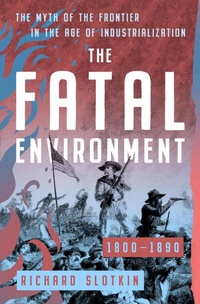
The Fatal Environment
The Myth of the Frontier in the Age of Industrialization, 1800-1890
Published on 23. January 2024
632 pages
978-1-5040-9036-0 (ISBN)
Description

A two-time National Book Award finalist's "ambitious and provocative" look at Custer's Last Stand, capitalism, and the rise of the cowboys-and-Indians legend (
The New York Review of Books).
In The Fatal Environment, historian Richard Slotkin demonstrates how the myth of frontier expansion and subjugation of Native Americans helped justify the course of America's rise to wealth and power. Using Custer's Last Stand as a metaphor for what Americans feared might happen if the frontier should be closed and the "savage" element be permitted to dominate the "civilized," Slotkin shows the emergence by 1890 of a mythos redefined to help Americans respond to the confusion and strife of industrialization and imperial expansion.
"A clearly written, challenging and provocative work that should prove enormously valuable to serious students of American history." - The New York Times
"[An] arresting hypothesis." -Henry Nash Smith, American Historical Review
In The Fatal Environment, historian Richard Slotkin demonstrates how the myth of frontier expansion and subjugation of Native Americans helped justify the course of America's rise to wealth and power. Using Custer's Last Stand as a metaphor for what Americans feared might happen if the frontier should be closed and the "savage" element be permitted to dominate the "civilized," Slotkin shows the emergence by 1890 of a mythos redefined to help Americans respond to the confusion and strife of industrialization and imperial expansion.
"A clearly written, challenging and provocative work that should prove enormously valuable to serious students of American history." - The New York Times
"[An] arresting hypothesis." -Henry Nash Smith, American Historical Review
More details
Person
Richard Slotkin, widely regarded as one of America's leading cultural critics, is a two-time finalist for the National Book Award. In addition to his prize-winning trilogy on the myth of the frontier in America, Slotkin is the author of
Lost Battalions, a New York Times Notable Book, and
A Great Disorder, as well as three historical novels, including
The Return of Henry Starr¿. He is the Olin Professor of English and American Studies,Emeritus, at Wesleyan University.
Content
- Intro
- Title Page
- Contents
- Introduction to the Wesleyan Paperback Edition
- Part I: Myth Is the Language of Historical Memory
- Chapter 1: Exposition: The Frontier as Myth and Ideology
- Chapter 2: Myth and Historical Memory
- Myth and Ideology
- Whose Myth Is It?
- Chapter 3: The Frontier Myth as a Theory of Development
- Part II: The Language of the Frontier Myth
- Chapter 4: Regeneration Through Violence: History as an Indian War, 1675-1820
- The Wars of Dispossession
- Captive and Hunter
- The Myth and Ideology of Agrarianism
- Natural Aristocracy and the Cult of Washington
- The Dangerous Frontiersman and the Guilt of Dispossession
- Chapter 5: Ideology and Fiction: The Role of Cooper
- The Choice of Genre
- The Leatherstocking Myth
- The Cooperian Code: Race, Sex, and Class
- Part III: Metropolis vs. Frontier
- Chapter 6: The Backwash of a Closing Frontier: Industrialization and the Hiatus of Expansion, 1820-1845
- Facing the Desert: The Problem of Leadership in Irving's West
- Frontier Presidents: Transformation of the Soldier Aristocrat
- Transformation of the Hunter: Jacksonian Outlaws
- Chapter 7: Utopia/Dystopia: Plantation, Factory, and City, 1820-1845
- The Plantation as Utopia
- The Factory as Plantation
- Dystopia: The Last Days of Sodom
- Part IV: Myth of a New Frontier: Renewal and Breakdown, 1845-1850
- Chapter 8: A Choice of Frontiers: Texas, Mexico, and the Far West, 1835-1850
- Houston, Crockett, and the Return of the Frontiersman
- The Conquest of Mexico: Hunters or Conquistadores?
- Chapter 9: The Myth That Wasn't: Literary Responses to the Mexican War, 1847-1850
- Dime Novels and Romances
- Frémont and Carson: Heyward and Hawkeye in California
- Part V: The Railroad Frontier, 1850-1860
- Chapter 10: Prophecy of the Iron Horse
- Chapter 11: The Ideology of Race Conflict, 1848-1858
- Chapter 12: The Inversion of the Frontier Hero: William Walker and John Brown, 1855-1860
- William Walker: The American as Conquistador
- John Brown: Hawkeye as Revolutionary
- Part VI: Toward the Last Frontier, 1860-1876
- Chapter 13: Regimentation and Reconstruction: The Emergence of a Managerial Ideology, 1860-1873
- The Manager as Soldier-Aristocrat
- Chapter 14: The Reconstruction of Class and Racial Symbolism, 1865-1876
- The New Paternalism
- Paupers, Proletarians, and Indians
- The "Peace Policy" in Practice, 1869-1875
- Chapter 15: The New El Dorado, 1874
- Newspapers as Mythmakers
- The "Red Spectre of the Commune"
- Looking for Paradise: The Frontier as Escape
- Paradise Discovered
- Philanthropy, Effeminacy, and Corporate Paternalism
- Paradise Postponed
- Part VII: The Boy General, 1839-1876
- Chapter 16: West Point, Wall Street, and the Wild West, 1839-1868
- Chapter 17: The Boy General Returns
- or, Custer's Revenge, 1868-1876
- Part VIII: The Last Stand as Ideological Object, 1876-1890
- Chapter 18: To the Last Man: Assembling the Last Stand Myth, 1876
- The Making of an Ideological Object: Aims and Anticipations
- The Centennial War
- Seizing the Occasion
- The Great Antagonist: Sitting Bull as Metaphor
- "Sioux Civilization" in South Carolina, Myth, Anti-Myth, and No-Myth-at-All
- Chapter 19: The Indian War Comes Home: The Great Strike of 1877
- Strikers as Savages
- The Myth-Ideology of a Progressive Ruling Class: The Nation in 1876-1877
- Chapter 20: Morgan's Last Stand: Literary Mythology and the Specter of Revolution, 1876-1890
- The Boy Hero: Custer, Ragged Dick, and Tom Sawyer
- From the Black Hills to "Buffland": John Hay's The Breadwinners
- Mythological Self-Criticism: Mark Twain's Frontier
- The Spirit of Massacre and the Instinct of Progress
- Conclusion and Prologue: The Turn of the Century
- Notes
- Bibliography
- Acknowledgments
- About the Author
- Copyright
