

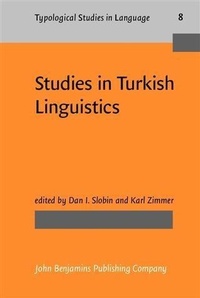
Studies in Turkish Linguistics
1st Edition
Published on 1. January 1986
VI, 294 pages
978-90-272-7916-3 (ISBN)
Description

Turkish is a member of the Turkic family of languages, which extends over a vast area in southern and eastern Siberia and adjacent portions of Iran, Afganistan, and China. Turkic, in turn, belongs to the Altaic family of languages. This book deals with the morphological and syntactic, semantic and discourse-based, synchronic and diachronic aspects of the Turkish language. Although an interest in morphosyntactic issues pervades the entire collection, the contributions can be grouped in terms of relative attention to syntax, semantics and discourse, and acquisition.
More details
Other editions
Additional editions
Dan I. Slobin | Karl Zimmer
Studies in Turkish Linguistics
Book
01/1986
John Benjamins Publishing Co
€132.50
Shipment within 10-15 days
Content
- STUDIES IN TURKISH LINGUISTICS
- Editorial page
- Title page
- Copyright page
- Table of contents
- INTRODUCTION
- THE TURKISH LANGUAGE
- ORGANIZATION OF THE BOOK
- Syntax
- Semantics and discourse
- Acquisition
- Acknowledgements
- REFERENCES
- TURKISH
- 1. History and Classification
- 2. Phonology and Orthography
- 2.1 Vowels
- 2.2 Consonants
- 2.3 Stress
- 3. Morphophonemics
- 3.1 Vowel Harmony
- 3.2 Other Morphophonemic Processes
- 4. Morphology
- 5. Syntax
- 6. Sources
- NOTES
- BIBLIOGRAPHY OF MODERN LINGUISTIC WORK ON TURKISH
- BIBLIOGRAPHY
- ABBREVIATIONS
- IMPERSONALPASSIVES AND THE -ArAk CONSTRUCTION IN TURKISH
- 0. Introduction
- 1. Background
- 1.1 The Two Proposals
- 1.2 The Unaccusative Hypothesis
- 1.3 Ungrammatical Impersonal Passives
- 1.4 Conclusions about Turkish Impersonal Passives
- 2. The -ArAk Construction
- 2.1 The Unaccusative Hypothesis and the -ArAk Construction
- 2.2 Impersonal Passives in -ArAk Constructions
- 2.3 A Further Problem
- 3. The Nature of the Turkish Impersonal Passive
- 3.1 A Proposal for Passives with Non-specific initial Subjects
- 3.2 The Nature of Passive II
- 3.3 The Effect on Grammatical Relations of the Passive II Rule
- 4. Conclusions
- NOTES
- REFERENCES
- MONOCLAUSAL DOUBLEPASSIVES IN TURKISH
- 1. Introduction
- 2. Alternative Analysis
- 3. Three Pieces of Evidence Consistent With (10)
- 4. Relativization
- 5. Conclusion
- NOTES
- REFERENCES
- LEXICAL CAUSATIVES IN TURKISH
- 1. Causative Formation
- 1.1 The Rule in Relational Grammar
- 1.2 The Lexical Rule
- 2. Lexical versus Syntactic Causative Formation: Tied Scores
- 2.1 Missing Subjects
- 2.2 Rule Interactions
- 2.2.1 Causative Formation and Object Incorporation
- 2.2.2 Causative Formation and Subject Incorporation
- 3. The Superiority of the Lexical Account
- 3.1 Causative Formation and Passive
- 3.2 Causative Formation and Benefactive Advancement
- 4. Challenges for the Lexical Account
- 4.1 Benefactive Advancement
- 4.2 Direct Object Retreat
- 4.3 Control Rules
- 5. Conclusion
- REFERENCES
- NOTES
- THE UNMARKED SENTENTIAL SUBJECT CONSTRAINTIN TURKISH
- 0. Introduction
- 1. The Infinitive Sentential Subjects
- 2. Relativization out of Relative Clauses
- 2.1 A Syntactic Constraint
- 2.2 The Unmarked Sentential Subject Constraint
- 2.3 The Impersonal Passives
- 2.4 Subject Incorporation
- NOTES
- REFERENCES
- HABITS AND ABILITIES IN TURKISH
- NOTES
- REFERENCES
- DEFINITENESSAND REFERENTIALITY IN TURKISH VERBAL SENTENCES
- 1. Introduction
- 2. Strategies
- 2.1 Deictic Terms and Possessives
- 2.2 Word Order
- 2.3 Stress
- 2.4 Modality
- 2.5 Accusative Case Ending
- 3. Conclusion
- NOTES
- REFERENCES
- DEFINITENESSAND REFERENTIALITYIN TURKISH NONVERBALSENTENCES
- 1. Introduction
- 2. Subject Noun Phrases
- 3. Predicate Noun Phrases
- 4. Concealed Existentials
- 5. Conclusion
- NOTES
- REFERENCES
- TOPICSWITCHING AND PRONOMINAL SUBJECTS IN TURKISH
- 1. Introduction
- 2. Null Subjects and Pronominal Subjects in Turkish
- 3. Topic Change and Pronominal Subjects
- 4. Topic of Discourse
- 5. Topics as Propositions
- 6. Empathy and Topic
- 7. Other Topic Shift Devices
- 8. Turkish Pronouns and Contrast
- NOTES
- REFERENCES
- PRONOMINAL VERSUSZERO REPRESENTATION OF ANAPHORA IN TURKISH
- 0. Introduction
- 1. The Pronoun System and Agreement in Turkish
- 2. Pronominal and Zero Representation of Anaphora
- 2.1 Zero Anaphora
- 2.2 Pronominal Anaphora
- 2.3 Free Variation of Pronominal and Zero Anaphora
- 3. The Role of Discourse Context
- 4. Some Concluding Remarks
- NOTES
- REFERENCES
- SEMANTIC EFFECTS OF WORD ORDER IN COMPLEX SENTENCES
- Cognitive Verbs and Interrogatives
- Conclusion
- NOTES
- REFERENCES
- THE ACQUISITION OF PAST REFERENCE IN TURKISH
- 1. Introduction
- 2. Tense, Aspect, and Mood Markers for Past Reference in Turkish
- 3. Analysis of the Data4
- 4. Conclusions
- NOTES
- Acknowledgments:
- REFERENCES
- THE SIGNIFICANCE OF WORD ORDER IN THE ACQUISITIONOF TURKISH
- Word Order Restrictions Governed by Grammatical RelationsAdjectives and adverbs.
- Noun Phrases
- Question Words and Markers
- Variation of Word Order to Code Pragmatic Distinctions
- REFERENCES
- THE ACQUISITION AND USE OF RELATIVE CLAUSES IN TURKIC AND INDO-EUROPEAN LANGUAGES
- Isolability of Clauses
- Participial Forms
- NOTES
- REFERENCES
- NAME INDEX
- SUBJECT INDEX
