

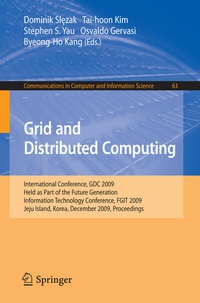
Grid and Distributed Computing
International Conference, GDC 2009, Held as Part of the Future Generation Information Technology Conferences, FGIT 2009, Jeju Island, Korea, December 10-12, 2009, Proceedings
1st Edition
Published on 10. May 2010
XIII, 229 pages
978-3-642-10549-4 (ISBN)
Description

As future generation information technology (FGIT) becomes specialized and fr- mented, it is easy to lose sight that many topics in FGIT have common threads and, because of this, advances in one discipline may be transmitted to others. Presentation of recent results obtained in different disciplines encourages this interchange for the advancement of FGIT as a whole. Of particular interest are hybrid solutions that c- bine ideas taken from multiple disciplines in order to achieve something more signi- cant than the sum of the individual parts. Through such hybrid philosophy, a new principle can be discovered, which has the propensity to propagate throughout mul- faceted disciplines. FGIT 2009 was the first mega-conference that attempted to follow the above idea of hybridization in FGIT in a form of multiple events related to particular disciplines of IT, conducted by separate scientific committees, but coordinated in order to expose the most important contributions. It included the following international conferences: Advanced Software Engineering and Its Applications (ASEA), Bio-Science and Bio-Technology (BSBT), Control and Automation (CA), Database Theory and Application (DTA), D- aster Recovery and Business Continuity (DRBC; published independently), Future G- eration Communication and Networking (FGCN) that was combined with Advanced Communication and Networking (ACN), Grid and Distributed Computing (GDC), M- timedia, Computer Graphics and Broadcasting (MulGraB), Security Technology (SecTech), Signal Processing, Image Processing and Pattern Recognition (SIP), and- and e-Service, Science and Technology (UNESST).
More details
Other editions
Additional editions
Dominik Slezak | Tai-hoon Kim | Stephen S.T. Yau
Grid and Distributed Computing
International Conference, GDC 2009, Held as Part of the Future Generation Information Technology Conferences, FGIT 2009, Jeju Island, Korea, December 10-12, 2009, Proceedings
Book
11/2009
Springer
€53.49
Shipment within 7-9 days
Content
Autonomic Management of Object Replication for FT-CORBA Based Intelligent Transportation Systems.- Meshlization of Irregular Grid Resource Topologies by Heuristic Square-Packing Methods.- An Architecture and Supporting Environment of Service-Oriented Computing Based-On Context Awareness.- Relaxed Time Slot Negotiation for Grid Resource Allocation.- A Brokering Protocol for Agent-Based Grid Resource Discovery.- Towards a Better Understanding of Locality-Awareness in Peer-to-Peer Systems.- Default ?-Logic for Modeling Customizable Failure Semantics in Workflow Systems Using Dynamic Reconfiguration Constraints.- A Back Propagation Neural Network for Evaluating Collaborative Performance in Cloud Computing.- SCAIMO - A Case for Enabling Security in Semantic Web Service Composition.- Automatic Synthesis and Deployment of Intensional Kahn Process Networks.- Extended Heartbeat Mechanism for Fault Detection Service Methodology.- Trust-Oriented Multi-objective Workflow Scheduling in Grids.- Empirical Comparison of Race Detection Tools for OpenMP Programs.- Efficient Service Recommendation System for Cloud Computing Market.- Scalable Cooperative Positioning System in Wireless Sensor Networks.- One-to-One Embedding between Hyper Petersen and Petersen-Torus Networks.- A Dynamic Mobile Grid System for 4G Networks.- Authorization Framework for Resource Sharing in Grid Environments.- Design and Implementation of a SOA-Based Medical Grid Platform.- RFID-Based Onion Skin Location Estimation Technique in Indoor Environment.- Harmonized Media Service Middleware Using to Emotional Knowledge.- A Trust Evaluation Model for Cloud Computing.- Multiple Reduced Hypercube MRH(n): A New Interconnection Network Reducing Both Diameter and Edge of Hypercube.- Embedding Algorithm between MRH(n) andHypercube.- Fuzzy Based Approach for Load Balanced Distributing Database on Sensor Network.- An Ontology-Based Resource Selection Service on Science Cloud.
"A Dynamic Mobile Grid System for 4G Networks (p. 140-141)
Abstract. Future networks specially International Mobile Telecommunications- advanced, better known as 4G, will come up with a panoply of services so as to provide a comprehensive and secure IP-based solution where facilities such as voice, data and stremed multimedia will be provided to users anywhere at anytime.
This solution will also provide much higher data rates compared to previous generations. More importantly, the 4G architecture will strongly promote ubiquitous computing, which involves many computational devices and systems simultaneously. Such devices and systems can even be unaware that they are contributing to computational process. Grid systems have been known in traditional networks as an e?cient solution to provide distributed services.
However, their applicability to 4G networks is not straightforward because of the intrinsic features of serveral network categories. In this paper, we propose a new Grid architecture suitable with the characteristics of 4G networks. A particular emphasis will be put on the provision of ubiquitous computational services in and across ad hoc environments. We de?ne a new relational model enabling Grid service composing.
1 Introduction
Mobile networks are witnessing a prominent development. They are changing from being simple access means to value added service providers. In fact, considering the growing mobile population and the induced raw and unexploited resources, important applications and services could be de?ned based on the infrastructure provided by mobile networks. The advent of 4G networks will probably promote the development of more sophisticated services.
The architecture of these networks, mainly their cooperative nature, will allow the implementation of ubiquitous computational frameworks. In fact, 4G networks build bridges between traditionally heterogeneous networks (e.g., WLAN, UMTS, WSN) in a manner that the shortcuts of a network are overcame by the strengthes of other networks.
For instance, the short range characterizing ad hoc networks can be extended using mobile backbones (possibly constituted by cellular segments). This allows taking bene?t of the high transmission rates available through ad hoc networks over long ranges. Grid [1] is a distributed system composed of various, heterogeneous, autonomous and distributed resources such as processes, computing applications,"
Abstract. Future networks specially International Mobile Telecommunications- advanced, better known as 4G, will come up with a panoply of services so as to provide a comprehensive and secure IP-based solution where facilities such as voice, data and stremed multimedia will be provided to users anywhere at anytime.
This solution will also provide much higher data rates compared to previous generations. More importantly, the 4G architecture will strongly promote ubiquitous computing, which involves many computational devices and systems simultaneously. Such devices and systems can even be unaware that they are contributing to computational process. Grid systems have been known in traditional networks as an e?cient solution to provide distributed services.
However, their applicability to 4G networks is not straightforward because of the intrinsic features of serveral network categories. In this paper, we propose a new Grid architecture suitable with the characteristics of 4G networks. A particular emphasis will be put on the provision of ubiquitous computational services in and across ad hoc environments. We de?ne a new relational model enabling Grid service composing.
1 Introduction
Mobile networks are witnessing a prominent development. They are changing from being simple access means to value added service providers. In fact, considering the growing mobile population and the induced raw and unexploited resources, important applications and services could be de?ned based on the infrastructure provided by mobile networks. The advent of 4G networks will probably promote the development of more sophisticated services.
The architecture of these networks, mainly their cooperative nature, will allow the implementation of ubiquitous computational frameworks. In fact, 4G networks build bridges between traditionally heterogeneous networks (e.g., WLAN, UMTS, WSN) in a manner that the shortcuts of a network are overcame by the strengthes of other networks.
For instance, the short range characterizing ad hoc networks can be extended using mobile backbones (possibly constituted by cellular segments). This allows taking bene?t of the high transmission rates available through ad hoc networks over long ranges. Grid [1] is a distributed system composed of various, heterogeneous, autonomous and distributed resources such as processes, computing applications,"
