

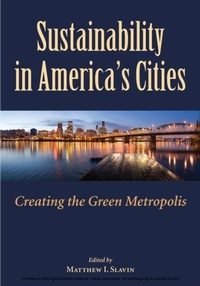
Sustainability in America's Cities
Description

"Sustainability" is more than the latest "green" buzzword. It represents a new way of viewing the interactions of human society and the natural world. Sustainability in America's Cities highlights how America's largest cities are acting to develop sustainable solutions to conflicts between development and environment. As sustainability rises to the top of public policy agendas in American cities, it is also emerging as a new discipline in colleges and universities. Specifically designed for these educational programs, this is the first book to provide empirically based, multi-disciplinary case studies of sustainability policy, planning, and practice in action. It is also valuable for everyone who designs and implements sustainability initiatives, including policy makers, public sector and non-profit practitioners, and consultants. Sustainability in America's Cities brings together academic and practicing professionals to offer firsthand insight into innovative strategies that cities have adopted in renewable energy and energy efficiency, climate change, green building, clean-tech and green jobs, transportation and infrastructure, urban forestry and sustainable food production. Case studies examine sustainability initiatives in a wide range of American cities, including San Francisco, Honolulu, Philadelphia, Phoenix, Milwaukee, New York City, Portland, Oregon and Washington D.C. The concluding chapter ties together the empirical evidence and recounts lessons learned for sustainability planning and policy.
All prices
More details
Other editions
Additional editions
Person
Matthew Slavin is founder and principal of Sustaingrup, developing clean energy technologies and sustainable building and aligning business and government leadership, goals and strategy to create a more sustainable future. His publications on energy, climate change and sustainability have been featured in leading professional journals and metropolitan newspapers.
Content
Foreword by Kent Portney
Acknowledgments
Chapter 1. The Rise of the Urban Sustainability Movement in America
Matthew I. Slavin
Chapter 2. Strategic Climate Action Planning in Portland
Matthew I. Slavin and Kent Snyder
Chapter 3. Greening the Industrial District: Transforming Milwaukee's Menomonee Valley from a Blighted Brownfield into a Sustainable Place toWork and Play
Christopher De Sousa
Chapter 4. Phoenix, the Role of the University, and the Politics of Green-Tech
Jonathan Fink
Chapter 5. LEED in the Nation's Capitol: A Policy and Planning Perspective on Green Building in Washington, D.C.
Gerrit Knapp, Amy E. Gardner, Ralph Bennett, Madlen Simon, and Cari Varnier
Chapter 6. The Greening of Mobility in San Francisco
Aaron Golub and Jason Henderson
Chapter 7. Wind, Waves, and Watts: Creating a Clean Energy Future for Honolulu
Matthew I. Slavin, Douglas A. Codiga, and Jason J. Zeller
Chapter 8. Clean Waters, Clean City: Sustainable Storm Water Management in Philadelphia
Lynn Mandarano
Chapter 9. Toward a Sustainable New York City: Greening through Urban Forest Restoration
P. Timon McPhearson
Chapter 10. Greening the Food Supply in New York
Nevin Cohen and Jennifer Obadia
Chapter 11. Where Sustainability Stands Now: Contemporary Trends and Future Prospects
Matthew I. Slavin
References
Contributors
index

