

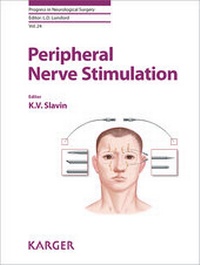
Peripheral Nerve Stimulation
Progress in Neurological Surgery 24
1st Edition
Published on 24. March 2011
224 pages
978-3-8055-9489-9 (ISBN)
Available for download
Description

In a rapidly growing field of neuromodulation against pain, this excellent publication presents a unique compilation of the latest theoretical and practical information for electrical stimulation of the peripheral nerves. Chapters cover the use of peripheral nerve stimulation in particular indications such as migraine, cluster headache, pain in Chiari malformation and fibromyalgia, as well as in specific body parts such as head and neck, trunk, and extremities. Furthermore, chapters on history, technical aspects, mechanism of action, terminology, complications and other important aspects of this pain-relieving modality give you a full overview of the field. Written by leading experts, this publication provides a comprehensive and updated summary of the currently available scientific information on peripheral nerve stimulation. All chapters contain original information making this book an invaluable reference for all who deal with the management of severe and chronic pain - including neurosurgeons and neurosurgical trainees, pain specialists and practitioners, anesthesiologists and neurologists.
More details
Other editions
Additional editions
Slavin
Peripheral Nerve Stimulation
Book
03/2011
1st Edition
S. Karger
€94.15
Article exhausted; check different version
Persons
Content
1 - Progress in Neurological Surgery [Seite 3]
2 - Contents [Seite 6]
3 - Series Editor's Note [Seite 8]
4 - Preface [Seite 10]
5 - Preface to the Third Edition [Seite 11]
6 - Preface to the Second Edition [Seite 12]
7 - History of Peripheral Nerve Stimulation [Seite 13]
7.1 - Abstract [Seite 13]
7.2 - Invention of PNS [Seite 14]
7.3 - PNS Progress: Early Years [Seite 16]
7.4 - PNS Progress: Maturation Stage [Seite 17]
7.5 - PNS Progress: Percutaneous Era [Seite 19]
7.6 - Percutaneous Nerve Stimulation [Seite 21]
7.7 - PNS Progress: Recent Advancements [Seite 21]
7.8 - Conclusion [Seite 22]
7.9 - References [Seite 23]
8 - Central Mechanisms of Peripheral NerveStimulation in Headache Disorders [Seite 28]
8.1 - Abstract [Seite 28]
8.2 - Gate Control Theory of Pain [Seite 29]
8.3 - References [Seite 35]
9 - Peripheral Nerve Stimulation for ChronicNeurogenic Pain [Seite 39]
9.1 - Abstract [Seite 39]
9.2 - Mechanism of Action [Seite 41]
9.3 - Indications and Patient Selection [Seite 42]
9.4 - Surgical Insertion Technique [Seite 43]
9.5 - Trial of Stimulation [Seite 47]
9.6 - Permanent Implantation [Seite 47]
9.7 - Results [Seite 47]
9.8 - Authors' Experience [Seite 47]
9.9 - Complications [Seite 50]
9.10 - Conclusion [Seite 50]
9.11 - References [Seite 51]
10 - Percutaneous Peripheral Nerve Stimulation [Seite 53]
10.1 - Abstract [Seite 53]
10.2 - Initial Surgical Electrode Placements [Seite 54]
10.3 - Peripheral Neurostimulation: Pertinent Anatomy and Physiology [Seite 55]
10.4 - Nerve Trunks [Seite 56]
10.5 - Fascicular Anatomy [Seite 56]
10.6 - Blood Supply of Peripheral Nerves [Seite 56]
10.7 - Percutaneous Surgical Techniques [Seite 57]
10.8 - Discussion and Conclusion [Seite 63]
10.9 - Illustrative Cases [Seite 64]
10.10 - References [Seite 66]
11 - Peripheral Nerve Stimulation for theTreatment of Truncal Pain [Seite 70]
11.1 - Abstract [Seite 70]
11.2 - Mechanism of Action [Seite 71]
11.3 - Patient Selection [Seite 72]
11.4 - Failed Back Surgery Syndrome [Seite 72]
11.5 - Postherpetic Neuralgia [Seite 74]
11.6 - Inguinal Neuropraxia [Seite 74]
11.7 - Post- Thoracotomy Pain [Seite 75]
11.8 - PNfS Technical Considerations [Seite 75]
11.9 - PNfS Programming [Seite 78]
11.10 - References [Seite 80]
12 - Peripheral Subcutaneous Stimulation forIntractable Abdominal Pain [Seite 82]
12.1 - Abstract [Seite 82]
12.2 - References [Seite 87]
13 - Subcutaneous Occipital Region Stimulationfor Intractable Headache Syndromes [Seite 89]
13.1 - Abstract [Seite 89]
13.2 - History [Seite 89]
13.3 - Initial Observations [Seite 90]
13.4 - Early ONS Experience [Seite 90]
13.5 - Indications [Seite 92]
13.6 - ONS Trial [Seite 93]
13.7 - Techniques [Seite 93]
13.8 - Halo PNS [Seite 94]
13.9 - Outcomes [Seite 94]
13.10 - Complications [Seite 96]
13.11 - The Future [Seite 96]
13.12 - References [Seite 97]
14 - Peripheral Nerve Stimulation for OccipitalNeuralgia: Surgical Leads [Seite 98]
14.1 - Abstract [Seite 98]
14.2 - Classification and Terminology [Seite 99]
14.3 - Mechanism of Action and History of PNS [Seite 99]
14.4 - Occipital Neuralgia [Seite 101]
14.5 - Indications and Technique for the Implantation of Paddle Leads [Seite 102]
14.6 - Clinical Outcomes and Peer- Reviewed Evidence [Seite 105]
14.7 - Complications [Seite 105]
14.8 - Conclusions [Seite 106]
14.9 - References [Seite 106]
15 - Occipital Nerve Stimulation: Technical andSurgical Aspects of Implantation [Seite 108]
15.1 - Abstract [Seite 108]
15.2 - Surgical Technique [Seite 109]
15.3 - Stimulation Trial [Seite 109]
15.4 - Permanent Implant [Seite 111]
15.5 - Occipital Nerve Stimulation Programming: Patterns and Parameters [Seite 114]
15.6 - Complication Avoidance [Seite 114]
15.7 - Use of Occipital Stimulation for Occipital Neuralgia [Seite 117]
15.8 - Future Directions [Seite 119]
15.9 - References [Seite 119]
16 - Peripheral Neuromodulation for MigraineHeadache [Seite 121]
16.1 - Abstract [Seite 121]
16.2 - Surgical Procedure [Seite 122]
16.3 - Mechanism of Action [Seite 124]
16.4 - Independent Clinical Trials [Seite 124]
16.5 - Industry-Sponsored Clinical Trials [Seite 125]
16.6 - The Northwestern Experience [Seite 127]
16.7 - Conclusion [Seite 128]
16.8 - References [Seite 128]
17 - Occipital Neuromodulation for RefractoryHeadache in the Chiari MalformationPopulation [Seite 130]
17.1 - Abstract [Seite 130]
17.2 - Chiari Malformation: Etiology and Associated Symptomatology [Seite 131]
17.3 - Neurostimulation [Seite 132]
17.4 - Methods [Seite 132]
17.5 - Results [Seite 133]
17.6 - Complications [Seite 135]
17.7 - Discussion [Seite 136]
17.8 - Conclusion [Seite 137]
17.9 - References [Seite 137]
18 - Peripheral Nerve Stimulation in ChronicCluster Headache [Seite 138]
18.1 - Abstract [Seite 138]
18.2 - Occipital Nerve Stimulation [Seite 139]
18.3 - Other Neurostimulation Methods [Seite 142]
18.4 - Conclusions [Seite 143]
18.5 - References [Seite 143]
19 - Peripheral Nerve Stimulation forFibromyalgia [Seite 145]
19.1 - Abstract [Seite 145]
19.2 - Introduction [Seite 145]
19.3 - Conclusion [Seite 155]
19.4 - References [Seite 155]
20 - 'Hybrid Neurostimulator': Simultaneous Useof Spinal Cord and Peripheral Nerve FieldStimulation to Treat Low Back and Leg Pain [Seite 159]
20.1 - Abstract [Seite 159]
20.2 - Hybrid Stimulation Pilot Study Details [Seite 160]
20.3 - Results [Seite 163]
20.4 - Theoretical Mechanisms of Action [Seite 163]
20.5 - Discussion [Seite 165]
20.6 - Conclusions [Seite 166]
20.7 - References [Seite 166]
21 - Stimulation of the Peripheral NervousSystem for the Painful Extremity [Seite 168]
21.1 - Abstract [Seite 168]
21.2 - Review of the Literature [Seite 169]
21.3 - Mechanism of Action [Seite 170]
21.4 - Patient/Candidate Selection [Seite 171]
21.5 - Selection of Neuromodulation System [Seite 172]
21.6 - Neuromodulation Trial [Seite 173]
21.7 - Permanent PNS/PNfS Implantation [Seite 177]
21.8 - Common Neural Targets and Treatable Syndromes for PNfS and PNS [Seite 178]
21.9 - Conclusions [Seite 180]
21.10 - References [Seite 181]
22 - Sphenopalatine Ganglion Interventions:Technical Aspects and Application [Seite 183]
22.1 - Abstract [Seite 183]
22.2 - Anatomic and Physiologic Considerations [Seite 184]
22.3 - Physiologic Considerations and Applications [Seite 185]
22.4 - Sphenopalatine Ganglion Interventional Procedures [Seite 186]
22.5 - Approaches to the Sphenopalatine Ganglion [Seite 187]
22.6 - Sphenopalatine Ganglion Stimulation and Outcomes [Seite 189]
22.7 - Conclusion [Seite 189]
22.8 - References [Seite 190]
23 - Spinal Nerve Root Stimulation [Seite 192]
23.1 - Abstract [Seite 192]
23.2 - Clinical Evidence and Indications for Spinal Nerve Root Stimulation [Seite 193]
23.3 - Intraspinal Nerve Root Stimulation [Seite 194]
23.4 - Transforaminal Nerve Root Stimulation [Seite 195]
23.5 - Extraforaminal Nerve Root Stimulation [Seite 197]
23.6 - Trans- Spinal Nerve Root Stimulation [Seite 198]
23.7 - Conclusion [Seite 199]
23.8 - References [Seite 199]
24 - Technical Aspects of Peripheral NerveStimulation: Hardware and Complications [Seite 201]
24.1 - Abstract [Seite 201]
24.2 - Components of Peripheral Nerve Stimulation Systems [Seite 202]
24.3 - Peripheral Nerve Stimulation Accessories [Seite 208]
24.4 - Peripheral Nerve Stimulation Complications [Seite 209]
24.5 - Conclusions [Seite 213]
24.6 - References [Seite 213]
25 - Peripheral Nerve Stimulation: Definition [Seite 215]
25.1 - Abstract [Seite 215]
25.2 - Neurostimulation Classifications [Seite 216]
25.3 - Definition of Peripheral Nerve Stimulation [Seite 218]
25.4 - Conclusion [Seite 220]
25.5 - References [Seite 220]
26 - The Future of Peripheral Nerve Stimulation [Seite 222]
26.1 - Abstract [Seite 222]
26.2 - Current State of PNS: Key Issues [Seite 223]
26.3 - Future Prospects of PNS [Seite 224]
26.4 - Conclusion [Seite 228]
26.5 - References [Seite 228]
27 - Author Index [Seite 230]
28 - Subject Index [Seite 231]
2 - Contents [Seite 6]
3 - Series Editor's Note [Seite 8]
4 - Preface [Seite 10]
5 - Preface to the Third Edition [Seite 11]
6 - Preface to the Second Edition [Seite 12]
7 - History of Peripheral Nerve Stimulation [Seite 13]
7.1 - Abstract [Seite 13]
7.2 - Invention of PNS [Seite 14]
7.3 - PNS Progress: Early Years [Seite 16]
7.4 - PNS Progress: Maturation Stage [Seite 17]
7.5 - PNS Progress: Percutaneous Era [Seite 19]
7.6 - Percutaneous Nerve Stimulation [Seite 21]
7.7 - PNS Progress: Recent Advancements [Seite 21]
7.8 - Conclusion [Seite 22]
7.9 - References [Seite 23]
8 - Central Mechanisms of Peripheral NerveStimulation in Headache Disorders [Seite 28]
8.1 - Abstract [Seite 28]
8.2 - Gate Control Theory of Pain [Seite 29]
8.3 - References [Seite 35]
9 - Peripheral Nerve Stimulation for ChronicNeurogenic Pain [Seite 39]
9.1 - Abstract [Seite 39]
9.2 - Mechanism of Action [Seite 41]
9.3 - Indications and Patient Selection [Seite 42]
9.4 - Surgical Insertion Technique [Seite 43]
9.5 - Trial of Stimulation [Seite 47]
9.6 - Permanent Implantation [Seite 47]
9.7 - Results [Seite 47]
9.8 - Authors' Experience [Seite 47]
9.9 - Complications [Seite 50]
9.10 - Conclusion [Seite 50]
9.11 - References [Seite 51]
10 - Percutaneous Peripheral Nerve Stimulation [Seite 53]
10.1 - Abstract [Seite 53]
10.2 - Initial Surgical Electrode Placements [Seite 54]
10.3 - Peripheral Neurostimulation: Pertinent Anatomy and Physiology [Seite 55]
10.4 - Nerve Trunks [Seite 56]
10.5 - Fascicular Anatomy [Seite 56]
10.6 - Blood Supply of Peripheral Nerves [Seite 56]
10.7 - Percutaneous Surgical Techniques [Seite 57]
10.8 - Discussion and Conclusion [Seite 63]
10.9 - Illustrative Cases [Seite 64]
10.10 - References [Seite 66]
11 - Peripheral Nerve Stimulation for theTreatment of Truncal Pain [Seite 70]
11.1 - Abstract [Seite 70]
11.2 - Mechanism of Action [Seite 71]
11.3 - Patient Selection [Seite 72]
11.4 - Failed Back Surgery Syndrome [Seite 72]
11.5 - Postherpetic Neuralgia [Seite 74]
11.6 - Inguinal Neuropraxia [Seite 74]
11.7 - Post- Thoracotomy Pain [Seite 75]
11.8 - PNfS Technical Considerations [Seite 75]
11.9 - PNfS Programming [Seite 78]
11.10 - References [Seite 80]
12 - Peripheral Subcutaneous Stimulation forIntractable Abdominal Pain [Seite 82]
12.1 - Abstract [Seite 82]
12.2 - References [Seite 87]
13 - Subcutaneous Occipital Region Stimulationfor Intractable Headache Syndromes [Seite 89]
13.1 - Abstract [Seite 89]
13.2 - History [Seite 89]
13.3 - Initial Observations [Seite 90]
13.4 - Early ONS Experience [Seite 90]
13.5 - Indications [Seite 92]
13.6 - ONS Trial [Seite 93]
13.7 - Techniques [Seite 93]
13.8 - Halo PNS [Seite 94]
13.9 - Outcomes [Seite 94]
13.10 - Complications [Seite 96]
13.11 - The Future [Seite 96]
13.12 - References [Seite 97]
14 - Peripheral Nerve Stimulation for OccipitalNeuralgia: Surgical Leads [Seite 98]
14.1 - Abstract [Seite 98]
14.2 - Classification and Terminology [Seite 99]
14.3 - Mechanism of Action and History of PNS [Seite 99]
14.4 - Occipital Neuralgia [Seite 101]
14.5 - Indications and Technique for the Implantation of Paddle Leads [Seite 102]
14.6 - Clinical Outcomes and Peer- Reviewed Evidence [Seite 105]
14.7 - Complications [Seite 105]
14.8 - Conclusions [Seite 106]
14.9 - References [Seite 106]
15 - Occipital Nerve Stimulation: Technical andSurgical Aspects of Implantation [Seite 108]
15.1 - Abstract [Seite 108]
15.2 - Surgical Technique [Seite 109]
15.3 - Stimulation Trial [Seite 109]
15.4 - Permanent Implant [Seite 111]
15.5 - Occipital Nerve Stimulation Programming: Patterns and Parameters [Seite 114]
15.6 - Complication Avoidance [Seite 114]
15.7 - Use of Occipital Stimulation for Occipital Neuralgia [Seite 117]
15.8 - Future Directions [Seite 119]
15.9 - References [Seite 119]
16 - Peripheral Neuromodulation for MigraineHeadache [Seite 121]
16.1 - Abstract [Seite 121]
16.2 - Surgical Procedure [Seite 122]
16.3 - Mechanism of Action [Seite 124]
16.4 - Independent Clinical Trials [Seite 124]
16.5 - Industry-Sponsored Clinical Trials [Seite 125]
16.6 - The Northwestern Experience [Seite 127]
16.7 - Conclusion [Seite 128]
16.8 - References [Seite 128]
17 - Occipital Neuromodulation for RefractoryHeadache in the Chiari MalformationPopulation [Seite 130]
17.1 - Abstract [Seite 130]
17.2 - Chiari Malformation: Etiology and Associated Symptomatology [Seite 131]
17.3 - Neurostimulation [Seite 132]
17.4 - Methods [Seite 132]
17.5 - Results [Seite 133]
17.6 - Complications [Seite 135]
17.7 - Discussion [Seite 136]
17.8 - Conclusion [Seite 137]
17.9 - References [Seite 137]
18 - Peripheral Nerve Stimulation in ChronicCluster Headache [Seite 138]
18.1 - Abstract [Seite 138]
18.2 - Occipital Nerve Stimulation [Seite 139]
18.3 - Other Neurostimulation Methods [Seite 142]
18.4 - Conclusions [Seite 143]
18.5 - References [Seite 143]
19 - Peripheral Nerve Stimulation forFibromyalgia [Seite 145]
19.1 - Abstract [Seite 145]
19.2 - Introduction [Seite 145]
19.3 - Conclusion [Seite 155]
19.4 - References [Seite 155]
20 - 'Hybrid Neurostimulator': Simultaneous Useof Spinal Cord and Peripheral Nerve FieldStimulation to Treat Low Back and Leg Pain [Seite 159]
20.1 - Abstract [Seite 159]
20.2 - Hybrid Stimulation Pilot Study Details [Seite 160]
20.3 - Results [Seite 163]
20.4 - Theoretical Mechanisms of Action [Seite 163]
20.5 - Discussion [Seite 165]
20.6 - Conclusions [Seite 166]
20.7 - References [Seite 166]
21 - Stimulation of the Peripheral NervousSystem for the Painful Extremity [Seite 168]
21.1 - Abstract [Seite 168]
21.2 - Review of the Literature [Seite 169]
21.3 - Mechanism of Action [Seite 170]
21.4 - Patient/Candidate Selection [Seite 171]
21.5 - Selection of Neuromodulation System [Seite 172]
21.6 - Neuromodulation Trial [Seite 173]
21.7 - Permanent PNS/PNfS Implantation [Seite 177]
21.8 - Common Neural Targets and Treatable Syndromes for PNfS and PNS [Seite 178]
21.9 - Conclusions [Seite 180]
21.10 - References [Seite 181]
22 - Sphenopalatine Ganglion Interventions:Technical Aspects and Application [Seite 183]
22.1 - Abstract [Seite 183]
22.2 - Anatomic and Physiologic Considerations [Seite 184]
22.3 - Physiologic Considerations and Applications [Seite 185]
22.4 - Sphenopalatine Ganglion Interventional Procedures [Seite 186]
22.5 - Approaches to the Sphenopalatine Ganglion [Seite 187]
22.6 - Sphenopalatine Ganglion Stimulation and Outcomes [Seite 189]
22.7 - Conclusion [Seite 189]
22.8 - References [Seite 190]
23 - Spinal Nerve Root Stimulation [Seite 192]
23.1 - Abstract [Seite 192]
23.2 - Clinical Evidence and Indications for Spinal Nerve Root Stimulation [Seite 193]
23.3 - Intraspinal Nerve Root Stimulation [Seite 194]
23.4 - Transforaminal Nerve Root Stimulation [Seite 195]
23.5 - Extraforaminal Nerve Root Stimulation [Seite 197]
23.6 - Trans- Spinal Nerve Root Stimulation [Seite 198]
23.7 - Conclusion [Seite 199]
23.8 - References [Seite 199]
24 - Technical Aspects of Peripheral NerveStimulation: Hardware and Complications [Seite 201]
24.1 - Abstract [Seite 201]
24.2 - Components of Peripheral Nerve Stimulation Systems [Seite 202]
24.3 - Peripheral Nerve Stimulation Accessories [Seite 208]
24.4 - Peripheral Nerve Stimulation Complications [Seite 209]
24.5 - Conclusions [Seite 213]
24.6 - References [Seite 213]
25 - Peripheral Nerve Stimulation: Definition [Seite 215]
25.1 - Abstract [Seite 215]
25.2 - Neurostimulation Classifications [Seite 216]
25.3 - Definition of Peripheral Nerve Stimulation [Seite 218]
25.4 - Conclusion [Seite 220]
25.5 - References [Seite 220]
26 - The Future of Peripheral Nerve Stimulation [Seite 222]
26.1 - Abstract [Seite 222]
26.2 - Current State of PNS: Key Issues [Seite 223]
26.3 - Future Prospects of PNS [Seite 224]
26.4 - Conclusion [Seite 228]
26.5 - References [Seite 228]
27 - Author Index [Seite 230]
28 - Subject Index [Seite 231]

