

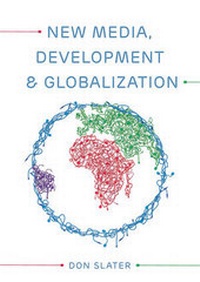
New Media, Development and Globalization
Description

This compelling book forces us to look at these terms afresh. Drawing on more than ten years of ethnographic fieldwork in Latin America, West Africa and South Asia, Don Slater seeks to challenge these terms as voicing specific northern narratives rather than universal truths, and to see them from the perspective of southern people and communities who are equally concerned to understand new machines for communication, new models of social change and new maps of social connection. The central question the book poses is: how we can democratize the ways we think and practise new media, development and globalization, opening these terms to dialogue and challenge within North-South relations?
Rooted in sociological debates, New Media, Development and Globalization will also be a provocative contribution to media and cultural studies, studies of digital culture, development studies, geography and anthropology.
More details
Other editions
Additional editions
Person
Content
1 Introduction: Frames and Dialogues 1
2 Communicative Ecology and Communicative Assemblages 27
3 Media Forms and Practices 68
4 Making Up the Future: New Media as the Material Culture of Development 99
5 Scaling Practices and Devices: Globalizing Globalization 130
6 Conclusion: Politics of Research: Forms of Knowledge, Participation and Generalization 155
Notes 189
References 191
Index 205
1
Introduction: Frames and Dialogues
Over the past few decades, the three terms in my title – new media, development and globalization – have fused into a holy trinity through which people increasingly organize and act upon their beliefs about the future. Individually, each term invokes cosmologies that structure our conceptual and practical universes around fundamental aspects of life: communication and mediation (new media); social change over historical time (development); and connectedness at different spatial scales (globalization). They are also so tightly interwoven that each term appears as both manifestation and cause of the other two: new media (or ICTs or digital culture or cognate terms) are understood as inherently globalizing and as constituting the inevitable informational future for social development; development is normatively, even commonsensically, narrated as a transition to unimpeded and technically enabled global information flows and associated forms of organization and sociality (‘networks’); and globalization designates an informational reconstitution of space and connection that is often taken for granted as describing our collective socio-economic future.
Together they make a compelling and seemingly irrefutable case about the way the world is going within which ‘everyone’ must position themselves, as if people everywhere were adapting to an altered natural habitat: individuals, households, communities, nations, the globe, have been set, as their fundamental tasks, the need to comprehend these changes, to imagine the new agencies and qualities that will emerge from them and, on the basis of these knowledges and desires, to forge strategies for surviving or advancing or ‘developing’. These interlinked processes are confronted as dangers and threats, as challenges, as opportunities, even as final solutions to the problems previously posed by unequal development or capitalism or pre-modern techno-cultures. In all of these cases, however, these interlinked terms have come to be understood in a thoroughly realist mode whereby they provide the analytical frameworks in and through which people are to organize social thought and action. More concretely, as academics who are researching and teaching this stuff, we are channelled into operating within containers labelled ‘new media’, ‘development’ and ‘globalization’, and their interweaving, in our production and circulation of new knowledges.
The aim of this book is to reposition these three terms and their conjoint narrative as just one kind of story about the future, told by certain kinds of people, and therefore as performatively part of the construction of whatever future will actually eventuate: the aim is simply to achieve an anthropological distance from these terms so that they can always be traced to someone's cosmology somewhere, and so that all contributions – northern or southern – to debates about communication, change and connectedness might be treated as equally or symmetrically cosmological. Stated more academically, I am concerned to demote all three from acting as analytical frames or metalanguages that contain (and constrain) research and political action, and to recognize them instead as part of the fields we study and act within, to render them as topics rather than resources. In this sense, I am not primarily concerned with critiquing these concepts, or debunking them as fictions or hype, or presenting new findings that confirm or refute or revise them, or adding new concepts that would help practitioners do (or contest) media, development or globalization ‘better’, though some of all that will inevitably be involved.
More specifically, and more urgently, the aim is to anthropologize these terms, recognizing them as elements of specifically northern cosmologies: stories ‘we’ tell about the rest of the world but which then structure and contain ‘their’ practical and ethical sense of the future and its possibilities. The present discussion is entirely structured by a series of ethnographic fieldwork encounters with new media, development and globalization in several non-northern locations (and a couple of marginal northern ones) – in the Caribbean and Latin America, South Asia and West Africa (detailed below) – in which the three terms of our title were encountered from non-northern standpoints, at the receiving end of beliefs, practices and regulatory controls organized through this trinity, and largely experienced as naturalized and realist terms, as references to objective processes established through impersonal knowledges that all participants regarded as social facts. By looking from the outside – standing in a different place – at northern beliefs about media, development and globalization we can make all three look strange, local, contingent, as part of northern cosmologies of pretty dubious generality. And all three terms are very much northern terms – they are both geographically and historically very specific and they are bound up with histories of northern preoccupations: media and development are inextricably tied to post-war Euro-American history, in the desire – an anxious one throughout post-war reconstruction and the Cold War – to construct a world of liberal democracy that necessarily included undistorted public spheres and private markets. New media and globalization are equally inseparable from a more recent redefinition of the West that envisages renewal through connectedness.
These three terms, naturalized as unchallengeable facts and frameworks, obviously come from somewhere very particular (and indeed originate partly from metropolitan academics like myself), and so another way of putting the problem is the idea that, historically, ‘the North provides the theory; the South provides the data’.1 This phrase captures and condenses a tremendous complexity of power relations, as well as a contemporary division of intellectual labour. Amongst other things it references a colonial history in which southern peoples were simultaneously and inseparably objects of knowledge and of rule, a doubled epistemological and political subordination – a knowledge/power coupling that has arguably continued seamlessly into postcolonial ‘development’ (Escobar 1995, 2000; Rahnema and Bawtree 1997). It references the extent to which southern experiences are regarded not as sui generis histories to be traced and lived but as merely local instances of global developmental logics (progress, modernization, information society) that are defined in the North, modelled on its experiences, hopes and anxieties, but presented as unanswerable and impersonal social facts. And it references an asymmetry of representation and self-representation, of innovation, discovery and creation: the stories we invent and tell ourselves about the way our world is going tend to come from the North (and, if not, they are treated as ‘culture’ or ‘belief’ or ‘identity’); and in this global division of narration, southern peoples are not narrators (agents) – or, at best, they are unreliable narrators – but are rather facts (objects) which may or may not fit into the story. Indeed, the structuring southern experience of ICTs (information and communication technologies) for/in development has been anxiety or even panic as to whether they fit in to the normative techno-developmental path of becoming an information society (as, for example, in the issue of ‘digital divide’ or Castells-style ‘informational black holes’), whether people or communities or nations will fall into the blank spaces between nodes, and whether their marginality might become irreversible.
The aim of this book, then, is to challenge ‘new media’, ‘development’ and ‘globalization’ as analytical frameworks, with obscured northern origins, into which southern ‘facts’ (people, lives, histories, plans) must fit themselves, and instead to assert an analytical and political symmetry between people's evolving theorizations and practices of communication, change and connection. Put crudely, the aim of most of the ethnographic storytelling in this book is to consistently portray development ‘beneficiaries’ in southern places and development agents in northern ones (whether in agencies, academies or government) as in principle identical: they are all treated simply as people trying to make sense of and act upon transformations of communication, change and connection. They clearly do so under extremely and frequently obscenely unequal conditions of knowledge and power (some of which inequalities can be traced precisely through this political division of epistemological standing between northern theories and southern facts); but, in analytical principle, any southern villager and any American professor is identically, and equally fallibly, attempting to theorize social change – as a basis for social action – under conditions of incomplete, contingent and situated knowledges. Let's try starting from there.
The strategy that is pursued here is best described in terms of Latour's (1988a, 1988b, 2005) notion of an ‘infra-language’ (though in the book I tend to use his simpler injunction to deploy intentionally ‘banal and empty’ concepts). Unlike the metalanguages of classical and critical social thought, whose universalistic aim is to contain or subsume everyone and everything, infra-languages, in Latour's...

