

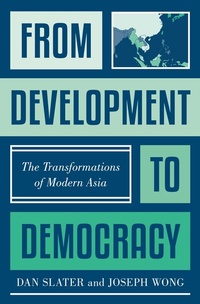
From Development to Democracy
The Transformations of Modern Asia
1st Edition
Published on 28. July 2022
368 pages
978-0-691-23107-5 (ISBN)
Description

Why some of Asia's authoritarian regimes have democratized as they have grown richer-and why others haven't
Over the past century, Asia has been transformed by rapid economic growth, industrialization, and urbanization-a spectacular record of development that has turned one of the world's poorest regions into one of its richest. Yet Asia's record of democratization has been much more uneven, despite the global correlation between development and democracy. Why have some Asian countries become more democratic as they have grown richer, while others-most notably China-haven't? In From Development to Democracy, Dan Slater and Joseph Wong offer a sweeping and original answer to this crucial question.
Slater and Wong demonstrate that Asia defies the conventional expectation that authoritarian regimes concede democratization only as a last resort, during times of weakness. Instead, Asian dictators have pursued democratic reforms as a proactive strategy to revitalize their power from a position of strength. Of central importance is whether authoritarians are confident of victory and stability. In Japan, South Korea, and Taiwan these factors fostered democracy through strength, while democratic experiments in Indonesia, Thailand, and Myanmar were less successful and more reversible. At the same time, resistance to democratic reforms has proven intractable in Singapore, Malaysia, Hong Kong, China, Vietnam, and Cambodia. Reconsidering China's 1989 crackdown, Slater and Wong argue that it was the action of a regime too weak to concede, not too strong to fail, and they explain why China can allow democracy without inviting instability.
The result is a comprehensive regional history that offers important new insights about when and how democratic transitions happen-and what the future of Asia might be.
Over the past century, Asia has been transformed by rapid economic growth, industrialization, and urbanization-a spectacular record of development that has turned one of the world's poorest regions into one of its richest. Yet Asia's record of democratization has been much more uneven, despite the global correlation between development and democracy. Why have some Asian countries become more democratic as they have grown richer, while others-most notably China-haven't? In From Development to Democracy, Dan Slater and Joseph Wong offer a sweeping and original answer to this crucial question.
Slater and Wong demonstrate that Asia defies the conventional expectation that authoritarian regimes concede democratization only as a last resort, during times of weakness. Instead, Asian dictators have pursued democratic reforms as a proactive strategy to revitalize their power from a position of strength. Of central importance is whether authoritarians are confident of victory and stability. In Japan, South Korea, and Taiwan these factors fostered democracy through strength, while democratic experiments in Indonesia, Thailand, and Myanmar were less successful and more reversible. At the same time, resistance to democratic reforms has proven intractable in Singapore, Malaysia, Hong Kong, China, Vietnam, and Cambodia. Reconsidering China's 1989 crackdown, Slater and Wong argue that it was the action of a regime too weak to concede, not too strong to fail, and they explain why China can allow democracy without inviting instability.
The result is a comprehensive regional history that offers important new insights about when and how democratic transitions happen-and what the future of Asia might be.
More details
Other editions
Additional editions
Book
08/2024
Princeton University Press
€27.50
Shipment within 10-20 days
Book
09/2022
Princeton University Press
€37.14
Shipment within 10-20 days
Persons
Dan Slater is the James Orin Murfin Professor in the Department of Political Science and director of the Center for Emerging Democracies at the University of Michigan. His books include Ordering Power: Contentious Politics and Authoritarian Leviathans in Southeast Asia. Joseph Wong is the Roz and Ralph Halbert Professor of Innovation at the Munk School of Global Affairs and Public Policy and professor of political science at the University of Toronto. His books include Healthy Democracies: Welfare Politics in Taiwan and South Korea.
Content
- Cover
- Contents
- Preface and Acknowledgments
- 1. Democracy through Strength
- 2. Shaping Developmental Asia
- 3. Japan: Asia's First Democratic Developmental State
- 4. Taiwan: The Exemplar of Democracy through Strength
- 5. South Korea: Democracy in Fits and Starts
- 6. China to 1989: Too Weak to Concede
- 7. Developmental Militarism: Reversible Exits
- 8. Developmental Britannia: Embittered Authoritarianism
- 9. Developmental Socialism: Dominance and Democracy Avoidance
- Conclusion: Democracy's Universality and Vulnerability
- Notes
- References
- Index
