

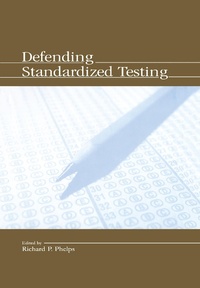
Defending Standardized Testing
Published on 23. March 2005
362 pages
978-1-135-61427-0 (ISBN)
Description

The education reform movement of the past two decades has focused on raising academic standards. Some standards advocates attach a testing mechanism to gauge the extent to which high standards are actually accomplished, whereas some critics accuse the push for standards and testing of impeding reform and perpetuating inequality. At the same time, the testing profession has produced advances in the format, accuracy, dependability, and utility of tests. Never before has obtaining such an abundance of accurate and useful information about student learning been possible. Meanwhile, the American public remains steadfast in support of testing to measure student performance and monitor the performance of educational systems.
Many educational testing experts who acknowledge the benefits of testing also believe that those benefits have been insufficiently articulated. Although much has been written on standardized testing policy, most of the material has been written by opponents. The contributing authors of this volume are both accomplished researchers and practitioners who are respected and admired worldwide. They bring to the project an abundance of experience working with standardized tests.
The goal of Defending Standardized Testing is to:
*describe current standardized testing policies and strategies;
*explain many of the common criticisms of standardized testing;
*document the public support for, and the realized benefits of, standardized testing;
*acknowledge the limitations of, and suggest improvements to, testing practices;
*provide guidance for structuring and administering large-scale testing programs in light of public preferences and the "No Child Left Behind Act" requirements; and
*present a defense of standardized testing and a vision for its future.
Defending Standardized Testing minimizes the use of technical jargon so as to appeal to all who have a stake in American educational reform.
Many educational testing experts who acknowledge the benefits of testing also believe that those benefits have been insufficiently articulated. Although much has been written on standardized testing policy, most of the material has been written by opponents. The contributing authors of this volume are both accomplished researchers and practitioners who are respected and admired worldwide. They bring to the project an abundance of experience working with standardized tests.
The goal of Defending Standardized Testing is to:
*describe current standardized testing policies and strategies;
*explain many of the common criticisms of standardized testing;
*document the public support for, and the realized benefits of, standardized testing;
*acknowledge the limitations of, and suggest improvements to, testing practices;
*provide guidance for structuring and administering large-scale testing programs in light of public preferences and the "No Child Left Behind Act" requirements; and
*present a defense of standardized testing and a vision for its future.
Defending Standardized Testing minimizes the use of technical jargon so as to appeal to all who have a stake in American educational reform.
Reviews / Votes
"...an easy to read book...This book provides a balanced approach to understanding the role of testing in general and standardized testing in particular. It will help the reader identify and understand some of the current debates within the community of testing experts."-PsycCRITIQUES
More details
Language
English
Place of publication
London
United Kingdom
Publishing group
Taylor & Francis Ltd
Target group
Professional and scholarly
File size
19,72 MB
ISBN-13
978-1-135-61427-0 (9781135614270)
Copyright in bibliographic data and cover images is held by Nielsen Book Services Limited or by the publishers or by their respective licensors: all rights reserved.
Schweitzer Classification
Other editions
Additional editions
Richard Phelps
Defending Standardized Testing
Book
02/2005
Psychology Press
€86.40
Shipment within 10-20 days
Richard Phelps
Defending Standardized Testing
Book
02/2005
Psychology Press
€215.41
Shipment within 10-20 days
Content
Contents: Foreword. J.J. Fremer, Introduction and Overview. R.P. Phelps, Persistently Positive: Forty Years of Public Opinion on Standardized Testing. G.J. Cizek, High-Stakes Testing: Contexts, Characteristics, Critiques, and Consequences. R.P. Phelps, The Rich, Robust Research Literature on Testing's Achievement Benefits. D. Goodman, R.K. Hambleton, Some Misconceptions About Large-Scale Educational Assessments. S.G. Sireci, The Most Frequently Unasked Questions About Testing. G.K. Cunningham, Must High Stakes Mean Low Quality? Some Testing Program Implementation Issues. C.W. Buckendahl, R. Hunt, Whose Rules? The Relation Between the "Rules" and "Law" of Testing. L. Crocker, Teaching for the Test: How and Why Test Preparation Is Appropriate. B.S. Plake, Doesn't Everybody Know That 70% Is Passing? K.F. Geisinger, The Testing Industry, Ethnic Minorities and Individuals With Disabilities. D. Rogosa, A School Accountability Case Study: California API Awards and the Orange County Register Margin of Error Folly. M.L. Bourque, Leave No Standardized Test Behind. Appendices.
