

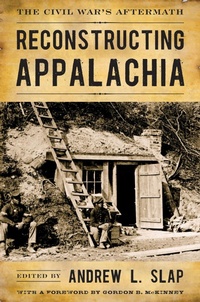
Reconstructing Appalachia
The Civil War's Aftermath
Published on 15. November 2022
392 pages
978-0-8131-3976-0 (ISBN)
Description

"Excellent, readable, and absorbing history... gives us a better understanding of this compelling aspect of the Civil War." -
Library Journal
Families, communities, and the nation itself were irretrievably altered by the Civil War and the subsequent societal transformations of the nineteenth century. The repercussions of the war incited a broad range of unique problems in Appalachia, including political dynamics, racial prejudices, and the regional economy.
This anthology of essays reveals life in Appalachia after the ravages of the Civil War, an unexplored area that has left a void in historical literature. Addressing a gap in the chronicles of our nation, this vital collection explores little-known aspects of history with a particular focus on the Reconstruction and post-Reconstruction periods. Acclaimed scholars John C. Inscoe, Gordon B. McKinney, and Ken Fones-Wolf are joined by up-and-comers like Mary Ella Engel, Anne E. Marshall, and Kyle Osborn in a unique volume investigating postwar Appalachia with clarity and precision.
Featuring a broad geographic focus, the compelling essays cover postwar events in Georgia, Kentucky, North Carolina, Tennessee, West Virginia, and Pennsylvania. This approach provides an intimate portrait of Appalachia as a diverse collection of communities where the values of place and family are of crucial importance. Highlighting a wide array of topics including racial reconciliation, tension between former Unionists and Confederates, the evolution of post-Civil War memory, and altered perceptions of race, gender, and economic status, Reconstructing Appalachia is a timely and essential study of a region rich in heritage and tradition.
"Outstanding." - North Carolina Historical Review
Families, communities, and the nation itself were irretrievably altered by the Civil War and the subsequent societal transformations of the nineteenth century. The repercussions of the war incited a broad range of unique problems in Appalachia, including political dynamics, racial prejudices, and the regional economy.
This anthology of essays reveals life in Appalachia after the ravages of the Civil War, an unexplored area that has left a void in historical literature. Addressing a gap in the chronicles of our nation, this vital collection explores little-known aspects of history with a particular focus on the Reconstruction and post-Reconstruction periods. Acclaimed scholars John C. Inscoe, Gordon B. McKinney, and Ken Fones-Wolf are joined by up-and-comers like Mary Ella Engel, Anne E. Marshall, and Kyle Osborn in a unique volume investigating postwar Appalachia with clarity and precision.
Featuring a broad geographic focus, the compelling essays cover postwar events in Georgia, Kentucky, North Carolina, Tennessee, West Virginia, and Pennsylvania. This approach provides an intimate portrait of Appalachia as a diverse collection of communities where the values of place and family are of crucial importance. Highlighting a wide array of topics including racial reconciliation, tension between former Unionists and Confederates, the evolution of post-Civil War memory, and altered perceptions of race, gender, and economic status, Reconstructing Appalachia is a timely and essential study of a region rich in heritage and tradition.
"Outstanding." - North Carolina Historical Review
More details
Other editions
Additional editions
Book
02/2014
The University Press of Kentucky
€35.50
Shipment within 10-20 days
Person
Andrew L. Slap, associate professor of history at East Tennessee State University, is the author of The Doom of Reconstruction: The Liberal Republicans in the Civil War Era.
Content
- Intro
- About the Author
- Title
- Copyright
- Contents
- Acknowledgments
- Introduction
- 1. A New Frontier: Historians, Appalachian History, and the Aftermath of the Civil War
- 2. Reconstruction-era Violence in North Georgia: The Mossy Creek Ku Klux Klan's Defense of Local Autonomy
- 3. UnReconstructed Appalachia: The Persistence of War in Appalachia
- 4. "The Other War Was but the Beginning": The Politics of Loyalty in Western North Carolina, 1865-1867
- 5. "Resistless Uprising"?: Thomas Dixon's Uncle and Western North Carolinians as Klansmen and Statesmen
- 6. Reconstructing Race: Parson Brownlow and the Rhetoric of Race in Postwar East Tennessee
- 7. Gathering Georgians to Zion: John Hamilton Morgan's 1876 Mission to Georgia
- 8. "Neither War nor Peace": West Virginia's Reconstruction Experience
- 9. A House Redivided: From Sectionalism to Political Economy in West Virginia
- 10. "Grudges and Loyalties Die So Slowly": Contested Memories of the Civil War in Pennsylvania's Appalachia
- 11. The Lost Cause That Wasn't: East Tennessee and the Myth of Unionist Appalachia
- 12. "A Northern Wedge Thrust into the Heart of the Confederacy": Explaining Civil War Loyalties in the Age of Appalachian Discovery, 1900-1921
- 13. Civil War Memory in Eastern Kentucky Is "Predominately White": The Confederate Flag in Unionist Appalachia
- List of Contributors
- Index
