

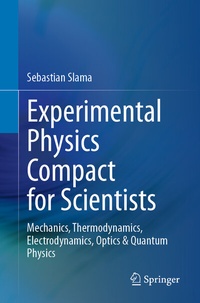
Experimental Physics Compact for Scientists
Description

This book compactly provides the fundamentals of experimental physics for students of the natural sciences who are taking physics as a minor or major subject. Interspersed throughout the main text are numerous exercises with pre-calculated solutions, and the most important formulas are listed again at the end of each chapter. This book enables readers to gain an overview of the individual areas and is thus ideally suited to accompany lectures during studies as well as for exam preparation.
The textbook originated from a lecture on "Experimental Physics for Natural Scientists" at the University of Tübingen and is intended for all students in subjects such as biochemistry, bioinformatics, biology, chemistry, computer science, mathematics, pharmacy, geoecology, and earth sciences.The first part of the book deals with Newtonian mechanics including continuum mechanics and oscillations and waves. The second part deals with the basic concepts of thermodynamics with emphasis onthe statistical explanations. The third part covers electromagnetic phenomena, especially electrostatics and magnetostatics, electrodynamics, and an introduction to electronic components and circuits. Optics with its subfields, ray optics, wave optics, and quantum optics, is presented in the fourth part. In the fifth and last part of the book, the reader is given an overview of the basic principles of quantum mechanics, including atomic and nuclear physics.
For this second edition, the content has been improved and supplemented in many places, including a new section on heat transport and phase transitions, as well as an outlook into alternative interpretations of quantum mechanics.
Reviews / Votes
"A very nice compact work that presents the central basic information on physics in a concise and understandable manner." Particularly noteworthy: "The sparing use of illustrations, which are, however, always provided ..." (Prof. Dr. Oliver Baumann, Faculty of Life Sciences, Department of Industrial Engineering and Management, HAW Hamburg)More details
Other editions
Additional editions
Person
Sebastian Slama comes from Passau, Germany, and studied physics at ETH Zurich. After graduating, he completed his doctorate in quantum optics at the University of Tübingen. In 2011, he was then appointed as a junior lecturer as part of the "Successful Studying in Tübingen" project funded by the German Federal Ministry of Research and Education (BMBF). Since then, Mr. Slama has been particularly involved in physics education for natural scientists in Tübingen. In 2012, Mr. Slama habilitated in experimental physics, and since 2017 he has been an apl. prof. at the University of Tübingen. In 2015, he received the teaching award of the University of Tübingen for the comprehensible preparation of physics teaching content for students of STEM subjects.
Content
Physical quantities and measurements.- Mechanics of rigid bodies.- Continuum mechanics.- Oscillations and waves.- Thermodynamics.- Electrostatics.- Magnetostatics.- Electrodynamics.- Electronics.- Optics.- Fundamentals of quantum physics.
