

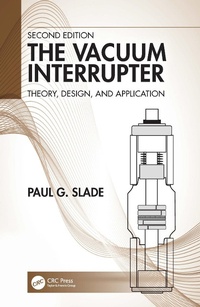
The Vacuum Interrupter
Theory, Design, and Application
2nd Edition
Published on 29. November 2020
666 pages
978-1-000-16998-0 (ISBN)
Description

Title: The Vacuum Interrupter: Theory, Design, and ApplicationShelving guide: Electrical Engineering
Dr. Paul Slade draws from his nearly six decades of active experience to develop this second edition of The Vacuum Interrupter: Theory, Design, and Application. This book begins by discussing the design requirements for high voltage vacuum interrupters and then the contact requirements to interrupt the vacuum arc. It then continues by describing the various applications in which the vacuum interrupter is generally utilized.
Part 1 of this book begins with a detailed review of the vacuum breakdown process. It continues by covering the steps necessary for the design and the manufacture of a successful vacuum interrupter. The vacuum arc is then discussed, including how it is affected as a function of current. An overview of the development and use of practical contact materials, along with their advantages and disadvantages, follows. Contact designs that are introduced to control the high current vacuum arc are also analyzed.
Part 2, on application, begins with a discussion of the arc interruption process for low current and high current vacuum arcs. It examines the voltage escalation phenomenon that can occur when interrupting inductive circuits. The occurrence of contact welding for closed contacts subjected to the passage of high currents, and for contacts when closing on high currents, is explored. The general requirements for the successful manufacture and testing of vacuum circuit breakers is then presented. The general application of vacuum interrupters to switch load currents, especially when applied to capacitor circuits, is also given. The interruption of high short circuit currents is presented along with the expected performance of the two major contact designs.
Owing to the ever-increasing need for environmentally friendly circuit protection devices, the development and application of the vacuum interrupter will only increase in the future. At present the vacuum circuit breaker is the technology of choice for distribution circuits (5kV to 40.5kV). It is increasingly being applied to transmission circuits (72.5kV to 242kV). In the future, its application for protecting high voltage DC networks is assured.
Audience
This is a practical source book for engineers and scientists interested in studying the development and application of the vacuum interrupter
Research scientists in industry and universities
Graduate students beginning their study of vacuum interrupter phenomena
Design engineers applying vacuum interrupters in vacuum switches, vacuum contactors, vacuum circuit breakers, and vacuum contactors
It provides a unique and comprehensive review of all aspects of vacuum interrupter technology for those new to the subject and for those who wish to obtain a deeper understanding of its science and application
Scientists and engineers, who are beginning their research into vacuum breakdown and aspects of the vacuum arc, will find the extensive bibliography and phenomenological descriptions to be a useful introduction
Dr. Paul Slade draws from his nearly six decades of active experience to develop this second edition of The Vacuum Interrupter: Theory, Design, and Application. This book begins by discussing the design requirements for high voltage vacuum interrupters and then the contact requirements to interrupt the vacuum arc. It then continues by describing the various applications in which the vacuum interrupter is generally utilized.
Part 1 of this book begins with a detailed review of the vacuum breakdown process. It continues by covering the steps necessary for the design and the manufacture of a successful vacuum interrupter. The vacuum arc is then discussed, including how it is affected as a function of current. An overview of the development and use of practical contact materials, along with their advantages and disadvantages, follows. Contact designs that are introduced to control the high current vacuum arc are also analyzed.
Part 2, on application, begins with a discussion of the arc interruption process for low current and high current vacuum arcs. It examines the voltage escalation phenomenon that can occur when interrupting inductive circuits. The occurrence of contact welding for closed contacts subjected to the passage of high currents, and for contacts when closing on high currents, is explored. The general requirements for the successful manufacture and testing of vacuum circuit breakers is then presented. The general application of vacuum interrupters to switch load currents, especially when applied to capacitor circuits, is also given. The interruption of high short circuit currents is presented along with the expected performance of the two major contact designs.
Owing to the ever-increasing need for environmentally friendly circuit protection devices, the development and application of the vacuum interrupter will only increase in the future. At present the vacuum circuit breaker is the technology of choice for distribution circuits (5kV to 40.5kV). It is increasingly being applied to transmission circuits (72.5kV to 242kV). In the future, its application for protecting high voltage DC networks is assured.
Audience
This is a practical source book for engineers and scientists interested in studying the development and application of the vacuum interrupter
Research scientists in industry and universities
Graduate students beginning their study of vacuum interrupter phenomena
Design engineers applying vacuum interrupters in vacuum switches, vacuum contactors, vacuum circuit breakers, and vacuum contactors
It provides a unique and comprehensive review of all aspects of vacuum interrupter technology for those new to the subject and for those who wish to obtain a deeper understanding of its science and application
Scientists and engineers, who are beginning their research into vacuum breakdown and aspects of the vacuum arc, will find the extensive bibliography and phenomenological descriptions to be a useful introduction
More details
Edition
2nd edition
Language
English
Place of publication
London
United Kingdom
Publishing group
Taylor & Francis Ltd
Target group
College/higher education
Professional and scholarly
Illustrations
103 Tables, black and white; 575 Illustrations, black and white
ISBN-13
978-1-000-16998-0 (9781000169980)
Copyright in bibliographic data and cover images is held by Nielsen Book Services Limited or by the publishers or by their respective licensors: all rights reserved.
Schweitzer Classification
Other editions
Additional editions
Book
08/2022
2nd Edition
CRC Press
€99.10
Shipment within 15-20 days
Book
11/2020
2nd Edition
CRC Press
€251.10
Shipment within 15-20 days
Person
Paul G. Slade has been an independent consultant for vacuum interrupter technology, electrical contacts and circuit interruption, since his retirement. He is also the holder of 23 US patents. He is the major contributor and editor of the 2nd edition of the book "Electrical Contacts: Principles and Applications". He is the recipient of the IEEE Ragnar Holm Scientific Achievement Award and of the German VDE Albert Keil Pries for his contributions to the science of electrical contacts. He is a fellow of the IEEE.
Content
1. High Voltage Vacuum Interrupter Design. 2. The Vacuum Arc. 3. The Materials, Design and Manufacture of the Vacuum Interrupter. 4. General Aspects of Vacuum Interrupter Application. 5. Application of The Vacuum Interrupter for Switching Load Currents. 6. Circuit Protection, Vacuum Circuit Breakers and Reclosers.
