

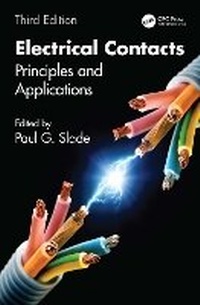
Electrical Contacts
Principles and Applications
3rd Edition
Will be published approx. on 2. December 2026
1432 pages
E-Book
978-1-040-52271-4 (ISBN)
Description

Covering the theory, application, and testing of contact materials, Electrical Contacts: Principles and Applications provides comprehensive coverage of electrical contact phenomena. The book discusses making electric contact and contact interface conduction; presents a general outline of important corrosion mechanisms and their measurement techniques; considers the results of contact wear when plug-in connections are made and broken; investigates the effect of thin noble metal plating on electronic connections; and relates crucial considerations for making high- and low-power contact joints. It examines contact use in switching devices, including the interruption of AC and DC circuits with currents ranging from 10 mA to 100 kA and voltages up to 1000 V, and describes arc formation between open and opening contacts. Arcing effects on contacts such as erosion, welding, and contamination are also addressed. Containing nearly 3,000 references, tables, equations, figures, drawings, and photographs, the book provides practical examples encompassing everything from electronic circuits to high-power circuits and from microamperes to megaamperes.
Reflects the latest advances in electrical contact science and technology
Examines current research on contact corrosion, materials, and switching
Includes updates and revisions in each chapter, as well as up-to-date references and new figures and examples throughout
Delivers three new chapters on dust contamination effects, electronic sensing for switching systems, and contact phenomena for MEMS applications
With contributions from recognized experts in the field, Electrical Contacts: Principles and Applications, Third Edition, assists practicing scientists and engineers in preventing costly system failures while offering graduate students in engineering and technology a comprehensive introduction to electrical contact phenomena.
Reflects the latest advances in electrical contact science and technology
Examines current research on contact corrosion, materials, and switching
Includes updates and revisions in each chapter, as well as up-to-date references and new figures and examples throughout
Delivers three new chapters on dust contamination effects, electronic sensing for switching systems, and contact phenomena for MEMS applications
With contributions from recognized experts in the field, Electrical Contacts: Principles and Applications, Third Edition, assists practicing scientists and engineers in preventing costly system failures while offering graduate students in engineering and technology a comprehensive introduction to electrical contact phenomena.
More details
Edition
3rd edition
Language
English
Place of publication
London
United Kingdom
Publishing group
Taylor & Francis Ltd
Target group
College/higher education
Illustrations
165 Tables, black and white; 983 Halftones, black and white; 983 Illustrations, black and white
ISBN-13
978-1-040-52271-4 (9781040522714)
Copyright in bibliographic data and cover images is held by Nielsen Book Services Limited or by the publishers or by their respective licensors: all rights reserved.
Schweitzer Classification
Other editions
Additional editions
Book
approx. 12/2026
3rd Edition
CRC Press
€148.50
Not yet published
Person
Paul G. Slade began his studies in the fascinating world of electrical contacts as a graduate student at the University of Wales, Cardiff, UK in the mid-1960s. Since that time, he has been involved with electrical contacts both as a research scientist and as a developer of switching components. Currently retired, he ended his five decades of experience in electrical contact research first at the Westinghouse R&D Center, Pittsburgh, Pennsylvania, USA, and then at the Eaton Corporation's Vacuum Interrupter Factory, Horseheads, New York, USA.
Content
0. Front Matter. 1. Electrical Contact Resistance: Fundamental Principles. 2. Introduction to Contact Tarnishing and Corrosion. 3. Gas Corrosion. 4. Effect of Dust Contamination on Electrical Contacts. 5. Power Connectors. 6. Low-Power Commercial, Automotive, and Appliance Connections. 7. Tribology of Electronic Connectors: Contact Sliding Wear, Fretting, and Lubrication. 8. Materials, Coatings, and Platings. 9. The Arc and Interruption. 10. The Consequences of Arcing. 11. Reed Switches. 12. Low Current and High Frequency Miniature Switches: Microelectromechanical Systems (MEMS), Metal Contact Switches. 13. Low Current Switching. 14. Medium to High Current Switching: Low Voltage Contactors, Circuit Breakers, and Vacuum Interrupters. 15. Arc Faults and Electrical Safety. 16. Arcing Contact Materials. 17. Contact Design and Attachment. 18. Electrical Contact Material Testing Design and Measurement. 19. Arc Interactions with Contaminants. 20. Sliding Electrical Contacts. 21. Illustrative Modern Brush Applications. 22. Sliding Contacts for Instrumentation and Control. 23. Metal Fiber Brushes 24. Useful Electric Contact Information.
