

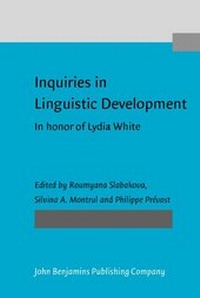
Inquiries in Linguistic Development
In honor of Lydia White
1st Edition
Published on 5. April 2006
VI, 363 pages
978-90-272-9353-4 (ISBN)
Description

The focus of this collection is on important themes in L2 acquisition, the nature of grammatical systems developed by language learners in L1 acquisition, third language acquisition, and bilingualism and language attrition. The chapters present an interesting mix of theoretical contributions, overview studies, and experimental designs exploring various research questions, such as learnability and access to UG, L1 influence, the nature of initial and endstate grammars, and variability. The linguistic domains investigated are also extremely diverse: morphosyntax, phonology, the lexicon, argument realization, language processing, and interface phenomena. This book, edited and written by McGill University alumni, is intended as a tribute to Lydia White's contribution to the field of generative second language acquisition. The authors present current work on language acquisition which further investigates several themes developed by White's research. Through these state-of-the-art contributions the reader will be able to identify important new directions in which generative language acquisition is developing and expanding.
More details
Other editions
Additional editions
Roumyana Slabakova | Silvina Montrul | Philippe Prevost
Inquiries in Linguistic Development
In honor of Lydia White
Book
04/2006
John Benjamins Publishing Co
€137.80
Shipment within 10-15 days
Persons
Content
- Inquiries in Linguistic Development
- Title page
- LCC data
- Table of contents
- Inquiries in linguistic development
- Introduction
- Part I: Learnability and parameter resetting
- Part II: Variability
- Part III: Incomplete ultimate attainment
- References
- Learnability and parameter setting
- `Passive' unaccusative errors in L2 English revisited
- 1. Introduction
- 2. Yusa (2002, 2003)
- 3. Experimental study
- 3.1. Hypotheses
- 3.2. Participants
- 3.3. Task and materials
- 3.4. Results
- 4. Discussion and conclusion
- Acknowledgements
- Notes
- References
- Appendix
- Manner-of-motion verbs with locational/directional PPs in L2 English and Japanese
- Motion verbs with locational/directional PPs in English and Japanese
- Motion verbs with locational/directional PPs in L2 acquisition
- Method
- Design
- Participants
- Materials
- Results
- The ESL study
- The JSL study
- Discussion
- The ESL study
- The JSL study
- Notes
- References
- Appendix A
- Example test item in the ESL study
- Appendix B
- Sentences included in the ESL picture-matching task
- Appendix C
- Example test item in the JSL study
- Appendix D
- Sentences included in the JSL picture-matching task
- A semantic parameter with a syntactic trigger in the L2 acquisition of Italian
- 1. Introduction
- 2. Previous studies on L2 acquisition of DPs
- 3. The data and their analysis
- 4. Predictions for second language acquisition
- 5. The study
- 5.1. Participants
- 5.2. Tasks and materials
- 5.3. Group results
- 5.4. Individual results
- 6. Discussion
- Notes
- References
- Investigating the L2 initial state
- 1. Introduction
- 2. Syntactic background
- 3. Initial state hypotheses and predictions
- 3.1. Full Transfer
- 3.2. Minimal Trees
- 3.3. Structural Minimality
- 4. The experiment
- 4.1. Participants
- 4.2. Procedure
- 4.3. Results
- 4.4. Discussion
- 5. Conclusion
- Notes
- References
- L1 phonotactic knowledge and the L2 acquisition of alternations
- 1. Introduction
- 2. The connection between phonotactics and alternations in acquisition
- 2.1. Studying the acquisition of alternations with L2 artificial language learning
- 3. The experiment
- 3.1. Materials
- 3.2. Subjects
- 3.3. Testing and training
- 4. Results
- 5. Discussion
- 6. Conclusions
- Notes
- References
- Variability
- Morphological variability in the development of L2 French morphosyntax
- 1. Introduction
- 2. Impairment in L2 acquisition
- 3. L1 Influence and morphological variability
- 4. The study
- 5. Results
- 5.1. Finiteness errors
- 5.2. Nonfinite forms in finite positions (excluding negation)
- 5.3. Finite forms in nonfinite positions (excluding negation)
- 5.4. Finiteness errors in negative utterances
- 6. Discussion
- Notes
- References
- Full transfer vs. partial transfer in L2 and L3 acquisition
- 1. Introduction
- 2. Linguistic assumptions
- 2.1. English and French
- 2.2. Chinese
- 2.3. Vietnamese
- 2.4. Summary of cross-linguistic facts on the verbal functional domain
- 3. Predictions
- 3.1. Full Transfer Full Access (FTFA)
- 3.2. Minimal Trees (MT)
- 3.3. Valueless Features Hypothesis (VFH)
- 4. Method
- 4.1. Participants
- 4.2. Experimental tasks
- 5. Results
- 5.1. Elicited written production task I: Composition on [1'301past]
- 5.2. Elicited written production task II: Sentence completion on adverb placement and agreement
- 5.3. Preference task I on agreement and [1'301past]
- 5.4. Preference task II on adverb placement
- 6. Summary of results, discussion and conclusion
- 6.1. L1 Vietnamese-L2 French initial state
- 6.2. L1 Chinese-L2 English-L3 French initial state
- Notes
- References
- Appendix
- A representational licensing-based account of asymmetries in the L2 acquisition of place
- 1. Introduction
- 2. Representation, licensing and predictions for L2 acquisition
- 2.1. Binarity and the representation of final consonant clusters
- 2.2. Representation of place in consonants
- 2.3. Phonetic interpretation of phonological outputs
- 2.4. Phonological licensing: Asymmetries and parasitic licensing
- 2.5. Representation-based predictions for the acquisition of new, position-sensitive contrasts
- 3. L2 acquisition of place
- 3.1. Acquiring place in the dependent of a branching onset
- 3.2. Acquiring place in coda: Parasitic licensing
- 4. Conclusion
- Notes
- References
- Processing reduced relative versus main verb ambiguity in English as a second language
- 1. Introduction
- 2. Background
- 3. The experiment with reduced relative clauses
- 3.1. Research questions
- 3.2. Participants
- 3.3. Six tasks
- 4. Results
- 4.1. Proficiency scores
- 4.2. Accuracy
- 4.3. Processing
- 4.4. Working memory and processing
- 5. Discussion
- 6. Conclusion
- Acknowledgement
- Note
- References
- Appendix
- Formalism and functionalism working together?
- 1. Background
- 2. Grammatical approach
- 3. Performance approach
- 4. Discourse-pragmatics approach
- 5. Interplay between approaches
- 6. Conclusion
- Acknowledgements
- References
- Incomplete ultimate attainment
- L2 acquisition of pragmatic and syntactic constraints in the use of overt and null subject pronouns
- 1. L1 transfer in end-state L2 grammars
- 2. The null subject phenomenon
- 2.1. Empty categories and their overt counterparts
- 2.2. The overt pronoun constraint
- 3. Turkish: A null subject language
- 3.1. Grammatical sketch
- 4. Research questions
- 5. The study
- 5.1. The participants
- 5.2. Tests
- 6. Results and discussion
- 6.1. Test 1: Picture selection task
- 6.2. Test 2: Written interpretation task
- 6.3. Test 3: Truth value judgment task (story task)
- 6.4. Test 4: Picture identification-listening task
- 7. Discussion
- 8. Conclusion
- Notes
- References
- L2 end state grammars and incomplete acquisition of Spanish CLLD constructions
- 1. Introduction
- 2. Topic constructions in Spanish and English
- 3. Sorace's theory of optionality
- 4. Predictions for L2
- 5. Experiment
- 5.1. Participants
- 5.2. Experimental tasks
- 5.3. Results
- 6. Discussion
- Notes
- References
- Knowledge of clitic doubling in Spanish
- 1. Introduction
- 2. Dative clitic doubling in Spanish
- 2.1. Restrictions on incorporation in Spanish
- 3. Datives in English
- 4. Second language acquisition and knowledge of clitic doubling
- 4.1. Theoretical approaches to language acquisition
- 5. Methodology
- 5.1. Participants
- 5.2. Description of the test
- 6. Analysis of the results
- 6.1. Knowledge of basic incorporation
- 6.2. Results: Basic preposition incorporation
- 6.3. Constraints on incorporation: Affectedness
- 6.4. Constraint against double incorporation
- 6.5. Results: Affectedness and double incorporation
- 6.6. Constraint against incorporation in intransitive sentences
- 6.7. Results: Double incorporation
- 6.8. Incorporation and possessors
- 6.9. Results: Possessors
- 7. Discussion and conclusions
- Acknowledgement
- Notes
- References
- Incomplete acquisition as a feature of bilingual and L2 grammars
- 1. Introduction
- 2. Simultaneous bilingual acquisition
- 2.1. The early years
- 2.2. The adult years
- 3. Incomplete acquisition in L1 and L2
- 3.1. Some similarities
- 3.2. Some differences
- 4. Implications for the nature of bilingual grammars
- 5. Conclusion
- Note
- References
- Index
