

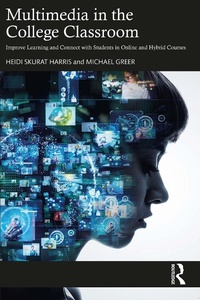
Multimedia in the College Classroom
Improve Learning and Connect with Students in Online and Hybrid Courses
1st Edition
Published on 25. April 2024
166 pages
978-1-040-00142-4 (ISBN)
Description

This practical guide to multimedia in online college instruction provides easy-to-follow instructions for designing multimedia assignments that maximize student learning while reducing cognitive load.
This book presents the learning process as a complex, multidimensional experience that includes texts as well as auditory and visual elements. Each chapter includes research-based activities to develop instructors' multimedia skills. The book leverages cutting edge cognitive research to improve accessibility and design, while also providing practical asynchronous and synchronous activities that engage learners.
Multimedia in the College Classroom is the ideal resource for any higher education instructor, administrator, or leader who wishes to learn about, reflect on, and implement research-based learning strategies through the targeted use of multimedia.
This book presents the learning process as a complex, multidimensional experience that includes texts as well as auditory and visual elements. Each chapter includes research-based activities to develop instructors' multimedia skills. The book leverages cutting edge cognitive research to improve accessibility and design, while also providing practical asynchronous and synchronous activities that engage learners.
Multimedia in the College Classroom is the ideal resource for any higher education instructor, administrator, or leader who wishes to learn about, reflect on, and implement research-based learning strategies through the targeted use of multimedia.
Reviews / Votes
"Skurat Harris and Greer not only say that multimedia can improve learning for students in higher education contexts, but throughout this book they demonstrate 'that multimedia can be the center of the entire learning process,' and in a 'choose-your-own adventure' structure they provide concrete assignments, practical pedagogical strategies, and personally compelling stories to support teachers in their use of multimedia, particularly for better teaching in online courses."Scott Warnock, Drexel University, USA
"Multimedia in the College Classroom is an essential contribution to the field of distance education. Crafting effective learning experiences takes care and deliberate planning, two things that Skurat Harris and Greer have emphasized throughout the text with concrete examples, resources, and a voice that guides instructors/designers to utilize multimedia within their online courses effectively. As they note, 'The number of multimedia elements in an online course is not as important as how those elements connect to the course learning outcomes to support student learning.' We couldn't agree more! This text will be incredibly useful to those looking to develop/expand their online courses and to incorporate more multimedia elements."
Jessie Borgman, Arizona State University, USA, and Casey McArdle, Michigan State University, USA, authors of 'Personal, Accessible, Responsive, Strategic: Resources and Strategies for Online Writing Instructors'
"This insightful and timely book helps us rethink how we teach and how we learn. Harris and Greer show how multimedia is not just an add on to text-based learning, but can be the center of the learning process in a way that improves both accessibility and connection. Their 'workshop in a book' approach makes it easy to try new teaching techniques to find the ones that work best in your own classroom. This book is a great resource for the modern teacher."
Rebecca Glazier, University of Arkansas at Little Rock, USA, author of 'Connecting in the Online Classroom: Building Rapport Between Teachers and Students' "Skurat Harris and Greer not only say that multimedia can improve learning for students in higher education contexts, but throughout this book they demonstrate 'that multimedia can be the center of the entire learning process,' and in a 'choose-your-own adventure' structure they provide concrete assignments, practical pedagogical strategies, and personally compelling stories to support teachers in their use of multimedia, particularly for better teaching in online courses."
-Scott Warnock, Drexel University
"Multimedia in the College Classroom is an essential contribution to the field of distance education. Crafting effective learning experiences takes care and deliberate planning, two things that Skurat Harris and Greer have emphasized throughout the text with concrete examples, resources, and a voice that guides instructors/designers to utilize multimedia within their online courses effectively. As they note, "The number of multimedia elements in an online course is not as important as how those elements connect to the course learning outcomes to support student learning." We couldn't agree more! This text will be incredibly useful to those looking to develop/expand their online courses and to incorporate more multimedia elements."
- Jessie Borgman and Casey McArdle, authors of Personal, Accessible, Responsive and Strategic: Resources and Strategies for Online Writing Instructors
"This insightful and timely book helps us rethink how we teach and how we learn. Harris and Greer show how multimedia is not just an add on to text-based learning, but can be the center of the learning process in a way that improves both accessibility and connection. Their "workshop in a book" approach makes it easy to try new teaching techniques to find the ones that work best in your own classroom. This book is a great resource for the modern teacher."
- Rebecca Glazier, author of Connecting in the Online Classroom: Building Rapport Between Teachers and Students
More details
Edition
1. Auflage
Language
English
Place of publication
London
United Kingdom
Publishing group
Taylor & Francis Ltd
Target group
College/higher education
Professional and scholarly
Illustrations
19 Line drawings, black and white; 1 Halftones, black and white; 20 Illustrations, black and white
ISBN-13
978-1-040-00142-4 (9781040001424)
Copyright in bibliographic data and cover images is held by Nielsen Book Services Limited or by the publishers or by their respective licensors: all rights reserved.
Schweitzer Classification
Other editions
Additional editions
Heidi Skurat Harris | Michael Greer
Multimedia in the College Classroom
Improve Learning and Connect with Students in Online and Hybrid Courses
Book
04/2024
1st Edition
Routledge
€205.90
Shipment within 3-4 weeks
Heidi Skurat Harris | Michael Greer
Multimedia in the College Classroom
Improve Learning and Connect with Students in Online and Hybrid Courses
Book
04/2024
1st Edition
Routledge
€50.60
Shipment within 3-4 weeks
Persons
Heidi Skurat Harris is the Graduate Coordinator of the Department of Rhetoric and Writing at the University of Arkansas at Little Rock, USA.
Michael Greer was an independent scholar based in Boulder, Colorado, USA.
Michael Greer was an independent scholar based in Boulder, Colorado, USA.
Content
1. Turning Content into Learning 2. Designing Multimedia for Deep Learning 3. Designing for Access 4. Improving Interaction in Synchronous Multimedia 5. Instructor Presence in Virtual Space 6. Integrating Multimedia for Purposeful Course Design 7. Further Reading and Exploration
