

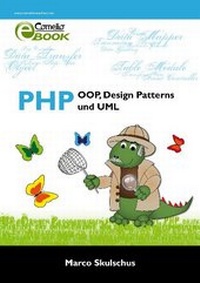
PHP
OOP, Design Patterns und UML
2nd Edition
Published on 23. December 2011
460 pages
978-3-939701-66-8 (ISBN)
Description

PHP 5 bietet dem Programmierer die Möglichkeit, PHP objektorientiert und unter Einsatz von gängigen objektorientierten Entwurfstechniken zu verwenden. Dieses Buch will Anfängern in der OOP, die aber gleichzeitig fortgeschrittene PHP-Programmierer sind, die OOP-Prinzipien anhand der PHP-Syntax erläutern. Nach einer Darstellung der neuen PHP-Techniken folgt ein umfangreicher Teil, der in das Wesen und den Nutzen von Entwurfsmustern einführt und eine Reihe von Mustern aus Standard- und Enterprisekatalog für die Entwicklung von erweiterbaren und wieder verwendbaren Architekturen in PHP vorstellt. Die Enterprise-Muster werden unter dem Blickwinkel der Mehrschichtigkeit eingeführt. Zur besseren Planung, Kontrolle und Dokumentation lernen PHP-Programmierer, eine Reihe von UML-Diagrammen sowie die Use Case-Technik zu verwenden.
All prices
More details
Other editions
Additional editions
Book
12/2011
2nd Edition
Comelio
€39.95
Shipment within 10-20 days
Person
Marco Skulschus (Jahrgang 1978) studierte Ökonomie in Wuppertal und Paris. Während des Studiums arbeitete er als Programmierer bei einem Internet-Startup und dann als Trainer/Berater für verschiedene IT-Unternehmen, bis er zu seinem heutigen Arbeitgeber kam. Bei der Comelio GmbH ist er im Bereich Softwareent-wicklung tätig und plant betriebswirtschaftliche Software im Bereich Auswertun-gen und Reporting. Er interessiert sich besonders für XML und Datenmodellierung, wobei er hier auch fortgeschrittene Techniken wie Ontologien verwendet.
Er blickt auf vier Bücher zum Thema XML (darunter XML Schema, XSLT und XSL-FO) sowie ein sehr umfangreiches Werk zum Thema Programmierung mit Oracle 10g, in wel-chem er auch die Verwendung von Oracle zusammen mit Java, C++ und PHP dar-stellt. Im Bereich PHP begann er seine schriftstellerische Arbeit mit einem Grund-lagen-Buch zu PHP und MySQL sowie einem Werk zu Standard-SQL. Zurzeit sind von ihm zusammen mit diesem Buch drei Bücher zur PHP-Programmierung bei Comelio Medien erhältlich.
Er blickt auf vier Bücher zum Thema XML (darunter XML Schema, XSLT und XSL-FO) sowie ein sehr umfangreiches Werk zum Thema Programmierung mit Oracle 10g, in wel-chem er auch die Verwendung von Oracle zusammen mit Java, C++ und PHP dar-stellt. Im Bereich PHP begann er seine schriftstellerische Arbeit mit einem Grund-lagen-Buch zu PHP und MySQL sowie einem Werk zu Standard-SQL. Zurzeit sind von ihm zusammen mit diesem Buch drei Bücher zur PHP-Programmierung bei Comelio Medien erhältlich.
Content
1 - Inhaltsverzeichnis [Seite 6]
2 - Vorwort [Seite 11]
3 - 1. Einfache Klassen [Seite 18]
3.1 - 1. 1. Aufbau einer Klasse [Seite 19]
3.1.1 - 1. 1. 1. Eigenschaften und Methoden [Seite 19]
3.1.2 - 1. 1. 2. Konstruktoren und Destruktoren [Seite 28]
3.1.3 - 1. 1. 3. Zugriffsschutz und Zugriffsmethoden [Seite 32]
3.2 - 1. 2. Erweiterte Klassenstrukturen [Seite 40]
3.2.1 - 1. 2. 1. Statische Methoden und Eigenschaften [Seite 40]
3.2.2 - 1. 2. 2. Konstanten [Seite 46]
3.3 - 1. 3. Klassenverbünde [Seite 50]
3.3.1 - 1. 3. 1. Klassen kombinieren [Seite 50]
3.3.2 - 1. 3. 2. Referenzen verstehen und beherrschen [Seite 57]
3.3.3 - 1. 3. 3. Algorithmen auslagern [Seite 61]
4 - 2. Erweiterte Klassen [Seite 67]
4.1 - 2. 1. Vererbung [Seite 67]
4.1.1 - 2. 1. 1. Einfache Vererbung [Seite 68]
4.1.2 - 2. 1. 2. Programmierung auf eine Schnittstelle hin [Seite 75]
4.1.3 - 2. 1. 3. Dynamische Bindung und Polymorphismus [Seite 89]
4.2 - 2. 2. Abstraktion [Seite 93]
4.2.1 - 2. 2. 1. Vererbungshierarchie und Prinzip [Seite 94]
4.2.2 - 2. 2. 2. Klienten [Seite 100]
4.2.3 - 2. 2. 3. Beziehungen zwischen Klassen [Seite 105]
4.3 - 2. 3. Schnittstellen [Seite 109]
4.3.1 - 2. 3. 1. Einfache Verwendung [Seite 109]
4.3.2 - 2. 3. 2. Mehrfache Implementierung [Seite 117]
5 - 3. Das UML-Klassendiagramm [Seite 120]
5.1 - 3. 1. Grundlagen [Seite 120]
5.1.1 - 3. 1. 1. Definition [Seite 120]
5.1.2 - 3. 1. 2. Einsatz der UML in PHP [Seite 124]
5.1.3 - 3. 1. 3. UML als Modellierungswerkzeug [Seite 127]
5.2 - 3. 2. Einfache Klassen und Verbünde [Seite 127]
5.2.1 - 3. 2. 1. Einfaches Klassendiagramm [Seite 127]
5.2.2 - 3. 2. 2. Statische Mitglieder und Konstanten [Seite 129]
5.2.3 - 3. 2. 3. Beziehungen zwischen Klassen [Seite 130]
5.3 - 3. 3. Klassenhierarchien [Seite 133]
5.3.1 - 3. 3. 1. Vererbung [Seite 133]
5.3.2 - 3. 3. 2. Abstraktion [Seite 137]
5.3.3 - 3. 3. 3. Schnittstellen [Seite 139]
5.4 - 3. 4. Beziehungen zwischen Klassen [Seite 140]
5.4.1 - 3. 4. 1. Assoziation [Seite 140]
5.4.2 - 3. 4. 2. Aggregation [Seite 141]
5.4.3 - 3. 4. 3. Komposition [Seite 142]
6 - 4. PHP-Spezialitäten [Seite 144]
6.1 - 4. 1. Magische Methoden [Seite 144]
6.1.1 - 4. 1. 1. Überladung von Eigenschaften [Seite 145]
6.1.2 - 4. 1. 2. Überladung von Methoden [Seite 148]
6.1.3 - 4. 1. 3. Zustand überprüfen [Seite 151]
6.1.4 - 4. 1. 4. Zeichenkette-Ausgabe [Seite 155]
6.1.5 - 4. 1. 5. Serialisierung [Seite 157]
6.1.6 - 4. 1. 6. Klassen exportieren [Seite 162]
6.1.7 - 4. 1. 7. Klassen automatisch laden [Seite 163]
6.2 - 4. 2. Ausnahmen [Seite 164]
6.2.1 - 4. 2. 1. Standard-Ausnahmen [Seite 166]
6.2.2 - 4. 2. 2. Abgeleitete Ausnahmen [Seite 170]
6.3 - 4. 3. Reflection [Seite 173]
6.3.1 - 4. 3. 1. Einfache Reflection [Seite 174]
6.3.2 - 4. 3. 2. PHP5-Reflection [Seite 184]
6.3.3 - 4. 3. 3. Dynamische Instanziierung [Seite 193]
7 - 5. Entwurfsmuster des Standardkatalogs (GoF) [Seite 198]
7.1 - 5. 1. Erzeugung [Seite 198]
7.1.1 - 5. 1. 1. Singleton [Seite 201]
7.1.2 - 5. 1. 2. Einfache Fabrik und Fabrikmethode [Seite 205]
7.2 - 5. 2. Struktur [Seite 212]
7.2.1 - 5. 2. 1. Dekorierer [Seite 212]
7.2.2 - 5. 2. 2. Kompositum [Seite 218]
7.2.3 - 5. 2. 3. Adapter [Seite 223]
7.2.4 - 5. 2. 4. Fassade [Seite 228]
7.3 - 5. 3. Verhalten [Seite 233]
7.3.1 - 5. 3. 1. Befehl [Seite 233]
7.3.2 - 5. 3. 2. Schablonenmethode [Seite 242]
7.3.3 - 5. 3. 3. Besucher [Seite 247]
7.3.4 - 5. 3. 4. Strategie [Seite 250]
8 - 6. Mehrschichtigkeit [Seite 254]
8.1 - 6. 1. Architekturvarianten [Seite 254]
8.1.1 - 6. 1. 1. Einführung [Seite 255]
8.1.2 - 6. 1. 2. Zwei Schichten [Seite 261]
8.1.3 - 6. 1. 3. Drei Schichten [Seite 262]
8.1.4 - 6. 1. 4. Vier und mehr Schichten [Seite 263]
8.1.5 - 6. 1. 5. Übersicht [Seite 266]
8.2 - 6. 2. Umsetzung in PHP [Seite 267]
8.2.1 - 6. 2. 1. Prozedurale Lösung mit Arrays [Seite 269]
8.2.2 - 6. 2. 2. Objektorientierte Variante [Seite 279]
8.2.3 - 6. 2. 3. XML [Seite 291]
8.2.4 - 6. 2. 4. WebServices [Seite 303]
9 - 7. Enterprise Application Muster [Seite 320]
9.1 - 7. 1. Basis-Muster [Seite 320]
9.1.1 - 7. 1. 1. Registry [Seite 321]
9.1.2 - 7. 1. 2. Weitere Basis-Muster [Seite 324]
9.2 - 7. 2. Datenzugriffsschicht [Seite 325]
9.2.1 - 7. 2. 1. Active Record [Seite 325]
9.2.2 - 7. 2. 2. Data Mapper [Seite 333]
9.2.3 - 7. 2. 3. Row Data Gateway [Seite 340]
9.2.4 - 7. 2. 4. Table Data Gateway [Seite 347]
9.2.5 - 7. 2. 5. Beziehungen [Seite 352]
9.2.6 - 7. 2. 6. Sonstige Muster [Seite 357]
9.3 - 7. 3. Domänenlogik [Seite 361]
9.3.1 - 7. 3. 1. Allgemeine Überlegungen [Seite 361]
9.3.2 - 7. 3. 2. Transaction Script [Seite 364]
9.3.3 - 7. 3. 3. Domain Model [Seite 367]
9.3.4 - 7. 3. 4. Table Module [Seite 371]
9.3.5 - 7. 3. 5. Service Layer [Seite 373]
9.4 - 7. 4. Präsentationsschicht [Seite 375]
9.4.1 - 7. 4. 1. Page Controller [Seite 375]
9.4.2 - 7. 4. 2. Front Controller [Seite 377]
9.4.3 - 7. 4. 3. Transform View [Seite 378]
9.4.4 - 7. 4. 4. Two Step View [Seite 381]
10 - 8. Planung mit Use Cases [Seite 384]
10.1 - 8. 1. Darstellung der Use Case-Technik [Seite 384]
10.1.1 - 8. 1. 1. Einführung [Seite 385]
10.1.2 - 8. 1. 2. Basismethodik [Seite 386]
10.1.3 - 8. 1. 3. Format der Anwendungsfälle [Seite 396]
10.2 - 8. 2. Anwendungsfälle in Text und UML [Seite 397]
10.2.1 - 8. 2. 1. Anwendungserzählungen [Seite 398]
10.2.2 - 8. 2. 2. Tabellarische Anwendungsfälle [Seite 400]
10.2.3 - 8. 2. 3. Use Case-Diagramm der UML [Seite 403]
10.2.4 - 8. 2. 4. Aktivitätsdiagramm der UML [Seite 411]
11 - Index [Seite 424]
2 - Vorwort [Seite 11]
3 - 1. Einfache Klassen [Seite 18]
3.1 - 1. 1. Aufbau einer Klasse [Seite 19]
3.1.1 - 1. 1. 1. Eigenschaften und Methoden [Seite 19]
3.1.2 - 1. 1. 2. Konstruktoren und Destruktoren [Seite 28]
3.1.3 - 1. 1. 3. Zugriffsschutz und Zugriffsmethoden [Seite 32]
3.2 - 1. 2. Erweiterte Klassenstrukturen [Seite 40]
3.2.1 - 1. 2. 1. Statische Methoden und Eigenschaften [Seite 40]
3.2.2 - 1. 2. 2. Konstanten [Seite 46]
3.3 - 1. 3. Klassenverbünde [Seite 50]
3.3.1 - 1. 3. 1. Klassen kombinieren [Seite 50]
3.3.2 - 1. 3. 2. Referenzen verstehen und beherrschen [Seite 57]
3.3.3 - 1. 3. 3. Algorithmen auslagern [Seite 61]
4 - 2. Erweiterte Klassen [Seite 67]
4.1 - 2. 1. Vererbung [Seite 67]
4.1.1 - 2. 1. 1. Einfache Vererbung [Seite 68]
4.1.2 - 2. 1. 2. Programmierung auf eine Schnittstelle hin [Seite 75]
4.1.3 - 2. 1. 3. Dynamische Bindung und Polymorphismus [Seite 89]
4.2 - 2. 2. Abstraktion [Seite 93]
4.2.1 - 2. 2. 1. Vererbungshierarchie und Prinzip [Seite 94]
4.2.2 - 2. 2. 2. Klienten [Seite 100]
4.2.3 - 2. 2. 3. Beziehungen zwischen Klassen [Seite 105]
4.3 - 2. 3. Schnittstellen [Seite 109]
4.3.1 - 2. 3. 1. Einfache Verwendung [Seite 109]
4.3.2 - 2. 3. 2. Mehrfache Implementierung [Seite 117]
5 - 3. Das UML-Klassendiagramm [Seite 120]
5.1 - 3. 1. Grundlagen [Seite 120]
5.1.1 - 3. 1. 1. Definition [Seite 120]
5.1.2 - 3. 1. 2. Einsatz der UML in PHP [Seite 124]
5.1.3 - 3. 1. 3. UML als Modellierungswerkzeug [Seite 127]
5.2 - 3. 2. Einfache Klassen und Verbünde [Seite 127]
5.2.1 - 3. 2. 1. Einfaches Klassendiagramm [Seite 127]
5.2.2 - 3. 2. 2. Statische Mitglieder und Konstanten [Seite 129]
5.2.3 - 3. 2. 3. Beziehungen zwischen Klassen [Seite 130]
5.3 - 3. 3. Klassenhierarchien [Seite 133]
5.3.1 - 3. 3. 1. Vererbung [Seite 133]
5.3.2 - 3. 3. 2. Abstraktion [Seite 137]
5.3.3 - 3. 3. 3. Schnittstellen [Seite 139]
5.4 - 3. 4. Beziehungen zwischen Klassen [Seite 140]
5.4.1 - 3. 4. 1. Assoziation [Seite 140]
5.4.2 - 3. 4. 2. Aggregation [Seite 141]
5.4.3 - 3. 4. 3. Komposition [Seite 142]
6 - 4. PHP-Spezialitäten [Seite 144]
6.1 - 4. 1. Magische Methoden [Seite 144]
6.1.1 - 4. 1. 1. Überladung von Eigenschaften [Seite 145]
6.1.2 - 4. 1. 2. Überladung von Methoden [Seite 148]
6.1.3 - 4. 1. 3. Zustand überprüfen [Seite 151]
6.1.4 - 4. 1. 4. Zeichenkette-Ausgabe [Seite 155]
6.1.5 - 4. 1. 5. Serialisierung [Seite 157]
6.1.6 - 4. 1. 6. Klassen exportieren [Seite 162]
6.1.7 - 4. 1. 7. Klassen automatisch laden [Seite 163]
6.2 - 4. 2. Ausnahmen [Seite 164]
6.2.1 - 4. 2. 1. Standard-Ausnahmen [Seite 166]
6.2.2 - 4. 2. 2. Abgeleitete Ausnahmen [Seite 170]
6.3 - 4. 3. Reflection [Seite 173]
6.3.1 - 4. 3. 1. Einfache Reflection [Seite 174]
6.3.2 - 4. 3. 2. PHP5-Reflection [Seite 184]
6.3.3 - 4. 3. 3. Dynamische Instanziierung [Seite 193]
7 - 5. Entwurfsmuster des Standardkatalogs (GoF) [Seite 198]
7.1 - 5. 1. Erzeugung [Seite 198]
7.1.1 - 5. 1. 1. Singleton [Seite 201]
7.1.2 - 5. 1. 2. Einfache Fabrik und Fabrikmethode [Seite 205]
7.2 - 5. 2. Struktur [Seite 212]
7.2.1 - 5. 2. 1. Dekorierer [Seite 212]
7.2.2 - 5. 2. 2. Kompositum [Seite 218]
7.2.3 - 5. 2. 3. Adapter [Seite 223]
7.2.4 - 5. 2. 4. Fassade [Seite 228]
7.3 - 5. 3. Verhalten [Seite 233]
7.3.1 - 5. 3. 1. Befehl [Seite 233]
7.3.2 - 5. 3. 2. Schablonenmethode [Seite 242]
7.3.3 - 5. 3. 3. Besucher [Seite 247]
7.3.4 - 5. 3. 4. Strategie [Seite 250]
8 - 6. Mehrschichtigkeit [Seite 254]
8.1 - 6. 1. Architekturvarianten [Seite 254]
8.1.1 - 6. 1. 1. Einführung [Seite 255]
8.1.2 - 6. 1. 2. Zwei Schichten [Seite 261]
8.1.3 - 6. 1. 3. Drei Schichten [Seite 262]
8.1.4 - 6. 1. 4. Vier und mehr Schichten [Seite 263]
8.1.5 - 6. 1. 5. Übersicht [Seite 266]
8.2 - 6. 2. Umsetzung in PHP [Seite 267]
8.2.1 - 6. 2. 1. Prozedurale Lösung mit Arrays [Seite 269]
8.2.2 - 6. 2. 2. Objektorientierte Variante [Seite 279]
8.2.3 - 6. 2. 3. XML [Seite 291]
8.2.4 - 6. 2. 4. WebServices [Seite 303]
9 - 7. Enterprise Application Muster [Seite 320]
9.1 - 7. 1. Basis-Muster [Seite 320]
9.1.1 - 7. 1. 1. Registry [Seite 321]
9.1.2 - 7. 1. 2. Weitere Basis-Muster [Seite 324]
9.2 - 7. 2. Datenzugriffsschicht [Seite 325]
9.2.1 - 7. 2. 1. Active Record [Seite 325]
9.2.2 - 7. 2. 2. Data Mapper [Seite 333]
9.2.3 - 7. 2. 3. Row Data Gateway [Seite 340]
9.2.4 - 7. 2. 4. Table Data Gateway [Seite 347]
9.2.5 - 7. 2. 5. Beziehungen [Seite 352]
9.2.6 - 7. 2. 6. Sonstige Muster [Seite 357]
9.3 - 7. 3. Domänenlogik [Seite 361]
9.3.1 - 7. 3. 1. Allgemeine Überlegungen [Seite 361]
9.3.2 - 7. 3. 2. Transaction Script [Seite 364]
9.3.3 - 7. 3. 3. Domain Model [Seite 367]
9.3.4 - 7. 3. 4. Table Module [Seite 371]
9.3.5 - 7. 3. 5. Service Layer [Seite 373]
9.4 - 7. 4. Präsentationsschicht [Seite 375]
9.4.1 - 7. 4. 1. Page Controller [Seite 375]
9.4.2 - 7. 4. 2. Front Controller [Seite 377]
9.4.3 - 7. 4. 3. Transform View [Seite 378]
9.4.4 - 7. 4. 4. Two Step View [Seite 381]
10 - 8. Planung mit Use Cases [Seite 384]
10.1 - 8. 1. Darstellung der Use Case-Technik [Seite 384]
10.1.1 - 8. 1. 1. Einführung [Seite 385]
10.1.2 - 8. 1. 2. Basismethodik [Seite 386]
10.1.3 - 8. 1. 3. Format der Anwendungsfälle [Seite 396]
10.2 - 8. 2. Anwendungsfälle in Text und UML [Seite 397]
10.2.1 - 8. 2. 1. Anwendungserzählungen [Seite 398]
10.2.2 - 8. 2. 2. Tabellarische Anwendungsfälle [Seite 400]
10.2.3 - 8. 2. 3. Use Case-Diagramm der UML [Seite 403]
10.2.4 - 8. 2. 4. Aktivitätsdiagramm der UML [Seite 411]
11 - Index [Seite 424]
