

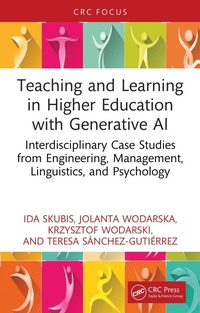
Teaching and Learning in Higher Education with Generative AI
Interdisciplinary Case Studies from Engineering, Management, Linguistics, and Psychology
1st Edition
Will be published approx. on 11. June 2026
158 pages
978-1-040-96047-9 (ISBN)
Description

This interdisciplinary book demonstrates how generative artificial intelligence (GenAI) changes higher education across diverse academic fields, including philology, management, engineering, and psychology. Drawing on empirical case studies, surveys, and experiments, this book combines theoretical and practical perspectives to explore AI's impact on learning and cognitive development. Each chapter offers discipline-specific analysis of how GenAI reshapes pedagogy - supporting multilingual education, enhancing reflective thinking, fostering self-regulated learning, and encouraging ethical awareness. By comparing case studies from varied academic and cultural contexts, this book highlights the opportunities and challenges of AI adoption, emphasizing responsible, creative, and critically informed approaches to academic innovation. It will appeal to researchers of AI in Higher Education across disciplines. Key features:
- Explains how GenAI transforms higher education across a variety of disciplines, from logistics to psychology.
- Includes practical and theoretical insights into AI's role in reshaping pedagogy, fostering critical thinking, and supporting multilingual education.
- Provides a global perspective on the opportunities and challenges of AI adoption through diverse case studies and empirical research.
- Explains how GenAI transforms higher education across a variety of disciplines, from logistics to psychology.
- Includes practical and theoretical insights into AI's role in reshaping pedagogy, fostering critical thinking, and supporting multilingual education.
- Provides a global perspective on the opportunities and challenges of AI adoption through diverse case studies and empirical research.
More details
Edition
1. Auflage
Language
English
Place of publication
London
United Kingdom
Publishing group
Taylor & Francis Ltd
Target group
College/higher education
Professional and scholarly
Illustrations
29 Tables, black and white; 4 Line drawings, black and white; 4 Illustrations, black and white
File size
2,22 MB
ISBN-13
978-1-040-96047-9 (9781040960479)
Copyright in bibliographic data and cover images is held by Nielsen Book Services Limited or by the publishers or by their respective licensors: all rights reserved.
Schweitzer Classification
Other editions
Additional editions
Ida Skubis | Krzysztof Wodarski | Jolanta Wodarska
Teaching and Learning in Higher Education with Generative AI
Interdisciplinary Case Studies from Engineering, Management, Linguistics, and Psychology
Book
approx. 06/2026
1st Edition
CRC Press
€68.50
Not yet published
Persons
Ida Skubis is an Assistant Professor at the Silesian University of Technology. A linguist with a PhD and MA degrees in four languages, she combines academic and international managerial experience. Her work focuses on interdisciplinary AI research, ethics, and management. She has received prestigious fellowships, including 10-month fellowships under Marie Sklodowska-Curie agreement in France and Israel, and numerous awards, including the scholarship of The Minister of Education and Science for Outstanding Young Scientists.
Jolanta Wodarska, PhD, DSc (Habilitation), Eng., is a Professor at the Silesian University of Technology in Poland. Her research interests focus on investment project planning, with particular emphasis on evaluating financial performance and implementation risk, as well as on methods and concepts for managing contemporary organizations. She is currently engaged in research on the application of artificial intelligence, including its use in education.
Krzysztof Wodarski, PhD, DSc (Habilitation), Eng., is a Professor at the Silesian University of Technology in Poland. His work includes strategic management and project management and more recently the application of artificial intelligence in business and education. He has extensive experience in higher education management and in business and science support institutions that foster entrepreneurship and investment.
Teresa Sanchez-Gutierrez, PhD, is an Associate Professor at the University of Cordoba, Spain, specializing in psychology and psychopharmacology. She has extensive experience in national and European research projects, international research stays, and academic leadership. Her work focuses on psychosis, adolescent cannabis use, biopsychosocial risk factors, and psychoeducational interventions, with contributions to innovative mental health research and applied clinical psychology.
Jolanta Wodarska, PhD, DSc (Habilitation), Eng., is a Professor at the Silesian University of Technology in Poland. Her research interests focus on investment project planning, with particular emphasis on evaluating financial performance and implementation risk, as well as on methods and concepts for managing contemporary organizations. She is currently engaged in research on the application of artificial intelligence, including its use in education.
Krzysztof Wodarski, PhD, DSc (Habilitation), Eng., is a Professor at the Silesian University of Technology in Poland. His work includes strategic management and project management and more recently the application of artificial intelligence in business and education. He has extensive experience in higher education management and in business and science support institutions that foster entrepreneurship and investment.
Teresa Sanchez-Gutierrez, PhD, is an Associate Professor at the University of Cordoba, Spain, specializing in psychology and psychopharmacology. She has extensive experience in national and European research projects, international research stays, and academic leadership. Her work focuses on psychosis, adolescent cannabis use, biopsychosocial risk factors, and psychoeducational interventions, with contributions to innovative mental health research and applied clinical psychology.
Content
Introduction.
Chapter 1: Generative AI and German Pluricentrism: ChatGPT and Advancing Language Education.
Chapter 2: Diversity of Use and Attitudes Toward Generative AI in Academic Teaching.
Chapter 3: Critical Thinking Competences and the Use of Generative AI.
Chapter 4: Attitudes, Perceptions, and Self-Regulated Learning in the Use of AI in Psychology Education.
Conclusions.
References.
Index.
Chapter 1: Generative AI and German Pluricentrism: ChatGPT and Advancing Language Education.
Chapter 2: Diversity of Use and Attitudes Toward Generative AI in Academic Teaching.
Chapter 3: Critical Thinking Competences and the Use of Generative AI.
Chapter 4: Attitudes, Perceptions, and Self-Regulated Learning in the Use of AI in Psychology Education.
Conclusions.
References.
Index.
