

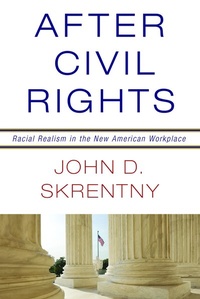
After Civil Rights
Racial Realism in the New American Workplace
1st Edition
Published on 24. November 2013
416 pages
978-1-4008-4849-2 (ISBN)
Description

A provocative new approach to race in the workplace
What role should racial difference play in the American workplace? As a nation, we rely on civil rights law to address this question, and the monumental Civil Rights Act of 1964 seemingly answered it: race must not be a factor in workplace decisions. In After Civil Rights, John Skrentny contends that after decades of mass immigration, many employers, Democratic and Republican political leaders, and advocates have adopted a new strategy to manage race and work. Race is now relevant not only in negative cases of discrimination, but in more positive ways as well. In today's workplace, employers routinely practice "racial realism," where they view race as real-as a job qualification. Many believe employee racial differences, and sometimes immigrant status, correspond to unique abilities or evoke desirable reactions from clients or citizens. They also see racial diversity as a way to increase workplace dynamism. The problem is that when employers see race as useful for organizational effectiveness, they are often in violation of civil rights law.
After Civil Rights examines this emerging strategy in a wide range of employment situations, including the low-skilled sector, professional and white-collar jobs, and entertainment and media. In this important book, Skrentny urges us to acknowledge the racial realism already occurring, and lays out a series of reforms that, if enacted, would bring the law and lived experience more in line, yet still remain respectful of the need to protect the civil rights of all workers.
What role should racial difference play in the American workplace? As a nation, we rely on civil rights law to address this question, and the monumental Civil Rights Act of 1964 seemingly answered it: race must not be a factor in workplace decisions. In After Civil Rights, John Skrentny contends that after decades of mass immigration, many employers, Democratic and Republican political leaders, and advocates have adopted a new strategy to manage race and work. Race is now relevant not only in negative cases of discrimination, but in more positive ways as well. In today's workplace, employers routinely practice "racial realism," where they view race as real-as a job qualification. Many believe employee racial differences, and sometimes immigrant status, correspond to unique abilities or evoke desirable reactions from clients or citizens. They also see racial diversity as a way to increase workplace dynamism. The problem is that when employers see race as useful for organizational effectiveness, they are often in violation of civil rights law.
After Civil Rights examines this emerging strategy in a wide range of employment situations, including the low-skilled sector, professional and white-collar jobs, and entertainment and media. In this important book, Skrentny urges us to acknowledge the racial realism already occurring, and lays out a series of reforms that, if enacted, would bring the law and lived experience more in line, yet still remain respectful of the need to protect the civil rights of all workers.
All prices
More details
Edition
Course Book
Language
English
Place of publication
Princeton, NJ
United States
Publishing group
De Gruyter
Target group
Professional and scholarly
Edition type
Digital original
Product notice
Reflowable
Illustrations
1 halftone. 8 line illus.
File size
2,08 MB
ISBN-13
978-1-4008-4849-2 (9781400848492)
Schweitzer Classification
Other editions
Additional editions
Book
11/2015
Princeton University Press
€30.60
Shipment within 10-20 days
Book
12/2013
Princeton University Press
€49.60
Shipment within 10-20 days
Person
John D. Skrentny is professor of sociology and director of the Center for Comparative Immigration Studies at the University of California, San Diego. His books include The Minority Rights Revolution and The Ironies of Affirmative Action: Politics, Culture, and Justice in America.
Content
List of Figures and Tables ix
Preface xi
Chapter 1 Managing Race in the American Workplace 1
Chapter 2 Leverage Racial Realism in the Professions and Business 38
Chapter 3 We the People Racial Realism in Politics and Government 89
Chapter 4 Displaying Race for Dollars Racial Realism in Media and Entertainment 153
Chapter 5 The Jungle Revisited? Racial Realism in the Low-Skilled Sector 216
Chapter 6 Bringing Practice, Law, and Values Together 265
Notes 291
Index 383
Preface xi
Chapter 1 Managing Race in the American Workplace 1
Chapter 2 Leverage Racial Realism in the Professions and Business 38
Chapter 3 We the People Racial Realism in Politics and Government 89
Chapter 4 Displaying Race for Dollars Racial Realism in Media and Entertainment 153
Chapter 5 The Jungle Revisited? Racial Realism in the Low-Skilled Sector 216
Chapter 6 Bringing Practice, Law, and Values Together 265
Notes 291
Index 383

