

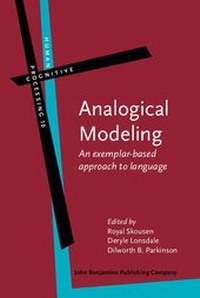
Analogical Modeling
An exemplar-based approach to language
1st Edition
Published on 29. November 2002
X, 416 pages
978-90-272-9694-8 (ISBN)
Description

Analogical Modeling (AM) is an exemplar-based general theory of description that uses both neighbors and non-neighbors (under certain well-defined conditions of homogeneity) to predict language behavior. This book provides a basic introduction to AM, compares the theory with nearest-neighbor approaches, and discusses the most recent advances in the theory, including psycholinguistic evidence, applications to specific languages, the problem of categorization, and how AM relates to alternative approaches of language description (such as instance families, neural nets, connectionism, and optimality theory). The book closes with a thorough examination of the problem of the exponential explosion, an inherent difficulty in AM (and in fact all theories of language description). Quantum computing (based on quantum mechanics with its inherent simultaneity and reversibility) provides a precise and natural solution to the exponential explosion in AM. Finally, an extensive appendix provides three tutorials for running the AM computer program (available online).
More details
Other editions
Additional editions
Royal Skousen | Deryle Lonsdale | Dilworth B. Parkinson
Analogical Modeling
An exemplar-based approach to language
Book
11/2002
John Benjamins Publishing Co
€132.50
Shipment within 10-15 days
Persons
Content
- Analogical Modeling
- Editorial page
- Title page
- LCC data
- Table of contents
- List of contributors
- Introduction
- Part I: The basics of Analogical Modeling
- Chapter 1: An overview of Analogical Modeling
- Chapter 2: Issues in Analogical Modeling
- Part II: Psycholinguistic evidence for Analogical Modeling
- Chapter 3: Skousen's analogical approach as an exemplar-based model of categorization
- Part III: Applications to specific languages
- Chapter 4: Applying AnalogicalModeling to the German plural
- Chapter 5: Testing Analogical Modeling
- Part IV: Comparing Analogical Modeling with TiMBL
- Chapter 6: A comparison of two analogical models. Tilburg Memory-Based Learner versus Analogical Modeling
- Chapter 7: A comparison of Analogical Modeling to Memory-Based Language Processing
- Chapter 8: Analogical hierarchy Exemplar-based modeling of linkers in Dutch noun-noun compounds
- Part V: Extending Analogical Modeling
- Chapter 9: Expanding k-NN analogy with instance families
- Chapter 10: Version spaces, neural networks, and Analogical Modeling
- Chapter 11: Exemplar-driven analogy in Optimality Theory
- Chapter 12: The hope for analogous categories
- Part VI: Quantum computing and theexponential explosion
- Chapter 13: AnalogicalModeling and quantum computing
- Part VII: Appendix
- Chapter 14: Data files for Analogical Modeling
- Chapter 15: Running the Perl/C version of the Analogical Modeling program
- Chapter 16: Implementing the Analogical Modeling algorithm
- Index
- In the series HUMAN COGNITIVE PROCESSING (HCP)
