

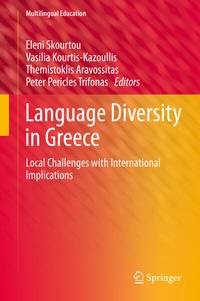
Language Diversity in Greece
Description

This volume explores how linguistic and cultural diversity in Greece, caused by various waves of emigration and immigration, has transformed Greek society and its educational system. It examines the country's current linguistic diversity, which is characterised by the languages of immigrants, repatriates, refugees, Roma, Muslim minorities, and Pomaks as well as linguistic varieties and dialects; and how schools and the state have designed and implemented programmes to deal with the significant educational challenges posed by these culturally and linguistically diverse groups.
In this regard, the book takes into account the nature and evolution of Greek society; Greece's traditional role as a labour-exporting country with a long history of migration to other countries; and major political, economic and social developments, such as the collapse of communism, the opening of borders in Eastern Europe, and the influx of immigrants from Muslim countries.
More details
Other editions
Additional editions
Persons
Content
Foreword; Jim Cummins.- Introduction; Eleni Skourtou, Vasilia Kourtis-Kazoullis, Themistoklis Aravossitas & Peter Pericles Trifonas.- Part I: Immigrant students in the Greek educational system.- Bilingual Infants and their treatment in the Greek Kindergarten; Dionysia Kontogianni, Vassilios Oikonomidis.- Bilingual Students in the Public Primary Education Context in Greece: A Deterrent for the Greek Educational Landscape or a Chance for Improvement? Evangelia Papalexatou, Vassilios Zorbas.- Interviewing as Understanding: Principles and Modalities for Transforming a Qualitative Research Instrument into a Stage of Integration Process for Immigrants; George Androulakis, Anastasia Gkaintartzi, Roula Kitsiou, Zoi Liveranou, Evi Markou.- Identities under Negotiation in a Second Language Academic Literacies Course; Christina Takouda, Dimitrios Koutsogiannis.- School and Family Cooperation: Strengthening Parents' Knowledge of Greek; Eleni Karantzola, Ioannis Galantomos.- Greek-SpanishCommunity: The Maintenance of the Spanish Language in Mixed Families; Anastasia-Olga Tzirides.- Part II: Muslim Students and Minority Schools.- The Project on the Education of Muslim Minority Children in Thrace, Greece: Stimulating the Educational Process and Enhancing Collaborative Practices; Thalia Dragonas, Anna Frangoudaki.- Reforming History for School and History for Education: A Pilot Study for History-Teaching for the Muslim Minority in Thrace; Vasilis Tsafos.- Pilot Literature Teaching in Thrace Muslim Minority; Venetia Apostolidou, Christos Daniil, Eleni Hodolidou.- A Pilot Application of Educational Materials for the Natural Sciences in the Programme for the Education of Muslim Minority Children in Thrace; Vasilis Tselfes.- Part III: Education of Roma Students.- Investigating Literacy Issues on Roma Education; Eleni Skourtou.- Expanded Pedagogical Spaces: Enhancing Roma Students' Involvement in School; Eleni Gana, Charoula Stathopoulou, Christos Govaris.- Underachievement ofRoma Children in Greece; Dimitrios Kassis.- Part IV: Education in the Greek Diaspora.- Narratives of Greekness in the Diaspora; Efthymia Papalexopoulou.- The Future of the Bilingual Greek Orthodox Minority in Istanbul: New Data; Eleni Sella-Mazi, Rika Rompopoulou.- Family Language Policies among Greek Migrants in Luxemburg: Results from a Comparative Study; Nikos Gogonas.- New Directions for Greek Education in the Diaspora: Teaching Heritage Language Learners in Canada; Themistoklis Aravossitas, Marianthi Oikonomakou.
