

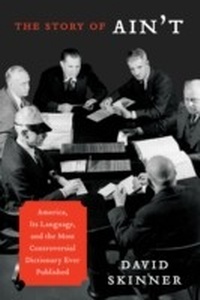
The Story of Ain't
Description

?It takes true brilliance to lift the arid tellings of lexicographic fussing into the readable realm of the thriller and the bodice-ripper....David Skinner has done precisely this, taking a fine story and honing it to popular perfection.?
?Simon Winchester, New York Times bestselling author of The Professor and the Madman
The captivating, delightful, and surprising story of Merriam Webster's Third Edition, the dictionary that provoked America's greatest language controversy. In those days, Webster's Second was the great gray eminence of American dictionaries, with 600,000 entries and numerous competitors but no rivals. It served as the all-knowing guide to the world of grammar and information, a kind of one-stop reference work.
In 1961, Webster's Third came along and ignited an unprecedented controversy in America's newspapers, universities, and living rooms. The new dictionary's editor, Philip Gove, had overhauled Merriam's long held authoritarian principles to create a reference work that had ?no traffic with...artificial notions of correctness or authority. It must be descriptive not prescriptive.? Correct use was determined by how the language was actually spoken, and not by ?notions of correctness? set by the learned few. Dwight MacDonald, a formidable American critic and writer, emerged as Webster's Third's chief nemesis when in the pages of the New Yorker he likened the new dictionary to the end of civilization..
The Story of Ain't describes a great cultural shift in America, when the voice of the masses resounded in the highest halls of culture, when the division between highbrow and lowbrow was inalterably blurred, when the humanities and its figureheads were shunted aside by advances in scientific thinking. All the while, Skinner treats the reader to the chippy banter of the controversy's key players. A dictionary will never again seem as important as it did in 1961.
- The Dictionary Wars: Discover how the 1961 publication of Webster's Third sparked a national firestorm, pitting traditionalists against linguistic reformers in a battle for the soul of the language.
- Descriptive vs. Prescriptive: Explore the explosive central debate: should a dictionary dictate correct usage, or should it simply describe how people actually talk? The answer would change lexicography forever.
- A Cast of Unforgettable Characters: Meet dictionary editor Philip Gove, the quiet revolutionary, and his brilliant nemesis, New Yorker critic Dwight Macdonald, whose fiery essays likened the new dictionary to the end of civilization.
- The Blurring of American Culture: Witness a pivotal moment in American history, as the lines between highbrow and lowbrow blur and the very definition of 'correctness' is challenged in the pages of a dictionary.
All prices
More details
Other editions
Additional editions
Person
David Skinner is a writer and editor living in Alexandria, Virginia. He writes about language, culture, and his life as a husband, father, and suburbanite. He has been a staff editor at the Weekly Standard, for which he still writes, and an editor of Doublethink magazine. He has written for the Wall Street Journal, the New Atlantis, Slate, the Washington Times, the American Spectator, and many other publications. Skinner is the editor of Humanities magazine, which is published by the National Endowment for the Humanities, and is on the usage panel for the American Heritage Dictionary.
