

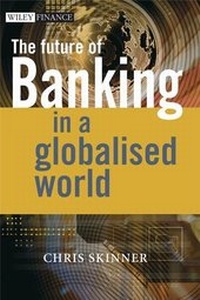
The Future of Banking
Description

Reviews / Votes
"The well-known industry prognosticator and contributor Chris Skinner has two new books coming out shortly from John Wiley..." ( Banking Technology, March 2007)More details
Other editions
Additional editions
Person
Content
Challenges for Bankers in the 21st Century.
PART 1 GLOBAL ISSUES.
1. India and China's Impact on Global Banking. 1.1 India versus China, part one: India services the world. 1.2 India's banking: run by civil servants. 1.3 India: the future is still bright. 1.4 India versus China: part two: a Chinese take-away. 1.5 China's banking: a renovation project. 1.6 China's banking: reforming through 2007. 1.7 Lessons to be learnt from China's banks. 1.8 Conclusion: China and India are two tigers you cannot ignore.
2. The Road from Baghdad to Zurich. 3. Faith in Banking.
4. When Two Tribes Go to War. 4.1 Round one. 4.2 End of round one. 4.3 Round two. 4.4 End of round two. 4.5 Round three. 4.6 A clear knockout, but who cleans up?
5. The European Union Unravels.
6. What Goes Around Comes Around.
7 Place Your Bets.
PART 2. RETAIL BANK MATTERS.
8. Strained Relationships.
9. The Banks That Like to Say No.
10. Edupyerryr Syndrome.
11. Call Centre of the Future. 11.1 Year 2008. 11.2 Year 2010.
12. The Big Issue - Fraud and Identity Theft. 12.1 The Internet time bomb. 12.2 The real issue here. 12.3 So what is the solution? 12.4 Biometrics. 12.5 Five-level authentication.
13. Channel technologies Through 2015. 13.1 Background. 13.2 The reality of the internet revolution. 13.3 Authentication technologies. 13.4 Authentication technologies: NFC, RFID and Zigbee. 13.5 Authentication technologies: the question of identity. 13.6 Connectivity technologies. 13.7 Video over internet protocol: critical for retail banking. 13.8 The decline of the keyboard. 13.9 Summary. 13.10 Key developments in front-office banking.
14. Administration Technologies Through 2015. 14.1 The arrival of the 'always-on society'. 14.2 Principles of the 'always-on society'. 14.2.1 If you stand still, you get run over. 14.2.2 Web 2.0. 14.2.3 Application versus platform. 14.2.4 Browsers versus services. 14.2.5 Computers versus devices. 14.2.6 Language versus interface. 14.2.7 Data versus data management. 14.2.8 Users versus participants. 14.2.9 Mass marketing versus collaborative commerce. 14.3 Building the 'ever-ready bank'. 14.3.1 The connectivity and authentication hub. 14.3.2 The information routing hub. 14.3.3 The applications hub. 14.3.4 The hub foundations. 14.4 Summary. 14.4.1 Key developments in back-office banking.
PART 3. PAYMENTS MATTERS.
15. The Cashless, Cardless Society. 15.1 The cashless society. 15.2 The cardless society.
16. Corporates Demand Access. 16.1 XML is one key to the TWIST approach. 16.2 'I'm as mad as hell and I'm not going to take it anymore! 16.3 See me, hear me.
17. SWIFT Changes in Wholesale Payments. 17.1 SWIFT2010 strategy.
18. The Future of Europe's Payments. 18.1 Why force the change? 18.2 The Single Payment Area (SPA). 18.3 How is it going? 18.4 By way of example, I want some euros using my credit card. 18.5 So how have Europe's banks responded? 18.6 STEP2: the Pan-European Automated Clearing House (PE-ACH). 18.7 The melting pot boils. 18.8 The Payments Services Directive.
PART 4. INVESTMENT BANK MATTERS.
19. Best Execution With Best Intentions.
20. Make or Break for Europe's Equity Markets. 20.1 The Markets in Financial Instruments Directive (MiFID). 20.2 The end of Europe's exchanges? 20.3 What will MiFID cost? 20.4 Is that it?
21. To Trade Or Not to Trade?
22. Risky Options.
SIBOS BLOGS.
SIBOS blog 2005: Copenhagen, Denmark.
SIBOS blog 2006: Sydney, Australia.
Appendix 1. Original Articles.
Appendix 2. About Chris Skinner.
Index.
