

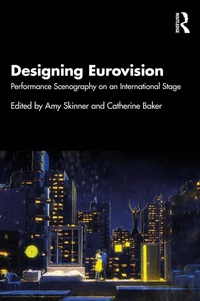
Designing Eurovision
Performance Scenography on an International Stage
Published on 14. May 2026
300 pages
978-1-040-51220-3 (ISBN)
Description

Designing Eurovision is the first book-length study of the visual and design elements of the Eurovision Song Contest (ESC).
As a unique visual phenomenon and commonly associated with spectacle performances, the scenography of Eurovision is in reality far more nuanced and layered, balancing acts of national identity-building with host country branding, visual tourism and cross-cultural aesthetics. The event demonstrates how ideological spaces are built across Europe and the wider world, highlighting the function of performance scenography in socio-political nation-building. Although the importance of the visual elements of Eurovision is widely acknowledged, this is the first volume to put ESC design front and centre, discussing the critical and practical aspects of creating performance scenography for this international stage. In addition, the volume highlights the significance of Eurovision in the development of performance technologies, frequently functioning as a test-bed for technological innovations in stage design for broadcast arena events. It also explores the visual design-led elements of the contest (set, costume, lighting and projection) and addresses the broader spatial dynamics of the ESC, exploring the socio-political elements of Eurovision performance space. The fluid relationship between the ESC as live performance and as Europe's largest televised cultural event opens up additional discussions in the book related to the role of liveness in scenographic practice.
This volume brings a unique focus on the materiality of the Eurovision stage, addressing multipronged topics including the history of ESC technologies, ESC scenography and national identity, ESC aesthetics and design, and the ESC host city as stage. It also incorporates interviews with practitioners who have worked on design elements for the ESC, giving practical perspectives on design at the contest. It will be of interest to researchers and scholars of theatre and performance, scenography, the Eurovision Song Contest, popular performance, and media and cultural studies, among others.
As a unique visual phenomenon and commonly associated with spectacle performances, the scenography of Eurovision is in reality far more nuanced and layered, balancing acts of national identity-building with host country branding, visual tourism and cross-cultural aesthetics. The event demonstrates how ideological spaces are built across Europe and the wider world, highlighting the function of performance scenography in socio-political nation-building. Although the importance of the visual elements of Eurovision is widely acknowledged, this is the first volume to put ESC design front and centre, discussing the critical and practical aspects of creating performance scenography for this international stage. In addition, the volume highlights the significance of Eurovision in the development of performance technologies, frequently functioning as a test-bed for technological innovations in stage design for broadcast arena events. It also explores the visual design-led elements of the contest (set, costume, lighting and projection) and addresses the broader spatial dynamics of the ESC, exploring the socio-political elements of Eurovision performance space. The fluid relationship between the ESC as live performance and as Europe's largest televised cultural event opens up additional discussions in the book related to the role of liveness in scenographic practice.
This volume brings a unique focus on the materiality of the Eurovision stage, addressing multipronged topics including the history of ESC technologies, ESC scenography and national identity, ESC aesthetics and design, and the ESC host city as stage. It also incorporates interviews with practitioners who have worked on design elements for the ESC, giving practical perspectives on design at the contest. It will be of interest to researchers and scholars of theatre and performance, scenography, the Eurovision Song Contest, popular performance, and media and cultural studies, among others.
More details
Language
English
Place of publication
London
United Kingdom
Publishing group
Taylor & Francis Ltd
Target group
College/higher education
Professional and scholarly
Illustrations
2 Tables, black and white; 24 Halftones, color; 24 Illustrations, color
File size
54,03 MB
ISBN-13
978-1-040-51220-3 (9781040512203)
Copyright in bibliographic data and cover images is held by Nielsen Book Services Limited or by the publishers or by their respective licensors: all rights reserved.
Schweitzer Classification
Other editions
Additional editions
Book
05/2026
1st Edition
Routledge
€52.50
Shipment within 10-20 days

Book
05/2026
1st Edition
Routledge
€192.50
Shipment within 10-20 days
Persons
Amy Skinner is Associate Professor in Co-Production in Mental Health Research at York St John University. She has specialist interests in scenography, mental health, and neurodiversity. Her book Meyerhold and the Cubists, on scenography and visual art, was long-listed for the 2019 Prague Quadrennial book prize. Her most recent publication explores scenography as resistance in mental health settings.
Catherine Baker is Reader in 20th Century History at the University of Hull. She specializes in media, popular culture, and national identity in post-Cold-War Europe, and has been publishing on Eurovision since 2008. Her most recent book is the edited collection The Routledge Handbook of Popular Music and Politics of the Balkans (2025).
Catherine Baker is Reader in 20th Century History at the University of Hull. She specializes in media, popular culture, and national identity in post-Cold-War Europe, and has been publishing on Eurovision since 2008. Her most recent book is the edited collection The Routledge Handbook of Popular Music and Politics of the Balkans (2025).
Content
Introduction: The Eurovision Song Contest through scenography and performance design
1. Eurovision as Combinatoire: the complex construction of the lighting and video in the Eurovision Song Contest
2. The scenography of backstage labour at Eurovision
3. 'Let's create our own world on that stage': a conversation with Andrew Cartmell
4. Accommodating multitudes: stage design and live production challenges at the Eurovision Song Contest during the 1980s and 1990s
5. 'It's a song contest, but it's also in many ways a technical competition': A chronology of Eurovision and a conversation with Ola Melzig
6. 'Welcoming Ukraine, Europe, and the world to Liverpool with open arms': a conversation with Julio Himede
7. A semblance of interaction: exploring logistical and theoretical issues within Eurovision's interactive digital performances
8. Designing a space for reflection: the case of Konstrakta
9. 'An ever-changing feast of ideas': A conversation with Jake Linzey
10. Costuming Eurovision: Trends, bodies, and technological futures
11. 'That's how you're representing yourself to the world': A conversation with Alin Le'Kal
12. Creating a world(ing) United By Music: interventions of cultural diplomacy between Ukraine and the United Kingdom in the Eurovision Song Contest 2023
13. Staging the nation: the politics of Eurovision host stages
14. The city as a stage: urban scenography and Liverpool's city-based programming at the 2023 Eurovision Song Contest
15. 'Scenography gives the starting point for your imagination': a conversation with TRI.Direction
Index
1. Eurovision as Combinatoire: the complex construction of the lighting and video in the Eurovision Song Contest
2. The scenography of backstage labour at Eurovision
3. 'Let's create our own world on that stage': a conversation with Andrew Cartmell
4. Accommodating multitudes: stage design and live production challenges at the Eurovision Song Contest during the 1980s and 1990s
5. 'It's a song contest, but it's also in many ways a technical competition': A chronology of Eurovision and a conversation with Ola Melzig
6. 'Welcoming Ukraine, Europe, and the world to Liverpool with open arms': a conversation with Julio Himede
7. A semblance of interaction: exploring logistical and theoretical issues within Eurovision's interactive digital performances
8. Designing a space for reflection: the case of Konstrakta
9. 'An ever-changing feast of ideas': A conversation with Jake Linzey
10. Costuming Eurovision: Trends, bodies, and technological futures
11. 'That's how you're representing yourself to the world': A conversation with Alin Le'Kal
12. Creating a world(ing) United By Music: interventions of cultural diplomacy between Ukraine and the United Kingdom in the Eurovision Song Contest 2023
13. Staging the nation: the politics of Eurovision host stages
14. The city as a stage: urban scenography and Liverpool's city-based programming at the 2023 Eurovision Song Contest
15. 'Scenography gives the starting point for your imagination': a conversation with TRI.Direction
Index
