

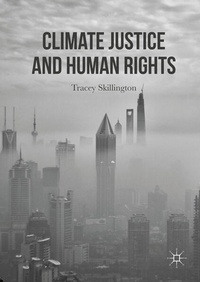
Climate Justice and Human Rights
Description

This book shows that escalating climate destruction today is not the product of public indifference, but of the blocked democratic freedoms of peoples across the world to resist unwanted degrees of capitalist interference with their ecological fate or capacity to change the course of ecological disaster. The author assesses how this state of affairs might be reversed and the societal relevance of universal human rights rejuvenated. It explores how freedom from want, war, persecution and fear of ecological catastrophe might be better secured in the future through a democratic reorganization of procedures of natural resource management and problem resolution amongst self-determining communities. It looks at how increasing human vulnerability to climate destruction forms the basis of a new peoples-powered demand for greater climate justice, as well as a global movement for preventative action and reflexive societal learning.
Reviews / Votes
"Tracey Skillington extends the normative debate on climate change considerably. She points out that climate change does not only affect the well-being of current and future generations. The inability or unwillingness of many states to react appropriately to climate change shows that it deepens and perpetuates domination across borders and it highlights the devastating consequences of the Westphalian system with regard to such global collective action problems. Starting from these insights, Skillington offers a new approach to what climate justice requires." (Andreas Niederberger, Professor of Philosophy, University of Duisburg-Essen, Germany)
More details
Other editions
Additional editions
Person
Dr. Tracey Skillington is Lecturer in Sociology at University College Cork, Republic of Ireland, where she had received her PhD in visual culture and the contemporary political spectacle. Her research interests include issues of justice that arise in relation to climate change and transnational memory projects. Recent publications include 'Climate Change and the human rights challenge: extending justice beyond the borders of the nation state' in The International Journal of Human Rights (2012), and 'Perspectives on Climate Change' in a special issue of the European Journal of Social Theory (2015) for which she was Editor.
