

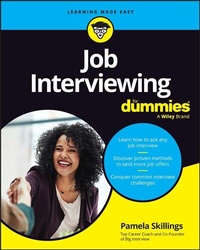
Job Interviewing For Dummies
Description

Job Interviewing For Dummies will teach you how to prepare for your next job interview, deal with tough questions, and gain the tools and skills to interview with confidence and poise. This book offers a structured, step-by-step approach for succeeding in virtual and in-person interviews. You'll find information, strategies, and examples to empower you to present your best self to potential employers. Learn how to anticipate and prepare for the most likely questions, regardless of your level or industry, and be prepared for anything--an interview on short notice, explaining gaps on your resume, changing careers, and beyond. With examples and stories from the interview trenches, this friendly Dummies guide will help you breathe new life into your job search.
* Gain the poise you need to own the interview room (or the video chat)
* Brush up on your interview skills if you haven't done this in a while
* Come prepared with impressive answers and questions to ask
* Overcome common challenges like resume gaps
This book is for anyone interested in finding a new job or helping others in their job search. With Job Interviewing For Dummies, be prepared to hear "yes" more often!
More details
Other editions
Additional editions
Person
Content
Part 1: Learning to Ace Any Job Interview 3
Chapter 1: Accelerating Your Career with Interview Skills 5
Chapter 2: Understanding the New World of Interviewing 17
Chapter 3: Getting to Know the Players and the Rules 53
Part 2: Using the Big Interview Approach to Interview Preparation 87
Chapter 4: Understanding Your Mission 89
Chapter 5: Preparing to Impress 105
Chapter 6: "Tell Me About Yourself" 117
Part 3: Acing Common Questions 133
Chapter 7: "Why Do You Want to Work Here?" 135
Chapter 8: "What Are Your Strengths and Weaknesses?" 145
Chapter 9: "Where Do You See Yourself in Five Years?" 161
Chapter 10: "Why Are You Looking for a New Role Now?" 167
Chapter 11: Mastering Behavioral Questions 177
Chapter 12: Answering Tricky Questions 193
Chapter 13: Asking Smart Questions 211
Part 4: Pulling Everything Together 221
Chapter 14: Your Interview Success Plan 223
Chapter 15: Mastering Nonverbal Communications 249
Chapter 16: Overcoming Common Interview Challenges 277
Part 5: The Part of Tens 303
Chapter 17: Ten Interview Tips from Hiring Managers 305
Chapter 18: Ten Red Flags You're Interviewing at a Toxic Workplace 315
Chapter 19: Ten Tips for Landing More Interviews 323
Index 331
Chapter 1
Accelerating Your Career with Interview Skills
IN THIS CHAPTER
Understanding the importance of interview skills
Meeting your interview coach
Avoiding common mistakes
Embracing best practices
Are you ready to learn how to ace your next job interview? I'm here to help.
I realize that you're probably not reading this book for fun. You're looking for a new job and you know you'll need to win over a series of interviewers before you can land that offer.
Demystifying the job interview is my specialty, so I'm well aware that most people dread interviewing and find the whole process exhausting.
It's true that job interviews can be challenging, but I can teach you the skills you need in order to wow any interviewer. These skills will boost your confidence and expand your career opportunities.
Mastering the Simple Techniques to Ace Any Job Interview
I'm here to give you actionable advice and real strategies, not just a lot of theory.
These are the same interview preparation techniques that I've taught to thousands of interview coaching clients over the years.
These techniques work. I've been teaching people to land their dream jobs for a long time.
I've also spent more than 15 years working as a hiring manager and human resources consultant.
I work on both sides of the interview table - so I know what interviewers are looking for and what turns them off.
Finally, I'm the founder and chief coach at Big Interview, an online interview training platform that is licensed by more than 600 schools, universities, and government agencies. Millions of users have benefited from our lessons and practice tools.
In other words, I spend all my time helping people with interviews and I want to share this knowledge with you.
Preparing for success
The most qualified candidate doesn't always get the job. In addition to the right qualifications and background, you need solid interviewing skills to compete in today's job market.
The first mantra I want you to learn is that preparation is everything.
Prepare well and you'll perform better than nine out of ten of your competitors. The trick lies in how you prepare.
If you know how to prepare, you can anticipate the majority of the interview questions you'll face. You can plan how to answer those questions in a way that will position you as a superior hire. You can practice in a way that boosts your confidence and refines your presentation skills.
I strongly believe that anyone with the right preparation can excel at interviewing.
Projecting confidence
Another rule to live by: Convey confidence, get hired.
If you seem confident in your abilities, you'll inspire confidence in others.
Confidence comes through in your body language and how you make eye contact, but especially in how you talk about your skills and accomplishments.
Projecting confidence is where a lot of job seekers run into trouble. Most people don't have a lot of practice in the art of self-promotion, so they shy away from the idea of "selling" their qualifications in interviews.
"I'm just not good at selling myself!" This is one of the most common complaints I hear from my coaching clients.
I love hearing these words because I know I can help these clients make a dramatic improvement in their interview game pretty quickly. They tend to be people who are successful and confident and poised, but just a bit too modest when it comes to talking about themselves.
Luckily, you can learn to "sell" yourself without feeling like a sellout.
Take my client Lawrence, for example. He was an accomplished IT professional with an impressive resume and no problem standing up to speak in front of a room full of colleagues.
However, he was struggling in job interviews, and he didn't understand why. Despite his impressive resume, he was being passed over in favor of other candidates.
The issue became clear in our first practice interview. He avoided bringing up his most impressive accomplishments and then stumbled and generalized when asked about his strengths.
Lawrence was a humble guy by nature and unaccustomed to talking about himself in glowing terms. Also, for the past several years, he had been promoted based on his work and his reputation, so his interview skills were rusty. He wasn't used to interviewing with people who didn't already know him and his track record.
If you can relate to Lawrence's challenges, you're not alone. Some of my most impressive clients have suffered from this same discomfort with self-promotion.
Like Lawrence, you can learn to work through this issue and start attracting offers.
Confidence versus arrogance
In daily life, people are rarely called on to list their strengths and weaknesses or summarize their proudest accomplishments.
In fact, many people grew up with the conditioning that it's obnoxious to brag or call attention to their achievements. This is just good manners when it comes to cocktail parties, but it will hurt you in job interviews.
It's unfair, but great candidates often get passed over for people with worse qualifications but better persuasion skills.
Candidates worry too much about coming across as arrogant - I would argue that if you're worried about sounding arrogant, you aren't in danger of actually crossing that line. I've had only a few coaching clients whom I advised on toning down their self-promotion. Every other client has benefited from turning up the volume on their accomplishments.
Yes, you should aim to be polite and likable. However, the interviewer also wants you to communicate what makes you stand out from other candidates. That's why you're there.
Their job is to pick the best candidate. It's impossible to get a full and complete picture of any human being from a conversation that lasts only 30 or 40 minutes, so the interviewer must rely on a limited set of data points.
You must clearly convey what sets you apart and how you can benefit the organization if hired.
I'm not recommending an aggressive or dishonest approach here. I'm talking about putting your best foot forward, knowing your strengths, and communicating them in a memorable and persuasive way.
To make sure you don't cross the line into arrogance, avoid
- Trying to hijack or "take control" of the interview
- Interrupting or correcting your interviewer
- Being condescending
- Acting like you're too good for the job
In a job interview, it's never a good idea to make your interviewer feel stupid, defensive, or annoyed. You want to make a connection, establish rapport, and make a positive impression.
Despite your expertise and impressive background, people won't want to work with you if they think you're obnoxious, demanding, confrontational, or full of hot air. Interviewers will worry that you have an attitude problem and wouldn't be a good team player.
How to sell yourself in an interview
One way to get more comfortable channeling your self-promotional side is to think about it as switching into Interview mode.
Interview mode is that version of you that's irresistible to employers. It's not a fake persona; it's just a more polished and confident and professional version of you - a version that isn't afraid to talk about how great you are.
Later in this book, I cover a number of effective ways to embrace Interview mode and "brag in a likable way." For now, here are a few big-picture recommendations to keep in mind as you read on:
- Own your strengths.
- Share your success stories.
- Make your individual contributions clear.
- Avoid self-deprecating comments.
- Practice confident, nonverbal communication (posture and eye contact, for example).
Being authentic
The good news is that you can learn to sell yourself in a way that still feels authentic. You don't have to lie, exaggerate, or act like a scam artist. You just have to do the work of understanding your key strengths and preparing to communicate them in a concise and compelling way.
Never, ever lie in a job interview. Interviewers are good at sniffing out blatant dishonesty; any lies you tell are likely to come back to haunt you. I encourage you to be truthful.
I want to stress that selling yourself doesn't mean misrepresenting the facts. Interviewers are more likely to connect with you and like you if they see you as a real and authentic human being and can get a sense of your true personality and values during the interview.
Sure, honesty is the best policy, but that doesn't mean you have to reveal everything - just be strategic about what you emphasize and how you present information. When it comes to job interviews, there is such a thing as being too truthful. You don't have to volunteer every weakness.
Understanding the interviewer's perspective
Interviewers are not all-powerful, judgmental robots. They are humans with their own jobs to do, with their own worries and...
