

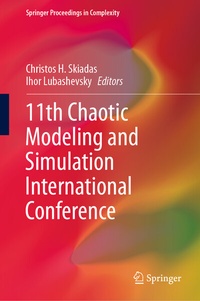
11th Chaotic Modeling and Simulation International Conference
1st Edition
Published on 28. May 2019
XIII, 318 pages
978-3-030-15297-0 (ISBN)
Description

Gathering the proceedings of the 11th CHAOS2018 International Conference, this book highlights recent developments in nonlinear, dynamical and complex systems. The conference was intended to provide an essential forum for Scientists and Engineers to exchange ideas, methods, and techniques in the field of Nonlinear Dynamics, Chaos, Fractals and their applications in General Science and the Engineering Sciences.
The respective chapters address key methods, empirical data and computer techniques, as well as major theoretical advances in the applied nonlinear field. Beyond showcasing the state of the art, the book will help academic and industrial researchers alike apply chaotic theory in their studies.
The respective chapters address key methods, empirical data and computer techniques, as well as major theoretical advances in the applied nonlinear field. Beyond showcasing the state of the art, the book will help academic and industrial researchers alike apply chaotic theory in their studies.
More details
Series
Language
English
Place of publication
Cham
Switzerland
Publishing group
Springer International Publishing
Product notice
Reflowable
Illustrations
XIII, 318 p. 161 illus., 97 illus. in color.
File size
14,50 MB
ISBN-13
978-3-030-15297-0 (9783030152970)
DOI
10.1007/978-3-030-15297-0
Schweitzer Classification
Other editions
Additional editions

Christos H. Skiadas | Ihor Lubashevsky
11th Chaotic Modeling and Simulation International Conference
Book
05/2019
Springer
€106.99
Shipment within 7-9 days
Content
- Intro
- Committees-CHAOS 2018
- Honorary Committee and Scientific Advisors
- International Scientific Committee
- Plenary-Keynote-Invited Speakers
- Preface
- 11th Chaotic Modeling and Simulation International Conference (5-8 June 2018, Rome, Italy)
- Contents
- Gravitational Waves, Relic Photons and Higgs Boson in a Fractal Models of the Universe
- 1 Introduction
- 2 Anisotropic Model for Binary Black Holes
- 3 Description of Transient Signals from Binary Objects
- 4 Description of an Individual Layer with Variable Parameters
- 5 Conclusions
- References
- Effect of Ordering of Displacement Fields Operators of Separate Quantum Dots, Elliptical Cylinders on the Deformation Field of Coupled Fractal Structures
- 1 Introduction
- 2 Ordering of the Displacement Fields Operators of Separate Quantum Dots
- 3 Coupled Fractal Structure: Quantum Dots and Elliptical Cylinders
- 4 Conclusions
- References
- Percolation Process in the Presence of Velocity Fluctuations: Two-Loop Approximation
- 1 Introduction
- 2 The Model
- 3 Feynman Diagrammatic Technique
- 4 UV Renormalization
- 5 Conclusion
- References
- Phase Transition in Incompressible Active Fluid: Effect of Long-Range Interactions
- 1 Introduction
- 2 Microscopic Formulation
- 2.1 Effect of Long-Range Interactions
- 3 Field-Theoretic Approach
- 4 Renormalization Group Analysis
- 5 Critical Properties
- 5.1 Fixed Points for Finite w
- 5.2 Fixed Points for w rightarrowinfty
- 6 Conclusion
- References
- On the Exponential Decay of Solutions in Dual-Phase-Lag Porous Thermoelasticity
- 1 Introduction and Basic Equations
- 2 Preliminaries
- 3 Existence of Solutions
- 4 Case e&0. Exponential Decay of Solutions
- 5 Case e=0. Slow Decay of Solutions
- 6 Conclusions
- References
- Dynamical Invariant Calculations Involving Evolution Equations with Discontinuities
- 1 Introduction
- 2 Jerk Systems
- 2.1 JD3 System
- 2.2 JD4 System
- 2.3 Adaptive Control of the JD3 System
- 3 Conclusion
- References
- Gröbner Basis Method in FitzHugh-Nagumo Model
- 1 Introduction
- 2 Results
- 3 Discussion
- References
- Digital Signature: Quantum Chaos Approach and Bell States
- 1 Introduction
- 2 The Model
- 3 Bell States
- 4 QDS Scheme
- 5 Results
- 6 The Security Analyze
- 6.1 Security Against Repudiation
- 6.2 Security Against Forging
- 7 Conclusions
- References
- Large Scale Behavior of Generalized Stochastic Magnetohydrodynamic Turbulence with Mirror Symmetry Breaking
- 1 Introduction
- 2 Model A of Active Vector Advection with Spatial Parity Violation
- 3 Field Theoretic Formulation of the A Model of Active Admixture Without Symmetry Breaking
- 4 Analysis of Canonical Dimensions
- 5 Renormalization Group Approach to the A Model of Active Advection
- 6 Helicity Induced Instability
- 7 Field theoretic Formulation of the A Model with Symmetry Breaking
- 8 Renormalization Group Analysis of the A Model with Symmetry Breaking for Helical Environments
- 9 Conclusion
- References
- Modeling Turbulence via Numerical Functional Integration
- 1 Introduction
- 2 Functional Integral for the Generating Function
- 3 Numerical Implementation
- 4 Single-Time Velocity Correlation of Burgers Equation
- 5 Discussion
- 6 Conclusion
- References
- Nonlinear Noise Reduction on TESS Simulated Data
- 1 Introduction
- 1.1 Nonlinear Time Series Analysis
- 1.2 Data Requirements
- 2 Kepler Versus TESS as Data Sources
- 3 The Simulated Data
- 4 The Processing Command-Line Sequence in TISEAN
- 5 Example I-Nonlinear Analysis of Simulated Data for a Noise-like Light Curve
- 5.1 Choice of Delay and Embedding Dimension
- 5.2 Power Spectra and Light Curve
- 6 Example II-Nonlinear Analysis of Simulated Data for a Periodic Light Curve
- 6.1 Choice of Delay and Embedding Dimension
- 6.2 Phase Space Reconstruction
- 6.3 Power Spectra for TIC 18114057
- 7 Discussion: Choice of Parameters for Nonlinear Analysis of Tess Simulated Data
- 7.1 Time Delay
- 7.2 Phase-Space Dimension
- 8 Conclusion: Even for Pre-processed Data Nonlinear Noise Reduction Works!
- References
- A Phase-Space Approach to Non-stationary Nonlinear Systems
- 1 Introduction
- 2 A Time-Dependent (Driven) Quantum Oscillator
- 3 The Relation with the Solitonic and Statistical Physics
- 4 Phase-Space Representation of Nonlinear Dynamics
- 5 Conclusions
- References
- Spatial Extent of an Attractor
- 1 Introduction
- 2 Normal Form of a Dynamical System
- 3 Analysis of Sprott Systems by Normal Form Approach
- 3.1 Sprott D System
- 3.2 Sprott E System
- 3.3 Sprott F System
- 4 Conclusion
- References
- The FitzHugh-Nagumo Model and Spatiotemporal Fractal Sets Based on Time-Dependent Chaos Functions
- 1 Introduction
- 2 A Time-Dependent Logistic Map
- 3 The FitzHugh-Nagumo Model and 2-D Time-Dependent Chaos Map
- 4 Spatiotemporal Fractal Sets
- 5 Conclusions
- Appendix
- References
- Stochastic Navier-Stokes Equation for a Compressible Fluid: Two-Loop Approximation
- 1 Introduction
- 2 Model
- 3 Renormalization Group Analysis
- 4 Scaling Regimes
- 5 Conclusion
- References
- Stability of a Nonlinear Viscoelastic Problem Governed by Lamé Operator
- 1 Introduction
- 2 The Energy Equation
- 3 Conclusions
- References
- Renormalization Group Approach of Directed Percolation: Three-Loop Approximation
- 1 Introduction
- 2 The Model and Renormalization
- 3 Numerical Calculation
- 4 Summary
- References
- Reduced-Order Modeling of the Fluidic Pinball
- 1 Introduction
- 2 The Fluidic Pinball
- 3 Reduced-Order Model of the Vortex Shedding Flow Regime
- 4 Conclusions
- References
- Bifurcations of One-Dimensional One-Parametric Maps Revisited
- 1 Introduction
- 2 Transcritical Bifurcation in mathbbC
- 3 Structure
- References
- Memristor: Modeling and Research of Information Properties
- 1 Introduction
- 2 Memristor as Nonlinear Element
- 3 Chua's Sceme Based on the Memristor
- 4 Conclusions
- References
- Coexistence of Chaotic and Non-chaotic Orbits in a New Nine-Dimensional Lorenz Model
- 1 Introduction
- 2 A New Nine-Dimensional Lorenz Model (9DLM)
- 2.1 Governing Equations
- 2.2 The 9DLM Version 2 (9DLM-V2)
- 3 Discussion
- 3.1 Incommensurate Frequencies and Scale Interaction
- 3.2 Stability and Aggregated Feedback
- 3.3 Numerical Results for the Coexistence of Two Types of Orbits
- 3.4 Ensemble Runs
- 4 Conclusions
- References
- Transition to Deterministic Chaos in Some Electroelastic Systems
- 1 Introduction
- 2 Mathematical Model and Map of Dynamic Regimes
- 3 Atypical Transition to Chaos and Rare Attractors
- 4 Conclusion
- References
- Hyperchaos in Oscillating Systems with Limited Excitation
- 1 Introduction
- 2 Statement of the Problem and Mathematical Model
- 3 Symmetric Scenario of Transition to Hyperchaos
- 4 Conclusion
- References
- Non-linear Stability Observation Using Magneto-Controlled Diffraction with Opto-Fluidics
- 1 Introduction
- 2 Magnetism and Diffraction
- 3 Fixed Points and Trajectories
- 4 More Attractors
- 5 Conclusions
- References
- Rainbows, Billiards and Chaos
- 1 Introduction
- 2 Spheres and cylinders
- 3 Wave Chaos
- 4 Elastomechanics of Quartz Blocks
- 5 Conclusions
- References
- Experimental and Numerical Study of Spectral Properties of Three-Dimensional Chaotic Microwave Cavities: The Case of Missing Levels
- 1 Introduction
- 2 Experimental Setup and Measurements
- 3 Statistical Measures of Experimental Spectra of Chaotic Systems
- 4 Results
- 5 Conclusions
- References
- Author Index
