

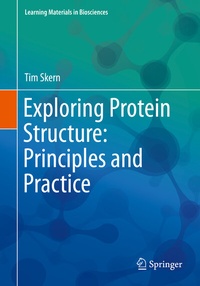
Exploring Protein Structure: Principles and Practice
Description

This textbook introduces the basics of protein structure and logically explains how to use online software to explore the information in protein structure databases. Readers will find easily understandable, step-by step exercises and video-trainings to support them in grasping the fundamental concepts.
After reading this book, readers will have the skills required to independently explore and analyze macromolecular structures, will be versed in extracting information from protein databases and will be able to visualize protein structures using specialized software and on-line algorithms.
This book is written for advanced undergraduates and PhD students wishing to use information from structural biology in their assignments and research and will be a valuable source of information for all those interested in applied and theoretical aspects of structural biology.
More details
Other editions
Additional editions
Person
Tim Skern is Professor for Biochemistry at both the Medical University of Vienna and the University of Vienna in Austria. He teaches courses in biochemistry, virology and scientific English to science and medical students and has supervised 25 master and 20 graduate students.
Tim Skern has published over 90 research papers on how viral proteins interact with the infected cell and has determined the three-dimensional structures of viral proteins using X-ray crystallography & NMR.
