

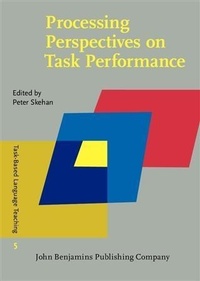
Processing Perspectives on Task Performance
1st Edition
Published on 30. April 2014
XII, 266 pages
978-90-272-7041-2 (ISBN)
Description

Understanding how second language task-based performance can be raised is vital for progress with task-based approaches to instruction. The chapters in this volume all attempt to advance this understanding, and do so within a viewpoint which assumes limited attentional capacities and accounts for second language speaking based on Levelt's model of first language speaking. Six empirical chapters present original studies. They explore the topics of task planning, familiarity of information in a task, task repetition, task characteristics, and the effects of using post-task transcription. The studies interweave with and build upon each other, reflecting their conjoint focus on how second language learning memory and attention limitations shape their performance in using the target language. In the concluding chapter the accumulated findings across these studies are discussed in terms of the nature of preparation for a task, the role of task structure, the respective claims of the Tradeoff and Cognition Hypotheses, the role of selective attention, and the implications of the studies for pedagogy. The book is a central reference for students in psycholinguistics, second language acquisition, and task-based language teaching.
More details
Other editions
Additional editions
Peter Skehan
Processing Perspectives on Task Performance
Book
04/2014
John Benjamins Publishing Co
€104.94
Shipment within 10-15 days
Person
Content
- Intro
- Processing Perspectives on Task Performance
- Editorial page
- Title page
- LCC data
- Dedication page
- Table of contents
- Series editors' preface to Volume 5
- Preface
- The context for researching a processing perspective on task performance
- Introduction
- The structure of the book
- Measurement issues
- References
- On-line time pressure manipulations
- Introduction
- Processes of L1 speaking
- L2 speaking processing and time pressure
- L2 speaking intervention targeting the bottleneck of time pressure
- Research Questions
- Method
- Participants
- English proficiency pre-test
- Material
- Slowed video for on-line planning
- Task conditions and instructions
- Measures of speaking performance
- Coding
- Analysis
- Results
- Pre-test
- Speaking conditions
- Discussion
- Intervention targeting content conceptualization
- Intervention targeting linguistic formulation
- Intervention targeting speech monitoring
- Conclusion
- Author note
- References
- Appendix A The Material Content (story scenes)
- Story 1 Mr. Bean Had a 'Sleepless Night'
- Story 2 Mr. Bean went 'Shopping'
- Appendix B Task instructions
- Task readiness
- Introduction
- A theoretical framework of task readiness
- Methods
- Participants
- Speaking tasks
- Proficiency criteria
- Study design: Independent variables
- Performance measures: Dependent variables
- Data analysis
- Results
- Fluency
- Accuracy
- Complexity
- Discussion
- Topic familiarity
- Strategic planning
- Proficiency
- The magnitude of task-internal and task-external readiness effects
- Task-internal readiness in form-meaning connection
- Compensation effects in fluency between task-internal and task-external readiness
- Implications
- Conclusion
- References
- Self-reported planning behaviour and second language performance in narrative retelling
- Introduction
- Early publications on planning
- Ortega's research into planning
- Motivation for the present research
- Method
- Research questions
- Research methodology
- Participants and setting
- Tasks
- Procedures
- Performance measures
- Segmenting the retrospective interviews
- First coding: Constructing the coding scheme
- Second coding: Real coding
- Results
- Basic quantitative analyses
- The codes and the Levelt model
- Quantitative data
- Frequency of reported planning behaviour and performance levels
- Discussion
- Build your own structure
- Avoid trouble, and be realistic
- Handle trouble when it occurs
- Plan small or specific (versus Plan General)
- Avoid grammar focus
- Conclusion
- References
- Appendix 1
- Instructions for the Picture Story Telling Task
- Instructions when you are a listener
- Appendix 2
- Retrospective interview prompts
- Appendix 3
- Coding Scheme: Planning activities of ESL speakers doing picture story telling task
- Get it right in the end
- Introduction
- Literature review
- Aims of the present study
- Research methodology
- Participants
- Experimental tasks
- Procedures
- Research design
- Data transcription and coding
- Data analysis
- Results
- Results for Research Question 1
- Results for Research Question 2
- Results for Research Question 3
- Summary of the results
- Discussion
- Effects of post-task transcribing
- Different effects of post-task transcribing on various aspects of task performance
- The role of interaction in pair-based transcribing
- The role of revision after transcribing
- Pedagogical implications
- Conclusion
- References
- Appendix
- Task Instruction and Letters for Interactive Decision-making Tasks
- Letter A: Cyber Love
- Letter B: Unbalanced Degree
- Structure, lexis, and time perspective
- Introduction
- Methods
- Participants
- English proficiency pre-test
- Material and tasks
- Operationalization of the Here-and-now and There-and-then conditions
- Procedure
- Data handling and coding
- Measures
- Research design and statistical analysis
- Results
- Discussion
- Conclusions
- Acknowledgments
- References
- Appendix A Task Instructions
- Instructions for There-and-Then Narration
- Instructions for Here-and-Now Narration
- Structure and processing condition in video-based narrative retelling
- Introduction
- Method
- Materials
- Research design
- Procedure: Interacting with students
- Data processing
- Participants
- Measures
- Analyses
- Results
- Discussion
- Conclusions
- References
- Limited attentional capacity, second language performance, and task-based pedagogy
- Major themes
- Planning, preparedness, and readiness
- Introduction
- The three studies
- Accuracy
- Complexity
- Fluency
- Lexis
- Interpretations
- Serial and parallel processing
- Structure
- Introduction
- The studies in this volume
- Interpretations
- Processing, task complexity, and cognition
- Selective attention and task conditions
- Second language performance: Positive and negative influences
- Pedagogy
- Tasks within lessons
- Principles for using a task-based approach
- References
- Author Biodata
- Index
